The tripod that came with my spotting scope was fine right up until the morning it wasn't. On my own back porch, with no wind and nowhere to be, it held the scope steady enough to watch a gray fox work the dry creek bed. Then Paul and I drove down to Aransas in January to see the whooping cranes, and a breeze came off the water and set that little tripod to shivering. A crane at two hundred yards through a shivering scope looks like a crane underwater. I spent one evening reading about tripods, which is a dull way to spend an evening, and in April 2024 I bought the K&F CONCEPT 64 inch travel tripod. Two and a half years later it has been to Lost Maples State Natural Area more times than I can count, to South Llano River State Park a good handful of times, and to Aransas twice.
I am sixty-three, retired after thirty-one years of flying, and I carry my own gear because there is nobody else to carry it. My camera is an older mirrorless body I bought used in 2022 with one long zoom lens, and the whole point of it is to bring home something I can look at later and say, that is what I saw. The tripod is the least interesting thing I own and the reason a good share of my photographs exist at all. What follows is what I have noticed carrying it around, including the parts that are not perfect.
The Quick Verdict
Tall enough that I stopped hunching, about two and a half pounds in the bag, and steady in the wind that spoiled my first crane trip. The carry bag is thin and the ball head takes a season to learn.
Amazon Check Today's Price →I stopped watching cranes through a shaking scope
A 64 inch aluminum travel tripod that folds to 15.5 inches, carries up to 17.6 pounds, and weighs about two and a half pounds over my shoulder. Mine has been behind the car seat since April 2024.
Amazon Check Today's Price on Amazon →How I've Used It
The tripod lives in its bag behind the driver's seat of the Outback, which is less a storage decision than a laziness decision. If it lived in the hall closet next to the scope it would stay there, and the whole reason I bought it was to stop talking myself out of dragging gear outside. In the bag it is easy to grab on the way out the door and it has gone with me every single time I have gone out since the spring of 2024.
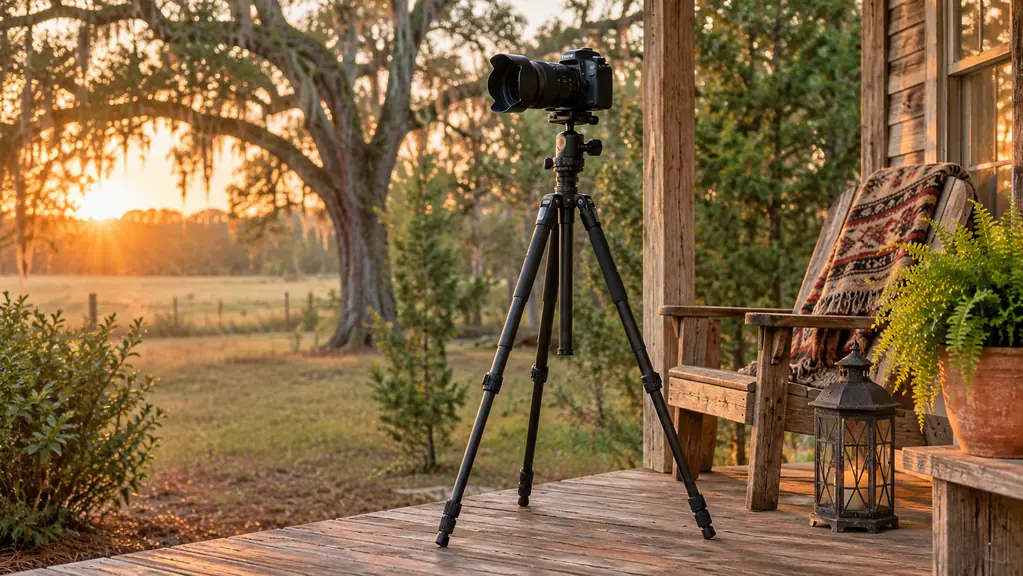
At home it stands on the porch boards and holds the camera with the long lens so I can watch the creek bed through the viewfinder instead of holding the whole thing in the air until my shoulders burn. I run it low on the porch, near its bottom height of about twenty inches, so I can sit in my chair and look through the camera without standing up. There are four sections in each leg and the locks are the quick flip kind. I can raise it with one hand while the camera hangs in the other, which is the only trick I actually needed from it.
In the field I use it differently. At Lost Maples I carry it folded and set it up when I stop, usually where the light comes through the trees. At South Llano it has held the scope on the riverbank while I waited on a heron to do something worth watching. At Aransas it holds the scope at a viewing area for as long as I care to stand there, and it held the camera on the two trips where the cranes came close enough to photograph rather than just admire. Three different jobs, no complaints from the tripod.
The turkey morning is the one I keep coming back to. Late October 2024, out on the porch before daylight with my coffee going cold beside me, legs set at about twenty-two inches so I could stay in the chair. The birds came down the creek bed a little after seven, six of them, scratching through the leaf litter in that slow way they have. I moved the camera along the line of them without standing up once. Not a photograph anyone would frame. Still the reason I own the thing.
What 64 Inches and 17.6 Pounds Actually Mean
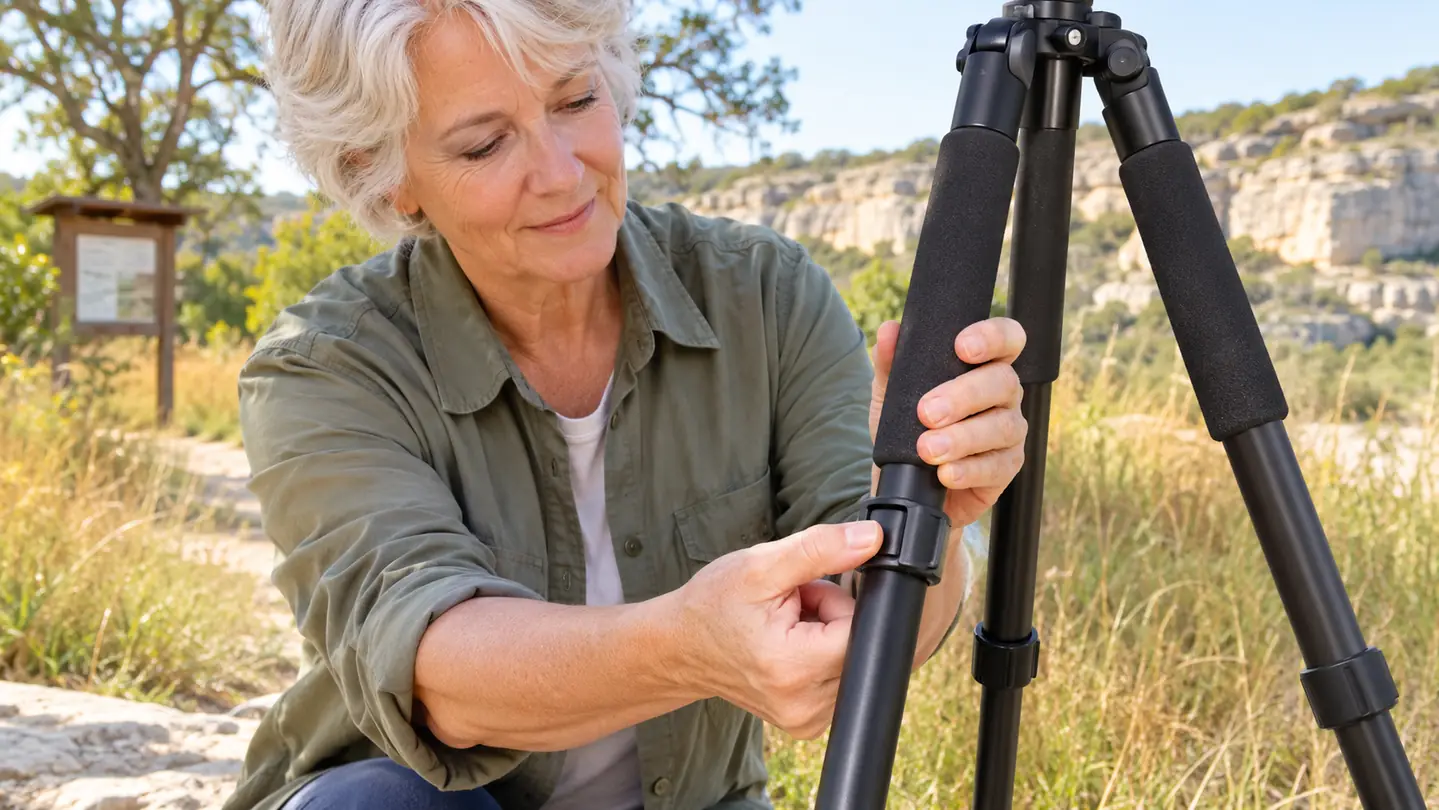
The legs are four sections and the height runs from about 20.4 inches at the bottom to 64.1 inches at the top. In plain terms, the low end is chair height and the high end puts the camera above my eye level, so I can stand up straight and look through the viewfinder instead of folding myself over it. That matters more at sixty-three than it did at forty, and I did not expect a tripod to be the thing that fixed my back on a Saturday morning.
Folded, it measures 15.5 inches, short enough to go behind a car seat and long enough that it will not slip into the side pocket of a small daypack. I carry it by the leg or across the top of my bag on a trail. The weight is 1.15 kilograms, a little over two and a half pounds. That is light enough that I forget about it on a two mile walk and heavy enough that it does not feel like a toy when I set it down.
The leg diameter is 1.5 inches at the widest section, and I suspect that is part of why it feels steadier than its weight suggests. I set it beside the little scope tripod on the porch one afternoon out of plain curiosity, and the difference at the top of the legs is not small. Folded at 15.5 inches it is shorter than my forearm, which is the comparison I actually use when I am deciding whether to bother bringing it at all.
The load figure is 17.6 pounds, which is the 8 kilogram rating on the ball head. My camera and the long zoom together are well under that, and the spotting scope is under it by a wide margin. Do not read that number as an invitation to hang a heavy professional rig on this thing. I would not, and I would not hand it to somebody who wanted to. For a hobbyist with one camera and one lens, there is more capacity here than you will ever use, and that is a comfortable place to be.
In the box from K&F CONCEPT you get the tripod, the 36 millimeter ball head, a quick release plate, a phone holder, a bag, and a small Allen wrench. The warranty runs one year. I have not needed the wrench or the warranty, and I have used the bag every single time.
The Ball Head, and Why It Took Me a Season
The head is a 36 millimeter ball head, which means the camera sits on a ball that you loosen, move to whatever angle you want, and tighten again. It rotates all the way around, so if I want to follow the creek bed from one end to the other I loosen, swing, and tighten. Coming from the little scope tripod, where the head moved in two stiff directions and never quite where I wanted, this felt loose and strange for a while. I over-tightened it for the first few months because I did not trust it. I was wrong to worry. It holds.
I learned the tension the hard way at South Llano in February 2025. I had the ball too loose, and every time I let go of the camera the long lens drooped toward the ground like it was tired. A quarter turn on the main knob fixed it. Now I set it once at the start of a session and leave it alone, and the only time I touch it again is when I want a different angle, which is the whole point of the thing.
The quick release plate is the part that changed my habits. The plate stays on the camera. When I want to shoot, I set the camera on the head and it locks into place, and when I want to walk I press the release and take the camera with me. Before this, mounting meant screwing the camera onto the tripod every time, which I did badly and slowly and sometimes not at all. Now it takes a second, so I actually do it.
There is a phone holder in the box. I have used it a handful of times when I wanted a steady shot of a place rather than a bird, and it does that job without fuss. The digiscoping, meaning my phone held up to the scope to take a picture through it, I still do with the adapter that came with the scope. That is not the tripod's fault. It is a different job.
In the Wind at Aransas
My first crane trip, January 2024, was the one that sent me shopping. The scope was on the little tripod that came with it, and the wind came across the water in a steady push, and the whole setup trembled. I could find the cranes. I could not hold them still. Paul kept saying they are right there, and I kept saying I know.
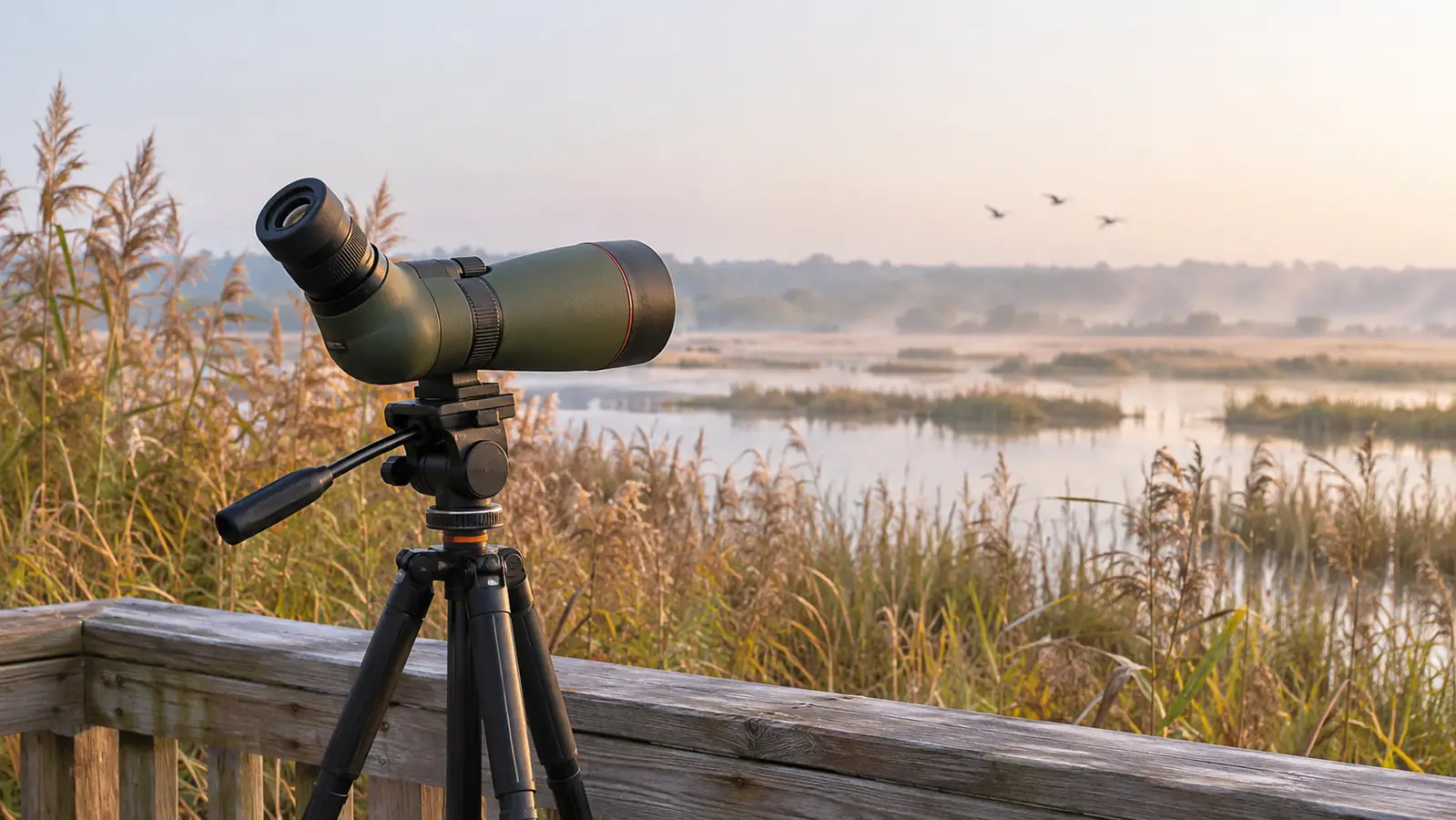
January 2025 and January 2026 were different. The scope went on this tripod, run low, with the top of it close to the ground and the legs doing the work. A tripod does not stop wind, and I am not going to pretend it does. What it does is put enough stiffness under the scope that the image settles instead of swimming. At 30 power, which is where I mostly live, a whooping crane stood in the marsh and stayed a crane. I watched one work a shallow pool for a long while and came home with a headache from squinting, which is the good kind.
The ground at those viewing areas is packed sand and shell, not level, and each leg section has its own lock, so I set two legs long and one short and the whole thing sat flat. That is a small thing that turns into a large thing when you are standing in one spot for an hour with a scope on top and no bench anywhere in sight.
The boat tour on one of those trips was the only time the tripod stayed in the car. Everywhere else, the viewing platforms and the roadside pullouts, it earned its place. If you go, take a jacket and take something steadier than what came in the scope box.
What It Does Not Do
The bag that comes with the K&F CONCEPT tripod is thin. It is a sleeve more than a padded case, and I would not check it on a plane or toss it loose in a truck bed. It is fine over my shoulder and fine behind the car seat, and that is all I ask of it.
The flip locks take a little care. If I close one carelessly with the leg not fully extended, it can pinch the side of my hand, and it has. That is not a defect so much as what flip locks do, and after two years I close them without thinking about it.
The ball head is not built for tracking. Following a moving bird means loosen, move, tighten, over and over. For a crane standing in a marsh this is nothing. For a warbler working through a cedar it is hopeless, and I do not try. When I want to follow something quick, I take the camera off and handhold it.
At the full 64 inches there is a little movement at the top in a hard gust. I run it lower when the wind is up. The tripod did not fail me. I just stopped asking it to be something it isn't.
What I Liked
- Steady under the scope at 30 power in coastal wind, which was the entire reason for buying it
- About two and a half pounds and 15.5 inches folded, so it rides behind the car seat and actually comes out
- Raises from roughly 20 inches to 64 inches, so I can sit for porch watching and stand up straight at a park
- The quick release plate stays on the camera, so mounting takes a second instead of a wrestling match
- Quick flip leg locks work with one hand while the other hand holds the camera
- 17.6 pounds of capacity is more than a hobbyist camera and long lens will ever need, and a phone holder comes in the box
Where It Falls Short
- The carry bag is thin and offers very little padding
- The flip locks will pinch a careless hand, and they pinched mine
- The ball head is awkward for anything that moves quickly
- Some movement at the top at full height in a hard gust
- A one year warranty is short for something meant to be carried outdoors
A tripod does not stop wind. What it does is put enough stiffness under the scope that the image settles instead of swimming.
Who This Is For
This suits a hobbyist who watches wildlife and wants photographs of it, the way I do. It suits somebody with one camera and one long lens, or a spotting scope, or both, who is tired of the gear being the reason the picture is blurry. It suits a porch watcher who wants to sit down while they look instead of standing and holding. It suits a state park walker willing to carry two and a half pounds in exchange for a still image at the end of the trail. Mostly it suits anybody who, like me, spent a few years blaming their own hands for what was really a shaky tripod.
Who Should Skip It
Skip it if you shoot for a living and need something rated for a heavy professional rig, because 17.6 pounds of capacity is not that. Skip it if you want to track birds in flight smoothly, because the ball head fights you there and no amount of practice will change that. Skip it if you know you will not carry it, because the steadiest tripod in the world does nothing in a closet. And if the little tripod that came with your scope has never once bothered you, skip it for now and wait until it does. That is exactly what I did, and by the time I went looking I knew what I wanted.
If your scope shivers in the wind, this is the fix I found
64 inches at full height, 15.5 inches folded, 17.6 pounds of capacity, and about two and a half pounds to carry. Mine has been in the back of the car since April 2024.
Amazon Check Today's Price on Amazon →