Four and a half years ago I bought a pair of Vortex Crossfire HD 10x42 binoculars because I kept missing things. I had one small pair of drugstore binoculars left over from my flying days, and they went dim at exactly the hour when the animals finally show up. Dusk is when the deer step out of the cedar and when the gray fox cuts across the dry creek bed behind the house. Those old glasses turned all of it into gray soup. I am 63 now, retired after 31 years as a flight attendant. Paul and I live on four acres outside Kerrville, and I am not a professional anything. I am a woman with a porch, a chair, and a genuine wish to see what is out there.
The Crossfire HD 10x42 is the pair I still reach for. There was no clever research behind the choice. A friend at South Llano River State Park handed me hers for ten minutes, and I could suddenly make out the markings on a bird I had only ever seen as a shape. I bought mine in March 2022. It has hung on a hook by my back door ever since, and it has gone on nearly every walk since then.
The Quick Verdict
Four and a half years of daily porch use and it still does the one job I bought it for: it shows me the animal clearly at dawn and at dusk, without me fussing with it.
Amazon Check Today's Price →If dusk is a gray blur for you, start here
These are the glasses I bought in March 2022 and still carry to Lost Maples and South Llano. Check today's price on Amazon, and read the reviews from people who actually take them outside.
Amazon Check Today's Price on Amazon →How I've Used It
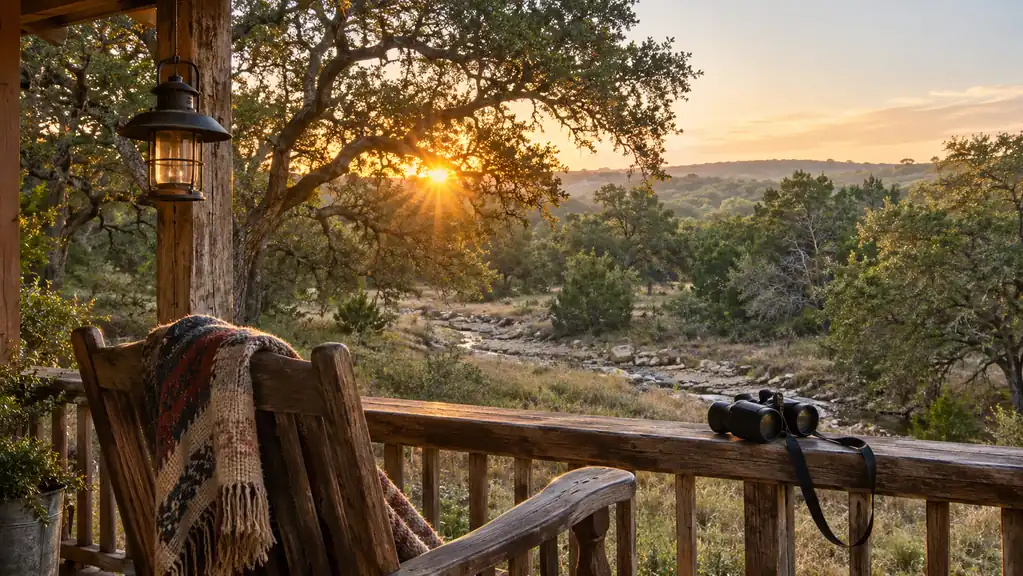
The short version is that I use these glasses more than any other thing I own for watching wildlife. They sit on the hook by the back door and I take them down with my coffee most mornings. From the porch I can pick up wild turkeys moving through the live oaks, an armadillo rooting under the cedar, or the painted buntings that come back to the creek bed every May. Four and a half years is long enough that I am past the stage of being impressed by a new purchase. What I can tell you now is what still works and what still annoys me.
The first good moment was a painted bunting in the cedar at the creek bed in May 2022. I had seen them before as colored smudges at the edge of the yard. With these the bird was looking back at me, head turned, entirely unbothered by an old woman in a bathrobe. That is the whole reason I own binoculars. Not to check a bird off a list, but to get a good enough look that the animal becomes an individual instead of a category.
I also take them to Lost Maples State Natural Area and South Llano River State Park, two or three times a month when the weather allows, and they ride in the console of the Outback. At Aransas on the coast, where Paul and I go once each January for the whooping cranes, the binoculars do the close work and my spotting scope does the distance. Four and a half years in, nothing has fogged, nothing has leaked, and nothing has come loose. That is not a thrilling sentence, but it is the one that matters when you are standing in coastal wind in January.
One morning in early October I was in the chair before the light, and a gray fox came out of the cedar on the far side of the creek bed. This is the animal my trail camera found and my own eyes had never confirmed. I lifted the Vortex and had him at once, sideways, nose down, unhurried. Then a truck downshifted on the county road and he was gone. People describe a fox as cat-like and I never quite understood it until I watched the way he picked his feet up and set them down again. That is not a photograph I can show anybody. It is a minute I got to keep.
What 10x42 Actually Means When You Are Standing in Cedar
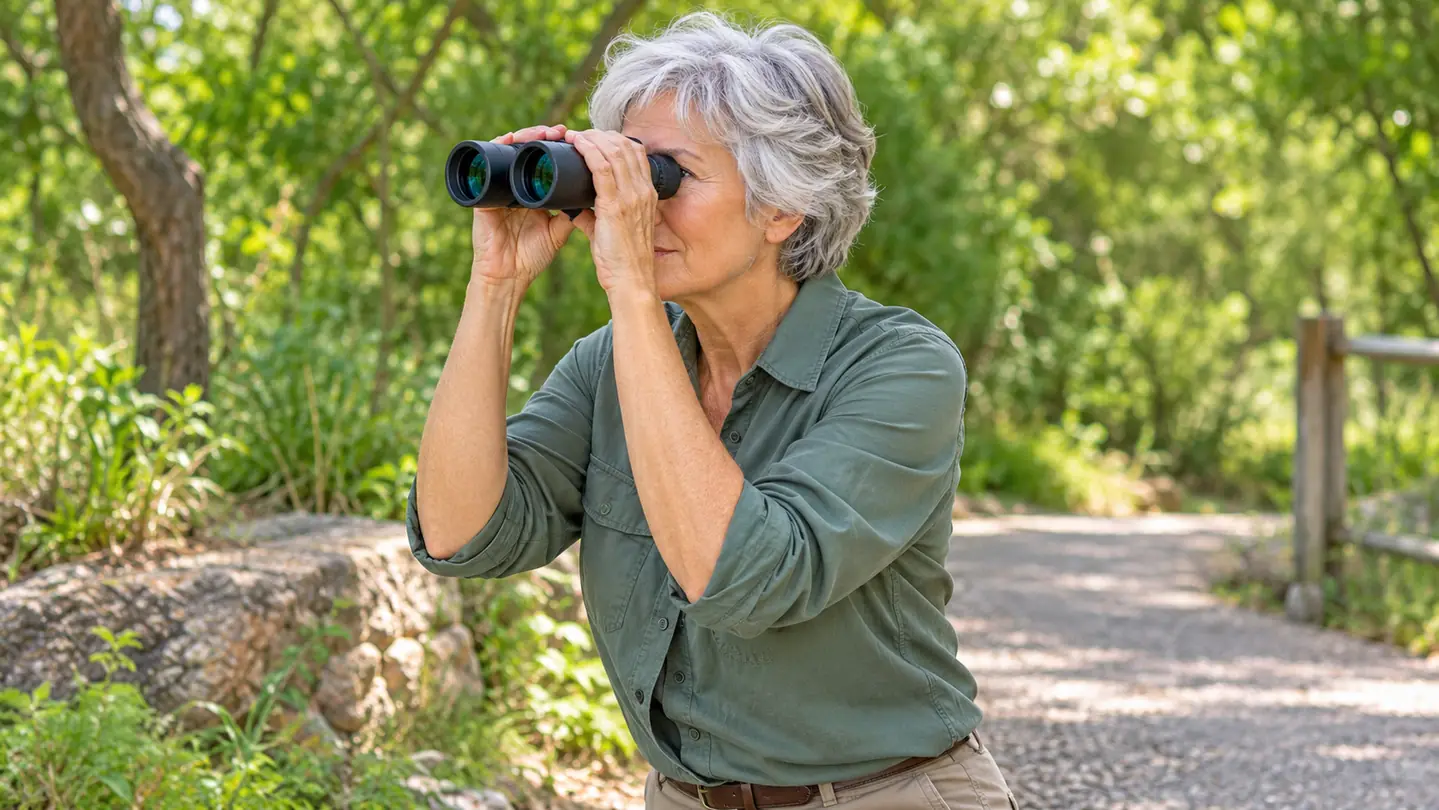
Ten power means the bird looks ten times bigger than it does to your bare eye. Forty two is the width of the front lens in millimeters, and that width is what decides how much light gets in. Those two numbers are a compromise, and it is a compromise that happens to suit the way I live. A 10x42 is small enough to hang by the door and carry on a two mile walk, and bright enough to be worth lifting in the half hour after the sun drops behind the ridge.
The weight is 1.4 pounds. On the porch that is nothing at all. Around my neck on a four mile walk at Lost Maples it starts to be something by the third mile, so I carry them in one hand or tuck them in the pack instead. The eye relief is 15 millimeters and the exit pupil is 4.2 millimeters, which is simply the size of the light circle that reaches your eye. The twist up eyecups are the part I use most without ever thinking about it. I keep mine up. A friend who wears glasses twisted hers down, held them to her lenses, and got the same full view instead of a dark ring closing in around the edges.
The lenses are fully multi coated, which is a plain way of saying less light bounces away before it reaches you. Compared with my old drugstore pair the difference is not subtle and it is not a matter of taste. In low light the old ones gave me a shape and a guess. These give me a shape with an edge on it, and an edge is usually where the identifying detail lives.
Here is what that looks like in practice. At Lost Maples the maples come up a narrow canyon and the far slope sits in shade most of the morning. Last November I stood in one spot for a good twenty minutes working a shape in the branches, and what I needed was not more magnification. I needed a clean picture at the edge of the frame. Cheap glasses give you a sweet spot in the middle and smear everywhere else, so you move your eye a hair off center and lose the whole thing. With the Vortex I could slide my gaze to the corner of the view and the bird stayed readable, which meant I could find it, lose it in the leaves, and find it again without starting over from nothing.
Fog, Rain and a Hill Country Cold Snap
The listing calls them fog proof and waterproof, and the rubber armor is the part you feel rather than read about. I have had them out on a wet February morning at South Llano, and I have left them on the porch rail through a cold snap because I am not as careful as I ought to be. They have never fogged on the inside. That matters more here than people expect, because Hill Country mornings can swing thirty degrees before nine o'clock and a cold lens in warm air is exactly how fog gets started.
The rubber coating is also the reason they have survived living with me. I have knocked them against a porch post and set them down on gravel next to my chair. There is a scuff on one side and no change whatsoever in the view. Four and a half years later, the armor is the part doing the quiet work and getting no credit for it.
February is the real test. On a morning two winters back at South Llano the river bottom read 34 degrees at sunrise and my own breath was fogging my reading glasses. The Vortex had been hanging cold on the strap for an hour. When I lifted them the view was already clean, while I was still wiping my glasses on my sleeve and blinking at the blur. I do not know the inside of a binocular well enough to explain why that works, and I do not need to. I only need it to keep happening, and it has, every winter since I bought them.
Where They Struggle
I am not going to pretend they are perfect. The honest limitation is the last ten minutes of light. At ten power with a 42 millimeter front lens, the image dims before the animals quit moving. On a late November evening the deer are still out there working the creek bed and I am already straining to hold the picture. My spotting scope on the tripod does better in that narrow window, but the scope is not the thing hanging by my door for a quick look with coffee.
The clearest example I can give you is a Saturday in late November. It was one of those Hill Country evenings where the sun drops behind the ridge at ten of six and everything on the ground keeps going for another twenty minutes. The turkeys were coming up the creek bed to roost, nine of them, and by the time the last three walked through I could tell they were turkeys and not much else. Not because they were far. Because there was no light left to give me. I sat and watched the shapes anyway, which is a fine way to spend an evening, but it is not what I bought the glasses for.
The second thing is that ten power is a lot of magnification to hold steady with your hands. If I am excited, the whole picture shakes and I have to brace my elbows on the porch rail and breathe out slowly like I am taking a photograph. Some people prefer eight power for exactly that reason. I knew it going in and chose ten anyway, because most of my watching happens at a distance across the creek bed where the extra reach earns its keep. That is a trade, and it is the right trade for me, not necessarily for you.
Third, on a long walk they are heavy enough that I notice them. Not a deal breaker, just the arithmetic of 1.4 pounds against four miles and a body that is 63 years old.
What I Compared, and What I Did Not Buy
People ask me about the Nikon Prostaff because it is the other name that comes up whenever someone is deciding what to look at. I have looked through a friend's pair once, at a state park, standing in the shade with the sun going down. It is a good binocular and I would not talk anybody out of it. But I never owned one. I did not test two pairs side by side for months, and I am not going to invent a comparison I did not live. What I can tell you honestly is why I stayed with the Vortex Crossfire HD. The view was clear out toward the edges of the frame, the eyecups worked with my friend's glasses, and the warranty is unlimited, unconditional and for life. For a person who leaves her glasses on a porch rail, that last part is not a small thing.
I also considered doing nothing, which is what I did for years with the drugstore pair. What changed my mind was realizing I was already spending the time. I was already up at first light with coffee. I was already walking the state parks. I was already watching. The only thing missing was being able to see. That is a strange thing to admit at 63, that I had been watching wildlife for years at half resolution and telling myself it was enough.
What I Liked
- Clear at dawn and dusk, a real step up from a drugstore pair
- Fog proof and waterproof through four and a half years of Texas weather
- Twist up eyecups work with glasses and without
- 1.4 pounds hangs by the door and rides in the console without fuss
- Unlimited, unconditional lifetime VIP warranty
Where It Falls Short
- Dim in the last ten minutes of usable light
- Ten power is hard to hold steady when you are excited
- Heavy enough to notice on a long walk
In low light the old pair gave me a shape and a guess. These give me a shape with an edge on it, and the edge is where the detail lives.
Who This Is For
This is for the person who already sits outside. If you have a chair by a window, a feeder you fill twice a week, or a walk you take every Saturday, these will change what that hour gives you back. It suits someone who watches from a fixed spot more than someone who covers ten miles of trail. It suits someone who wants one pair to do porch duty, state park duty and the once a year trip to the coast without owning three things. And it suits anyone who wears glasses and has spent years peering through binoculars that left them looking down a dark tunnel with the real picture somewhere in the middle.
Who Should Skip It
Skip these if your watching happens after the last light. A 10x42 will leave you wanting at full dark, and you will be happier with something that gathers more light, at more weight and more money, and you will know it the first evening you use it. Skip them if your hands are unsteady and you have no rail to lean on, because ten power will fight you all afternoon. And skip them if the thing you love most is long distance work, cranes out on a mudflat or a hawk on a far ridge, because that is scope work and no binocular is going to save you the tripod.
The pair that still hangs by my back door
Four and a half years, a lot of dawn light, and no regrets. If you want to see what is already in your yard, start with these. Check today's price on Amazon.
Amazon Check Today's Price on Amazon →