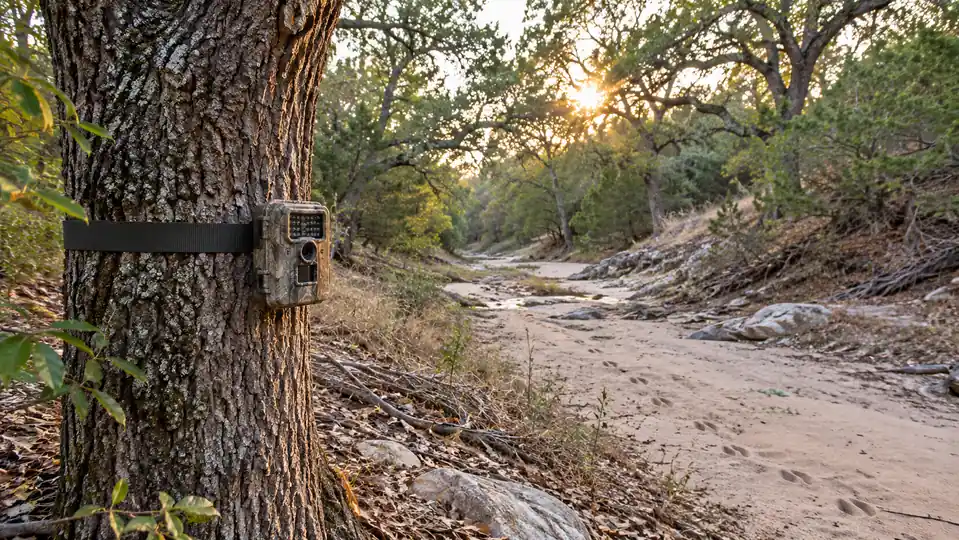
On a Tuesday morning in October 2022 I carried a GardePro A3S down the slope behind my house, strapped it to a live oak at about waist height, aimed it across the dry creek bed, and climbed back up to the porch without expecting much. I had been finding deer tracks in the sand all summer. I had heard turkeys before daylight. What I did not have was the faintest idea what happened out there between midnight and five in the morning, when I was asleep and the porch light was off.
Two weeks later I pulled the card, carried it up to the laptop, and got a gray fox. I have lived on these four acres for years and had never once seen a fox on them. It had been crossing that creek bed the whole time, a few hundred feet from where I sit with my coffee.
The A3S is a non-cellular, non-WiFi camera, so it does not send pictures anywhere. It sits on the tree and records, and once a week I put on shoes and walk out with a card reader to find out what happened. It runs on AA batteries. This is the only trail camera I have ever bought, it has been on that same live oak for about four years, and it has never gone quiet on me for a reason I could not fix by walking out there and looking.
The Quick Verdict
The A3S does the one job I actually needed, which was to show me the creek bed after dark, and it has done it for four years without asking anything of me. It will not send a picture to your phone and it will not flatter an animal at the far bank. For the way I use it, that trade has been worth making.
Amazon Check Today's Price →The creek bed does not stop at dark. This is how I found that out.
Four years on one tree, one walk a week with the card, and a fox I never knew I had. If you want to know what crosses your place at two in the morning, this is the plainest way I know to find out.
Amazon Check Today's Price on Amazon →How I've Used It
I mounted it once and it has not moved. The strap goes around the trunk of a single live oak at roughly waist height, low enough that I can open the door and work the buttons without kneeling in the sand, and the lens looks across the creek bed toward the far bank instead of back at the house. That aim is the most important thing I did. A camera pointed at the porch records you carrying out the recycling. A camera pointed at a creek bed records animals.
Setup is a push-button menu on the inside of the door with a small screen, and a handful of choices I made once and then forgot. Date and time. Stills, video, or both. I left the rest where it came. There is no pairing, no account, no password to lose. The reason I chose a non-cellular camera in the first place was that I did not want another device in my life asking for attention. The A3S asks for batteries and a card and is otherwise silent about the whole arrangement.
The strap itself is a simple web strap with a buckle, and it took me two tries to get it tight enough that the camera would not drift on the trunk. The first week it sagged maybe an inch and a half and every frame showed a little more sky than I wanted, which put the creek bed at the bottom edge of the picture. I climbed back down, unbuckled it, hauled it snug and set it again, and it has not shifted since. I check it with a tug every few months, mostly out of habit. It has never needed anything more than that.
I also got my first aim wrong, and I mention it because nearly everyone does. I had the camera pointed at the middle of the bank, which gave me a month of frames with a cedar limb waving at the bottom edge of the picture. The limb moved in the wind, the motion sensor did exactly what it was built to do, and I ended up with a hundred and forty photographs of a branch. Lowering the aim to just above the sand fixed most of it. That was my mistake, not the camera's.
What the Night Photos Actually Look Like
Night is the whole reason I bought it. The A3S uses no-glow night illumination, which means there is nothing visible glowing at the tree when something walks through. I have stood on the porch at midnight and looked down at that oak and seen no light at all. Whatever comes through the creek bed gets no warning that it is being watched, which is the only way you get a fox to walk normally past a camera.
The GardePro design leans on a Sony Starvis sensor, and that sensor earns its keep in the gray half hour, the stretch after sunset when the light is gone but the animals are only just getting started. My old habit was to give up at that hour and go inside. This camera is still producing usable black and white frames at the point where I would have quit. Most of my deer pictures, and every last one of my armadillo pictures, came in that window.
One night in early January I got eleven frames between midnight and four, all of them the same gray fox working the same twenty feet of sand, back and forth, nose down, in no hurry about anything. It was cold that week, down in the twenties, and the pictures got a little grainier as the night wore on. I could still tell exactly what I was looking at, and the time stamps walked me through the whole visit in order, which is the thing a single good photograph cannot do for you.
What it will not do is make an animal at the far bank look close. A fox at the edge of the frame is a fox-shaped thing, and I know it is a fox because I know what lives here, not because the detail is generous. Something at the near bank, eight or ten steps from the lens, is sharp enough to count whiskers. Out at the far edge you get shape, gait and size, and that is usually enough to answer the question, but it is not a portrait.
Video With Sound, and the Two Modes I Keep Coming Back To
The A3S records 1296P video with sound, and I did not think I needed the sound. I was wrong about that. A flock of turkeys working down the creek bed in November is a racket, all clucks and dry leaves, and a silent clip of it is only half the picture. The audio is also how I finally figured out that a noise I kept hearing after dark was an armadillo rooting around under the cedars and not a person.
The sound is the part I would have guessed was a gimmick, and it is the part I would miss most now. A raccoon working at the edge of the sand makes a very specific small clatter, and once you have heard it on a recording you can identify it from the porch without looking up. Same with the turkeys, and same with the deer, who are quieter than you would think until they step on a dry leaf. I have played a short clip for Paul in the kitchen and had him name the animal from the next room.
Time-lapse is the mode I use least and enjoy most. I set it on a foggy morning in late November and got a short record of the creek bed going from flat gray to gold as the sun cleared the trees, with nothing in it but light and one extremely slow deer. Hybrid mode is what I actually leave it in now, a still frame plus a short clip whenever the motion sensor trips, so I get one picture to glance at and the video to check when the picture turns out to be interesting.
The motion sensor is keen and it does not know the difference between a raccoon and a swinging branch. In a windy week I will delete a couple hundred blanks. That is not a defect exactly, it is what a motion camera does when it lives in a tree, but it means the card wants emptying weekly or you end up scrolling through a great deal of nothing to reach the four frames that matter.
Batteries, the Weekly Walk, and the Solar Question
It runs on AA batteries and it is easy on them. The unit is rated at 1.5 watts, and with no radio, no upload and no signal to hunt for, nothing gets wasted trying to reach a tower that is not out here anyway. I change batteries a few times a year, more often in a cold snap, and I have never had it die in the middle of a week I cared about. Night video clips are the heaviest draw of anything it does, so a week with a lot of fox traffic costs more battery than a week of stills.
I keep a strip of fresh AAs in the kitchen drawer and change them on a schedule instead of waiting for the camera to complain, usually the first week of the month through the summer and more often once the nights turn cold. What I have learned is that cold is the only thing that really eats them. One December we dropped into the low twenties for four nights running, and that set went faster than any summer month I can remember. Warm weather, this camera will run a long time on very little.
There is a solar panel for it, the SP350, sold separately, and it would cut those battery changes down. I have never bought one. My camera sits under heavy oak and cedar canopy and I doubt a panel up there would gather enough sun to justify the trouble. If your camera is going out on an open fence line or the edge of a field, that arithmetic changes and I would look at the panel first.
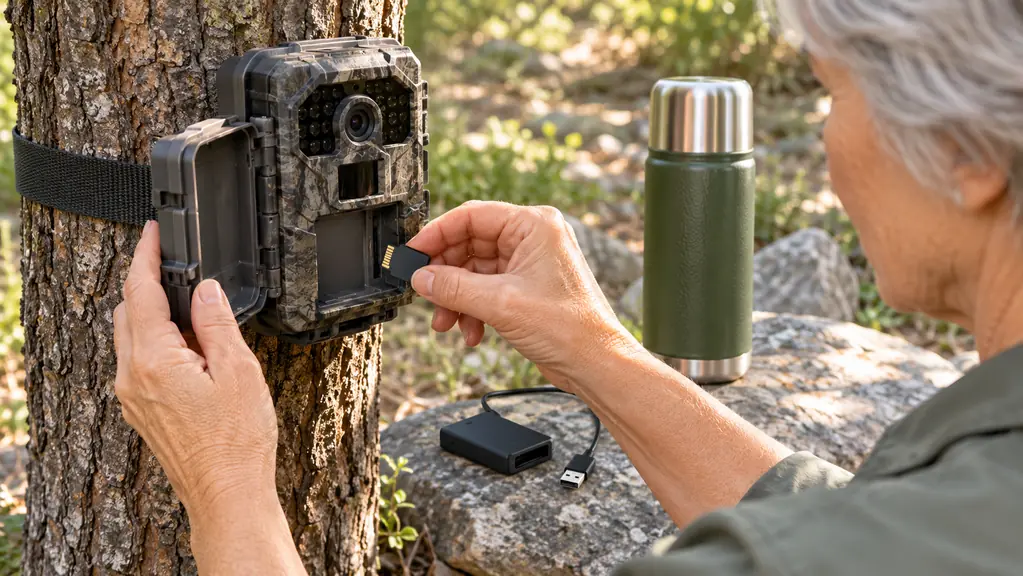
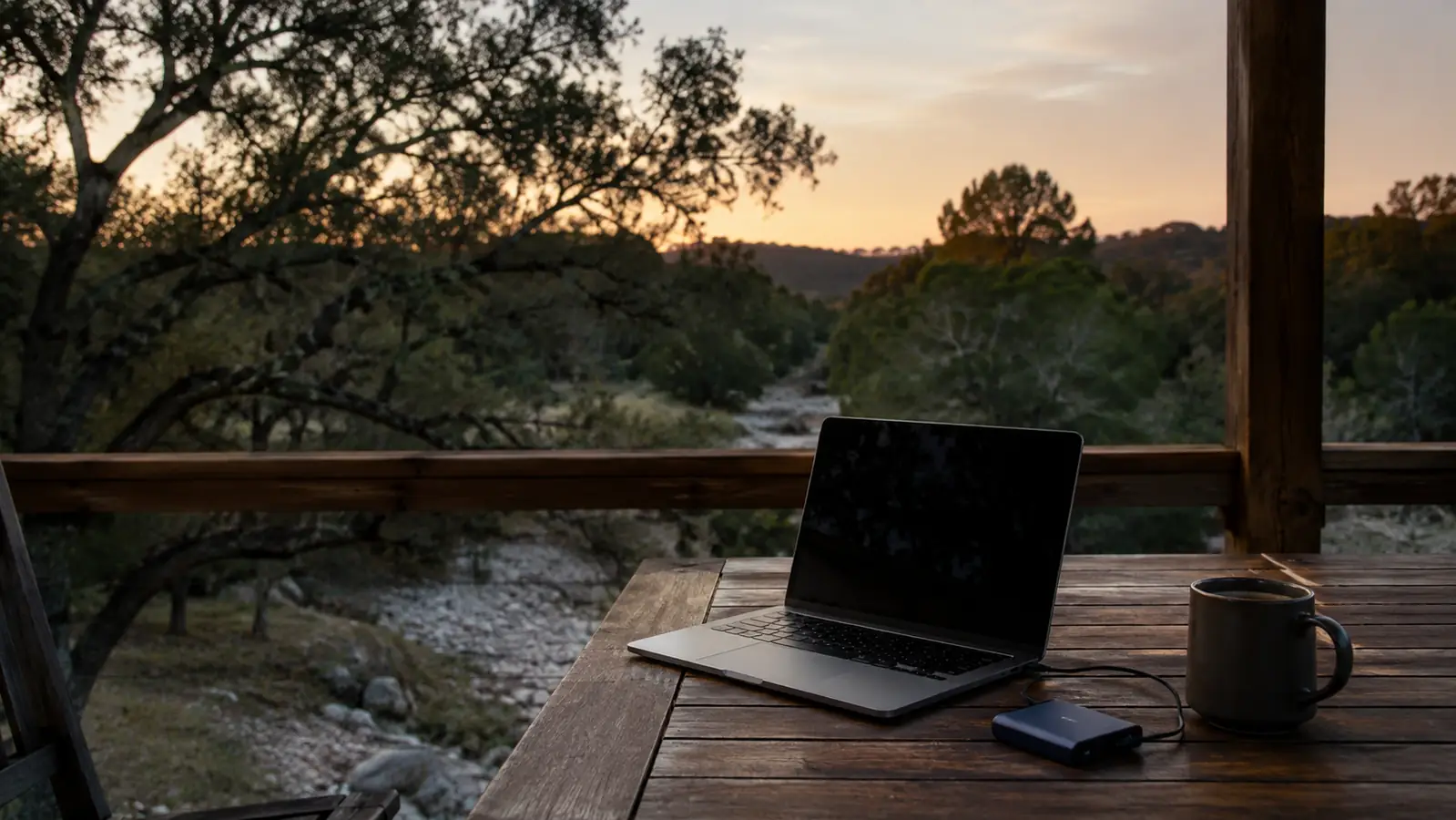
The weekly walk is the part people underestimate when they read about these cameras. A cellular model sends pictures to your phone and this one does not. This one requires a person with shoes on. I have come to like the ritual, the walk down the slope with coffee, the ten minutes at the laptop with Paul asking who came by, but I will not pretend it is convenient. If the camera is a forty minute drive from your house, or if you travel, the card fills up and you lose the week.
What It Gets Wrong
Four years in, the complaints are small and consistent. The menu is a little screen inside the door and the buttons are small, and in January with cold hands it is a fiddly business to change a setting. GardePro put the card in behind that same door, so a quick swap in bad weather means standing there with the front hanging open. None of it is hard. All of it is awkward when it is thirty eight degrees and drizzling.
The bigger thing is the one you either accept or you do not. There is no phone, no app, no image arriving while you eat breakfast. If what you want is a deer on your lock screen at seven in the morning, this is the wrong camera and nothing I like about mine will change that. What it offers instead is a camera that needs nothing from you but batteries and a walk, with no signal to lose and no plan to keep up.
The last honest note is about detail at distance. The A3S is good at the near bank and merely adequate at the far edge of the creek. I have learned to read gait and silhouette, which is a skill I did not have in 2022, and I have also learned that a camera can only do so much with a small animal and a lot of dark.
What I Liked
- No-glow night illumination, so nothing glows at the tree and animals behave normally
- Sony Starvis sensor holds up in the gray half hour when most of my animals show
- 1296P video with sound, and the audio genuinely adds information
- Time-lapse and hybrid modes are useful, not filler
- Non-cellular design means no account, no pairing and low power draw
- At 350 grams it straps to a young tree without a mount
Where It Falls Short
- No phone access at all, so the card means a weekly walk
- Small screen and small buttons, unpleasant in cold weather
- Detail falls off at the far bank
- Moving limbs trip the motion sensor and fill the card with blanks
- The solar panel is a separate purchase
The first card I pulled had a gray fox on it at 2:14 in the morning. I had lived on that land for years and never once seen one.
Who This Is For
This is for the person who owns a few acres, or backs onto a greenbelt, and is genuinely curious about what moves through at night. You have a tree, a trail, and the patience for a weekly walk. You would rather spend ten minutes at a laptop than ten minutes in another phone app. You want to know what time the deer move, whether the armadillos are back, and what made that noise behind the shed. If you are the sort of person who keeps a pair of binoculars on a hook by the back door, you are already the customer for this.
Who Should Skip It
Skip it if you want pictures on your phone, if the camera will live somewhere you cannot reach once a week, or if you want magazine quality close ups of animals at long distance. A cellular camera solves the first problem. A much better lens and a much larger budget solve the third. And if your interest is really the birds at the feeder thirty feet off the porch, a feeder camera does that job far better than anything strapped to a tree in the dark. Buy for the job you actually have.
Four years, one tree, and I still walk down there every week
Nothing about the A3S is fancy. It straps to a trunk, it waits, and it shows you what came through while you were asleep. That has been worth more to me than any picture that ever arrived on a phone.
Amazon Check Today's Price on Amazon →