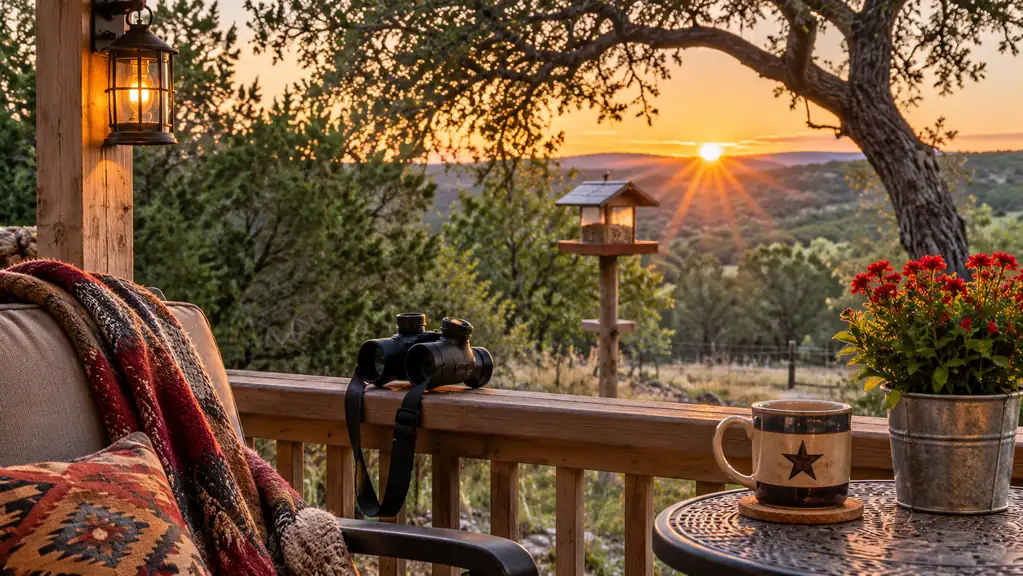
The first notification from the NETVUE Birdfy arrived while I was still in my robe, coffee in one hand, trying to remember whether I had filled the feeder the night before. My phone said a bird was at the feeder. I opened the clip and there was a cardinal, close enough that I could see the flat top of its crest and the way it turned its head before taking a seed. I have watched cardinals from my porch for years. This was the first time one watched back through a camera.
I bought the NETVUE Birdfy in September 2024. It is mounted on a post about thirty feet off my back porch on our four acres outside Kerrville, in sight of the chair where I sit every morning, far enough from the house that I worried about the signal and close enough that I can see when the seed runs low. I fill it with mixed seed about twice a week. Two years later, the regulars are cardinals, chickadees, titmice, house finches, and painted buntings in summer. Paul, my husband, has started asking who came by before he asks about the weather.
The Quick Verdict
A smart feeder that earns its place on the porch if you want close views and a record of who visits, with honest limits on bird ID and squirrels.
Amazon Check Today's Price →See Who Is Visiting Your Feeder Without Sitting Still
The NETVUE Birdfy sends the visit to your phone, labels most of the birds for free, and keeps a record you can look back on. It is the feeder I check with my first cup of coffee.
Amazon Check Availability on Amazon →How I've Used It
I did not buy the Birdfy to replace my binoculars. I bought it because the feeder I had before was a plain tube feeder with no camera, and I was tired of missing the small visits. I would see a flash of wings from the kitchen window and by the time I got to the porch the bird was gone. The Birdfy stays where the birds are. It records the visit and sends it to my phone, so I can look at it after the fact instead of trying to catch it live.
The setup is simple enough that I did it myself. The feeder weighs three pounds, so I can lift it down and put it back without asking Paul for help. I mounted it on a post, filled it with mixed seed, and connected it to the home Wi-Fi. The first week was mostly me learning which alerts were birds and which were leaves moving in the wind. By the second week I had a decent feel for it.
My routine now is the same most mornings. I pour coffee, sit in the porch chair, and open the clips. I do not watch live video for long. I like the short recordings, the ones the feeder captures on its own when something arrives. If a clip shows a bird I do not recognize, I use the bird ID that comes with it. The ID has been free the whole time. No subscription, no monthly fee, no surprise after the first year.
The first placement was not the right one. I had the post near a live oak because it looked natural there, and the squirrels treated it like a highway ramp. Moving the post out into the open made the feeder easier to see from the porch and harder for squirrels to reach from a branch. That was the single change that made the whole setup work better for me. The camera did not change. The location did.
What the 2K Camera Actually Shows
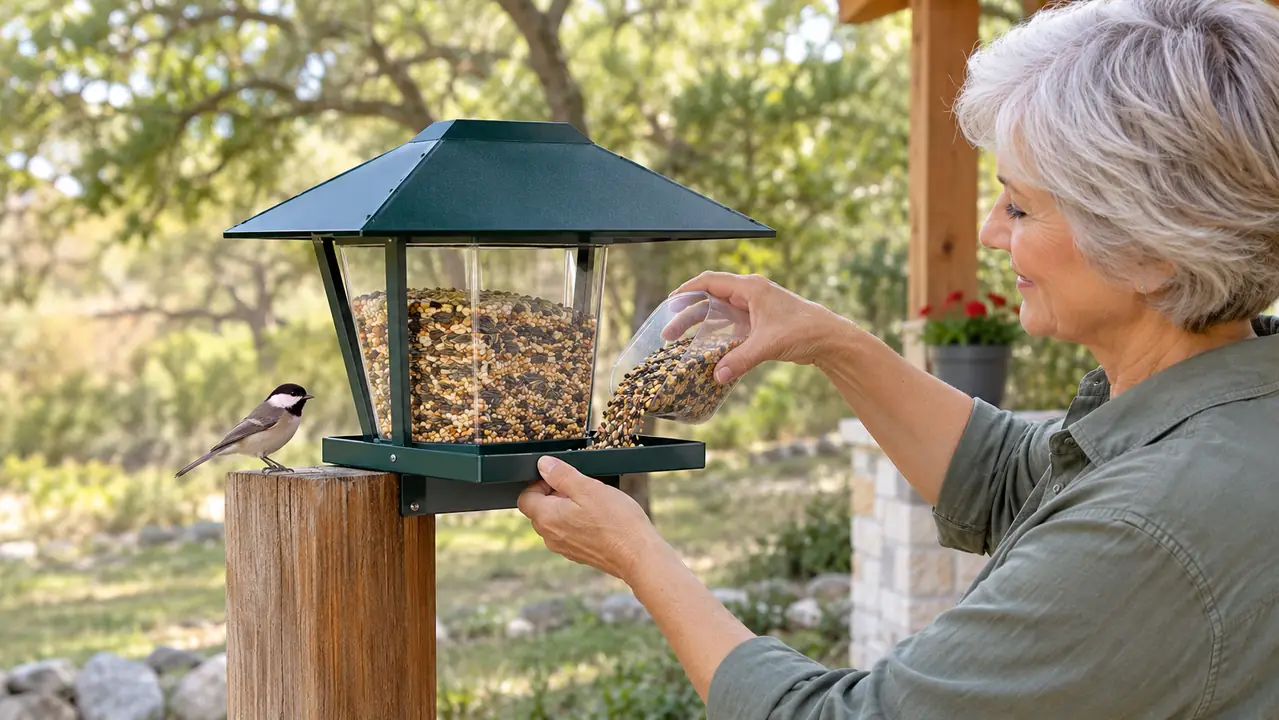
The camera is 2K, and that matters more than I expected. At thirty feet, I can see the markings on a chickadee's face and the difference between a house finch and a purple finch on a good morning. It is not a studio portrait. The bird has to be in the frame and the light has to cooperate. But it is far better than the blurry guess I used to make from the kitchen window.
The feeder captures visits on its own and sends a notification to my phone. I do not have to sit and wait with a finger on a button. That is the part that changed my mornings. I can be in the kitchen, in the hall closet putting away the spotting scope, or out on the porch with the binoculars, and the visit still gets recorded. The Birdfy does the waiting. I do the looking.
After dark, the camera switches to night vision. I have seen more moths than I care to admit, and the occasional squirrel making a late inspection. The night clips are softer than the daylight ones, which is what I expected. They are good for knowing something was there, not for fine detail. I still use the trail camera for the creek bed at night, because that is a different job.
I have taken digiscoped photos with my phone through the spotting scope, and those take patience. I have to line up the adapter, hold still, and hope the bird does the same. The Birdfy clip is already there when I open my phone. That ease is the reason I check it every morning and the reason I do not check the scope every morning. Different tools, different effort.
The Bird ID has been free the whole time. No subscription, no monthly fee, no surprise after the first year.
What It Gets Right and Where It Stumbles
The bird ID is useful, but it is not a field guide with a sense of humility. It gets the regulars right most of the time. Cardinals, chickadees, titmice, and house finches are usually labeled correctly. It has confused a house finch with a purple finch on a flat morning, and it has called a blurred shape a sparrow when I could not tell you what it was either. I treat the label as a starting point. If the ID matters, I look at the clip myself and check the markings.
The alerts can pile up. A windy day, a squirrel working the post, a branch moving in the frame, and my phone gets busy. I have learned to check the clips rather than trust every notification as a bird sighting. That is not a flaw in the feeder so much as a fact of a camera pointed at a place where things move. If you want a quiet phone, this is not the gadget for that.
The Wi-Fi connection has been stable at my distance. The feeder sits about thirty feet from the house and the signal has held through two years of Hill Country weather. I cannot tell you what it will do at the back of a long property or through a thick wall. I can tell you that mine has not dropped a clip I cared about. That is the limit of what I know.
I do not leave the alerts on all night. I check the phone in the morning and look at what came through after dark. The night vision is there if I want it, but I would rather sleep than hear a notification about a moth. That is a personal choice, not a knock on the feeder. It records what it records, and I decide when to look.
Seed, Squirrels, and the 1.5 Liter Capacity
The feeder holds 1.5 liters of seed. I fill it with mixed seed about twice a week, more in the summer when the buntings are around and the finches bring their cousins. The capacity is enough that I am not out there every day, but not so large that the seed sits and goes stale. That balance suits me. I would rather fill it often and keep it fresh.
The squirrels found it within days. I had it on a post near a live oak at first, and that was my mistake. I moved the post away from the oak, out in the open where they have to think about the approach, and that helped. I have not bought a baffle. They still try. One of them has learned to hang off the post and stare at the feeder like it owes him money. The Birdfy records those visits too, which is funny once and tiresome by the tenth clip.
The feeder is battery powered, and the listing says it is battery and solar powered. I have run mine on battery and have not added a solar panel. That means I keep an eye on the charge the way I keep an eye on the seed. If you are the kind of person who forgets a feeder for a month, add the panel or pick a different setup. The feeder is three pounds, so taking it down to charge is not a project, but it is still a chore.
Mixed seed brings a mix of birds, and it also brings a mess on the ground. The cardinals and chickadees are neat enough. The house finches are less tidy. I sweep the porch once a week and I do not mind it. If you want a feeder that leaves no hulls and no scatter, this is not that feeder. If you want birds close enough to see, the trade is worth it to me.
What I Liked
- Free lifetime bird ID with no subscription
- 2K camera captures clear daylight clips at porch distance
- Auto capture and phone notifications mean you do not have to wait
- 1.5 liter capacity fits a twice a week refill routine
- Stable Wi-Fi at thirty feet in my setup
- Night vision records after dark visits
Where It Falls Short
- Bird ID sometimes confuses similar species
- Squirrels find it fast and I ended up moving the post
- Alerts can pile up on windy days
- Night clips are softer than daylight clips
- Battery charging is a routine unless you add solar
How It Fits With the Rest of My Gear
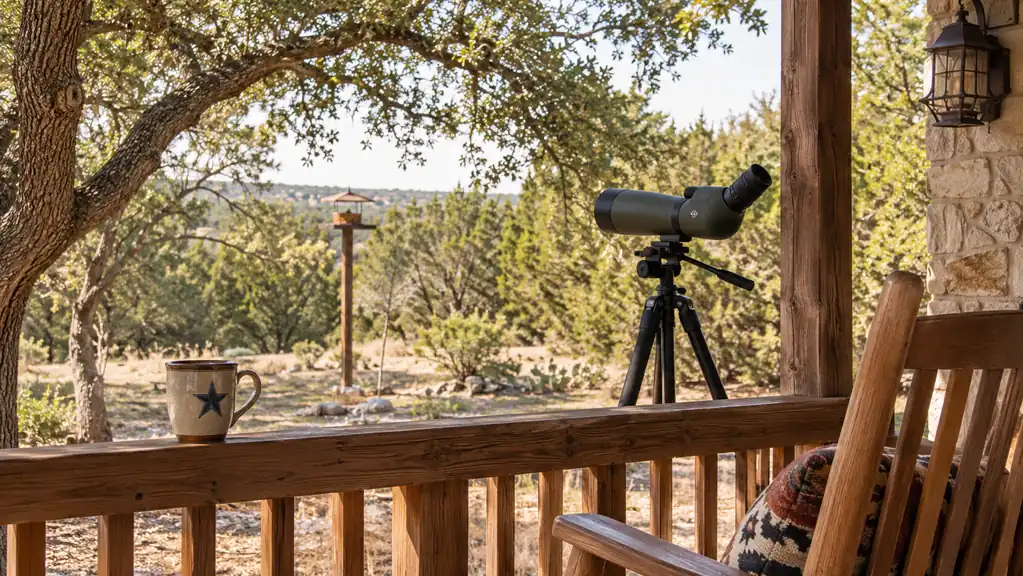
The Birdfy has a narrow job in my kit, and that is why I like it. My Vortex Crossfire binoculars are for finding and watching. The Gosky spotting scope is for distance, the whooping cranes at Aransas and the far side of a field at Lost Maples. The camera on the K&F tripod is for real photos. The GardePro trail camera is for the creek bed at night. The NETVUE Birdfy is for the feeder.
Before the Birdfy, the feeder was a blind spot. I could see the birds from the porch, but I could not see them close, and I could not keep a record. The trail camera faces the creek bed, not the porch, so it never helped with feeder visits. The Birdfy filled that gap without asking me to sit still. I still use the binoculars to watch behavior after the feeder tells me who is there. The feeder is the doorbell. The binoculars are the conversation.
I have not stopped using any of the other gear. If anything, the feeder has made me pay more attention to the creek bed. A painted bunting at the feeder in summer sends me looking at the cedar with the binoculars. A gray fox on the trail camera sends me out to the porch with coffee to see if it is still around. The Birdfy is a small piece of a larger habit, not a replacement for it.
That is the honest way I would describe it to a friend. It does not make the binoculars obsolete. It does not make the trail camera obsolete. It gives me a close view of one part of the yard that I used to miss. For a hobbyist like me, that is enough. I do not need one device to do everything. I need the right device for the spot I am watching.
Who This Is For
This is for the person who already feeds birds and wants to know more about who is visiting. If you have a porch, a post, and a home Wi-Fi signal that reaches the spot, the NETVUE Birdfy gives you close views and a record without turning birding into a job. It suits a hobbyist who likes animals first and gear second. It suits someone who will check the clips with coffee and not expect every label to be perfect.
Who Should Skip It
Skip it if you want a feeder you can fill and forget for weeks. Skip it if squirrels will drive you crazy and you are not willing to move the post or add a baffle. Skip it if you need perfect bird ID for a life list, because no camera at this level replaces a good field guide and your own eyes. And skip it if you are not prepared to keep the battery charged. The feeder rewards a little attention. It does not run on neglect.
Put a Window on the Feeder You Already Watch
If you want to see the visits you keep missing, the NETVUE Birdfy is the feeder I would hand to a friend. It has been on my post for two years, and it still makes me look up from my coffee.
Amazon Check Availability on Amazon →