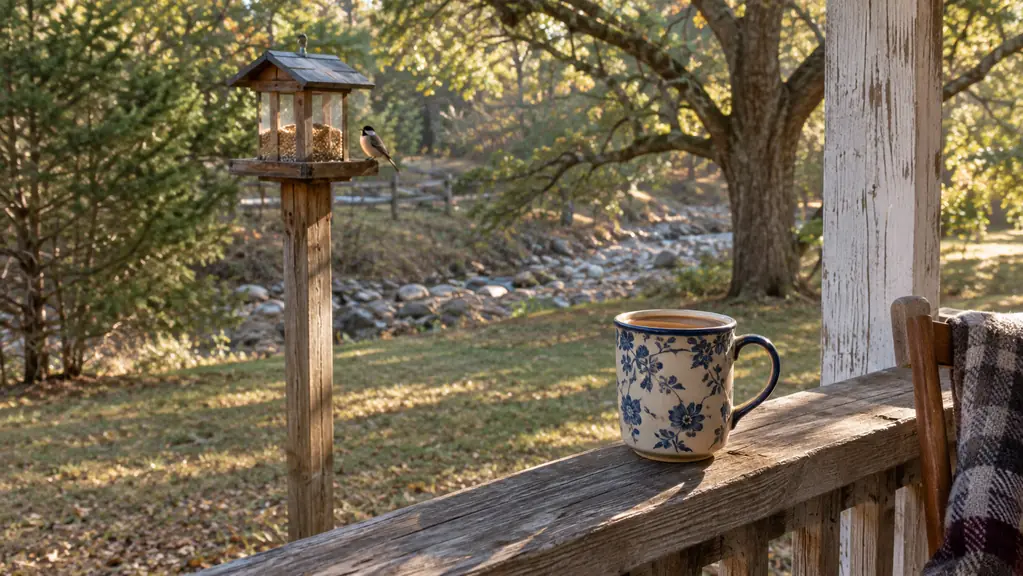
The first bird the NETVUE Birdfy caught for me was a male cardinal, a little after seven on a cool morning in late September, while I was standing in the kitchen waiting on the coffee to finish. My phone buzzed on the counter. By the time I got to the window he had flown, but there he was on the screen with his crest up and a sunflower seed in his beak. I had been watching that same patch of ground for three years with binoculars and a trail camera strapped to a live oak, and that was the first time a piece of gear told me a bird had arrived while I was in the other room.
So here is the short answer, and then I will show my work. For birds that come to a feeder, the NETVUE wins and it is not close. For anything moving along the creek bed after dark, or crossing ground a good distance from the house, my trail camera wins and that is not close either. They are two different jobs wearing similar clothes, and the mistake I see people make is buying one and expecting the other.
The trail camera is a GardePro A3S. I bought it in October 2022, strapped it to a live oak about waist height facing across the dry creek bed, and it has stayed on that same tree ever since. It is not cellular and it has no Wi-Fi. It runs on AA batteries and it writes to an SD card that I walk out and collect about once a week, then look at on my laptop at the kitchen table. In its first two weeks it caught a gray fox I did not know was using that creek bed at all.
| NETVUE Birdfy | GardePro A3S trail camera | |
|---|---|---|
| Bird identification | Names the bird for you, unlimited, with no paid subscription required | None. You look at the frame and work it out yourself |
| Getting the clip | Arrives on your phone over the home Wi-Fi, with a notification | You walk out once a week and pull the SD card |
| How far from the house | Has to stay within reach of your Wi-Fi | Anywhere you can walk to, no signal of any kind needed |
| After dark | Has night vision, though my night traffic at the feeder is thin | Sits on the creek bed all night, where the fox and the armadillos actually are |
| Power | Runs on its own battery, and a solar panel can be added later | AA batteries you swap out when they fade |
| Seed | Holds 1.5 liters, which at my house is a fill about twice a week | No seed. It watches, it does not feed |
| Best at | The birds that come to you | Everything that walks past one fixed spot |
How I Ended Up Running Both
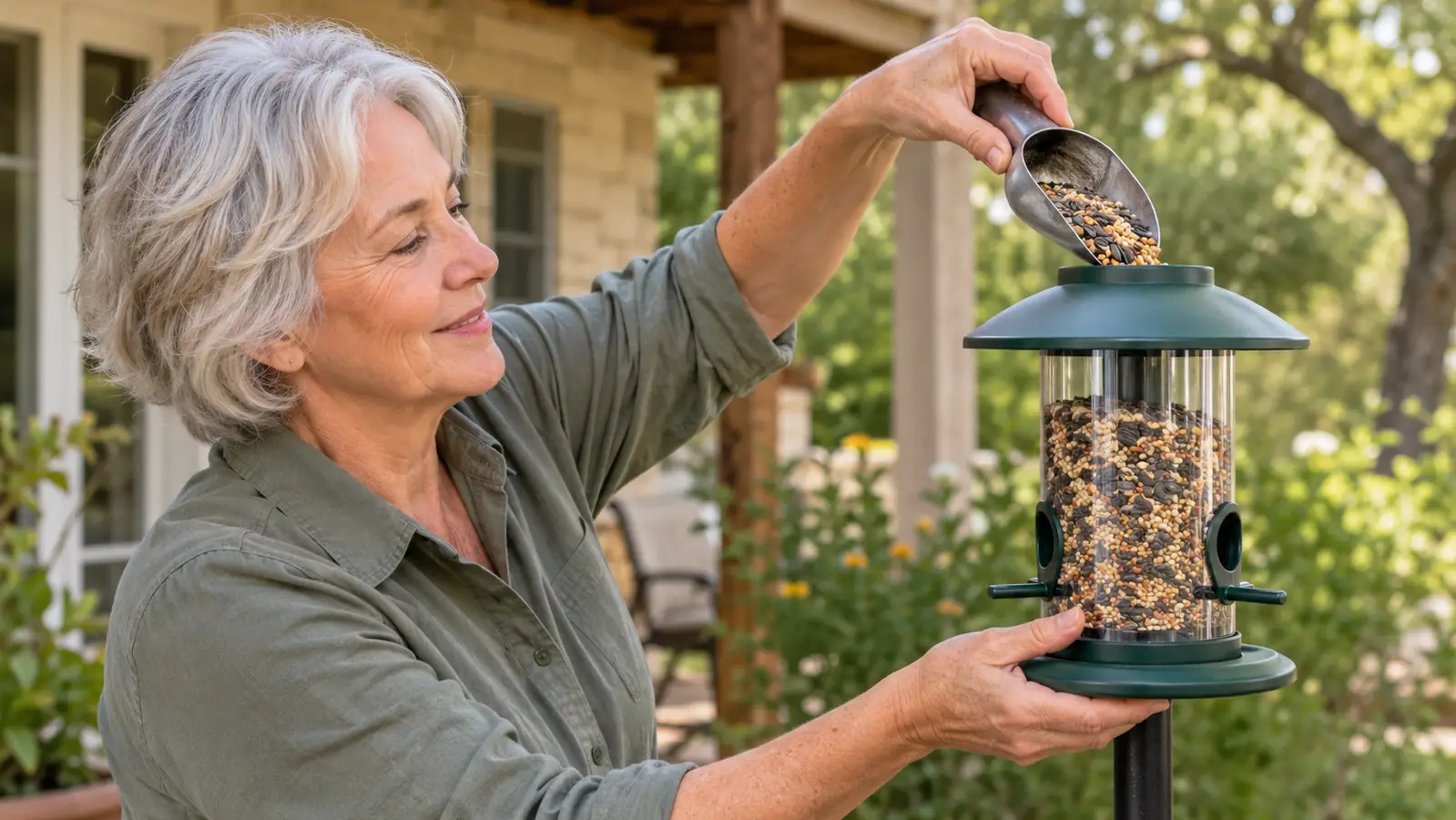
In September 2024 I bought the Birdfy and mounted it on a post off the back porch, about thirty feet from the house, which is close enough to reach our home Wi-Fi. The plain tube feeder I had used for years came down the same week. I fill the new one with mixed seed about twice a week, which is roughly what its 1.5 liter capacity asks for at my house with cardinals and house finches working it hard. It runs on its own battery and I have not added a solar panel, mostly because the post is right there and I walk past it anyway.
So I have been running both of these side by side for about two years, and they have never once done the same thing for me. The trail camera shows me a fixed piece of ground, day and night, whether or not anything is there, and it does not tell me what it is looking at. I have several hundred frames of armadillo hindquarters that prove the second part, plus one very fine picture of a turkey's feet.
That is the whole comparison in a line, and the rest of this is the detail behind it. Because the question people actually ask me is not which camera is better. It is whether aiming a trail camera at a feeder saves them from buying a feeder camera at all. It does not, and I will show you why without pretending the trail camera is the weaker tool. It is not. It is just pointed at a different question.
Where the Birdfy Wins
It tells me the name of the bird. That sounds like a small thing and it is the biggest thing on this page. Before the feeder camera I knew I had cardinals and chickadees and titmice because I had looked them up in a book and compared, and I was right most of the time and unsure the rest. Now the clip arrives already labeled through the AI bird ID, and there is no paid subscription attached to it. The painted buntings that come through in summer were the ones that surprised me. I had one on a June morning the summer after I put the feeder up, and I only caught it because the phone buzzed on the arm of my chair. A painted bunting does not sit still long enough for a woman on a porch to raise binoculars and focus and get a good long look. The clip was over before I got there, and it was still on my screen.
It tells me when. My phone buzzes, the clip is already there, shot on the 2K camera, and I can look at it in the kitchen with my coffee instead of standing frozen in the yard with my arms getting tired. Paul, who has never had the slightest interest in my gear, has started asking who came by. He asks it from the table without looking up from the crossword. Anybody new? And I have an answer now, which I did not have for the first three years I lived out here. Two years of a man who does not care about birds asking about birds before he has finished his toast.
And it puts a close-up where I already sit. Thirty feet, on a post, no walking, no card, no laptop. The camera has night vision, so the feeder is not blank after dark, though the traffic out there is mostly a daytime affair. The post sits close enough that I can fill it in the time it takes to finish one mug of coffee, and I keep the seed in a metal can in the mudroom so the whole errand is one trip instead of two. Two practical things to know before you buy one. It has to stay inside the reach of your Wi-Fi, and the capacity is 1.5 liters, which in warm weather with a busy feeder means a refill about twice a week.
Where the Trail Camera Wins
Night, and distance from the house. The GardePro has no Wi-Fi and no cellular connection, which sounds like a limitation until you understand what it buys you. It means the camera does not care where it is. It sits on a live oak facing the creek bed, runs on AA batteries, and writes to a card. I could hang it at the back fence and it would work exactly the same as it does now. The feeder camera cannot do that, and it is not a flaw in the feeder camera, it is the trade it made to be able to name a chickadee for you.
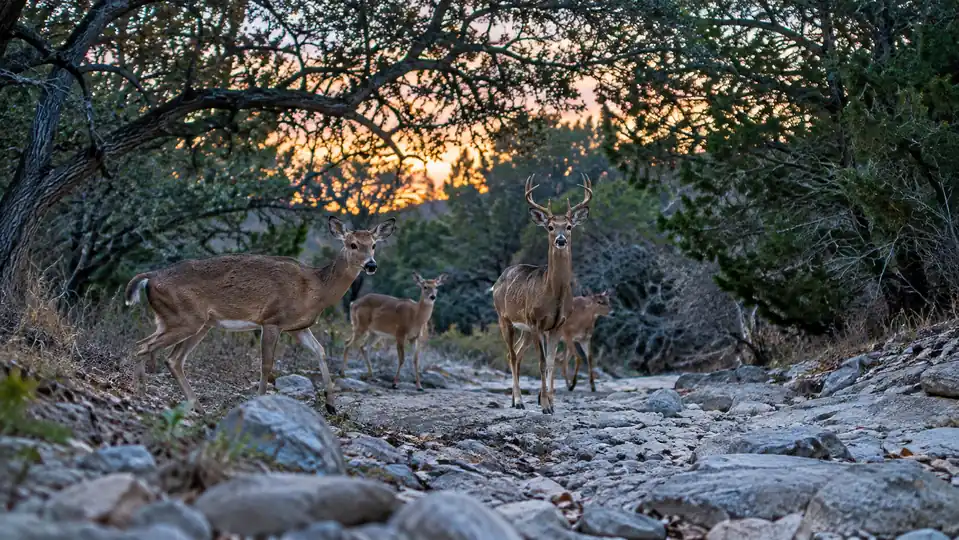
It catches the animals that never land on a feeder. The gray fox showed up in the first two weeks, and I had lived on this land for years without knowing one was using that creek bed. Wild turkeys walk through in a group. Deer, armadillos, and the occasional something at two in the morning that I look at twice before I decide it was a raccoon. If what you love is the ground and the night, this is the tool, and aiming it at a feeder narrows it down to the one thing the feeder camera already does better.
It is also the least demanding piece of gear I own. AA batteries, one card, a walk out once a week, and a look at the laptop. Monday mornings are my card pull. I take the coffee out with me, unhook the latch, swap the card for the spare I keep in my shirt pocket, and sit down at the kitchen table while the day is still cool enough to have the window open. The whole thing takes about ten minutes and it has turned into the part of the week I look forward to, which is not something I would have predicted about a chore. Four years on the same tree in Texas heat and it has asked nothing else of me. Nothing to charge on the porch, nothing to reconnect, nothing to remember except the card. That kind of dull reliability is worth more than any feature when the thing you are doing is watching wildlife you do not control.
The trail camera caught a gray fox on the creek bed in its first two weeks, an animal I had lived beside for years without ever knowing was out there.
Two Things I Would Get Right the First Time
The squirrels found the feeder within days. I had the post near the live oak because it was shaded and pleasant to look at, and that was the mistake. I put the feeder up on a Saturday. By Tuesday I had one hanging upside down off it with his back feet braced on the post, working the seed like a man at a buffet. I tried raising the feeder first, up to the tallest setting the post would give me, and that bought me exactly one quiet afternoon. Then I moved the post away from the oak, and the raids slowed to an occasional nuisance instead of a takeover. I never bought a baffle and I still have not. If you are putting one up, put it where a squirrel has to cross open ground to reach it. That single decision matters more than anything you can buy to hang under it.
The other one is signal. Thirty feet off the porch works. If I had hung the feeder out at the back fence where I can see the creek bed, it would not have reached the home Wi-Fi and I would have spent a weekend annoyed at a piece of gear that was doing nothing wrong. The trail camera is the opposite. It wants distance and it does not care about anything else. So the two of them end up in completely different places on the property, which is why I finally stopped trying to make one of them do the other's job.
If the birds come to you, this is the one I would buy again
The NETVUE Birdfy names what lands, shoots it on the 2K camera, and sends the clip to your phone over the home Wi-Fi. No paid subscription for the bird ID. Mine has been on the same post since September 2024.
Amazon Check Today's Price on Amazon →Who Should Buy Which
Buy the NETVUE feeder camera first if the birds are the point. You like watching what lands on the feeder, you want to know what it is called, and you would rather see it on your phone than stand in the yard with binoculars and cold hands. That is most of the people who ask me, and it is the reason I would spend here before I spent anywhere else. The unlimited bird ID with no subscription is what makes it hold up over years, because a feeder camera that billed you monthly to tell you a chickadee is a chickadee would wear thin by the second season.
Buy the trail camera first if the ground and the night are the point. If you want to know what crosses the creek bed, when the deer are moving, whether the fox is still around, a feeder camera will not tell you. It only knows the feeder. Moving the trail camera over to the feeder does not fix that either. It just narrows a wide view down to a small one and gives up the name in the bargain.
And if you can only do one this year, do the one that matches where you already look. I look at the porch with my coffee in the morning and at the creek bed in my head at night, so I ended up with both, bought about two years apart, and I would go in the same order again. The feeder camera answered the question I was asking every morning at the window. The trail camera answered a question I did not know I had until a fox walked through the frame.
Start with the one that tells you who came by
Battery powered, 1.5 liter seed capacity, 2K camera with night vision, and unlimited bird ID with no subscription. It is the piece of gear that made me stop guessing at what was on my own porch.
Amazon See the NETVUE Birdfy on Amazon →