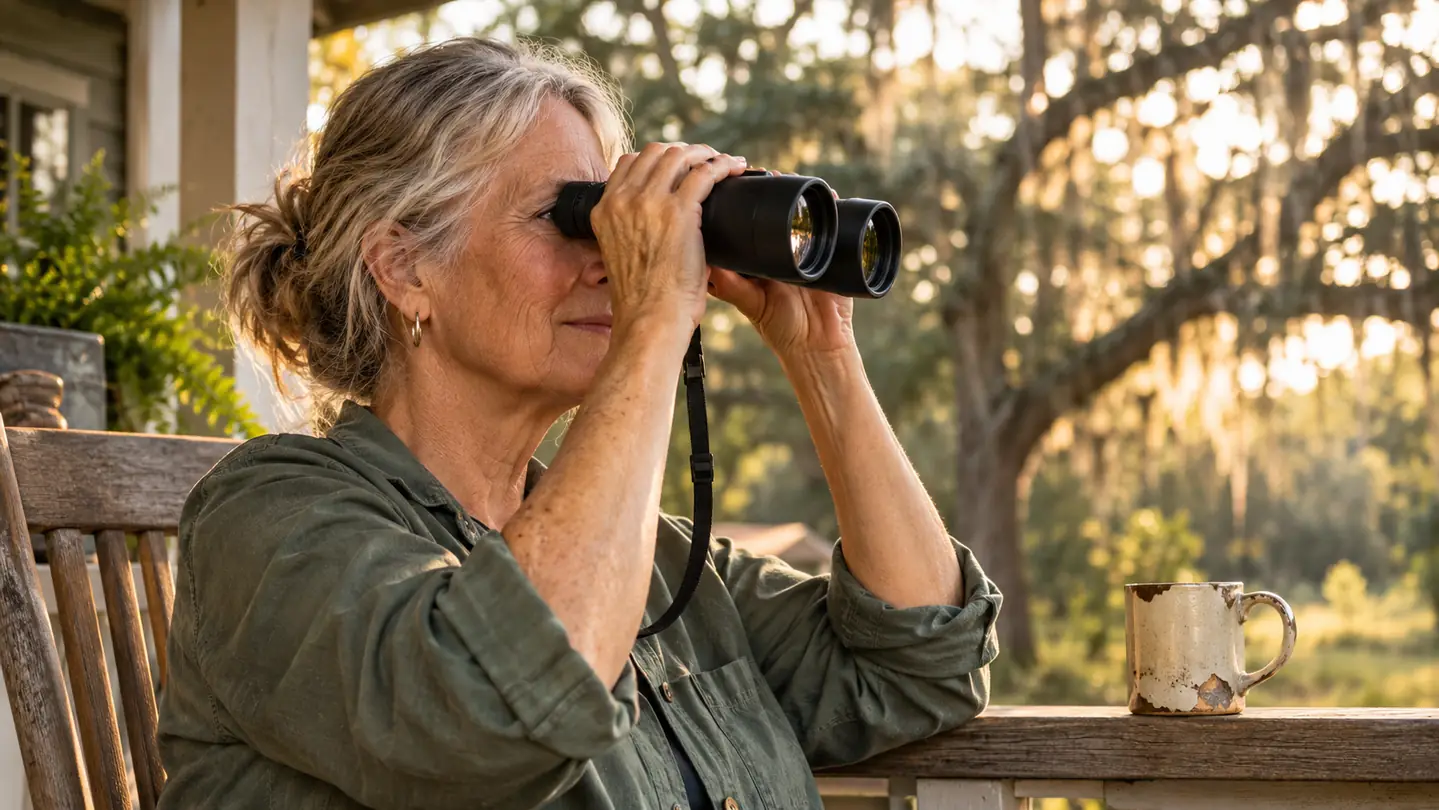
The first time I tried to find a bird in a live oak with binoculars, I found leaves. Thousands of leaves. Every last one of them looked like it might be a warbler for about half a second, and then it didn't. I stood in my own backyard outside Kerrville, sweating, with a strap around my neck, and understood that owning good glass and knowing how to find a bird in a tree are two entirely different skills. Nobody warns you about that part.
That was the spring of 2022, a few weeks after the Vortex Crossfire HD 10x42 came to live on a hook by my back door. I had assumed the binoculars would do the work. Ten power, 42 millimeter lenses, sharp as anything when I glassed the deer at the fence line. What I learned over the next four and a half years, mostly by being bad at it for a while, is that finding a bird in a tree is a set of five small habits. The Vortex made it easier. The habits are what took me from a wall of leaves to a painted bunting in the cedar down at the dry creek bed.
The one piece of gear that never stays home
The Vortex Crossfire HD 10x42 has ridden on a harness strap through porch mornings, Lost Maples walks and South Llano afternoons since March 2022. 10x magnification, 42mm objective lenses, waterproof and fog proof, 1.4 pounds. If you want one less thing to think about while you learn to find birds, this is the thing that stopped being a question for me.
Amazon See Today's Price on Amazon →Step 1: Set the Binoculars Up Before You Walk Outside
Half of my early misses were not the tree's fault. They were the eyecups. I wear glasses, and the Crossfire has eyecups that twist up and down for viewing with or without them. For the first month I had them twisted all the way up, which is the setting for someone not wearing glasses, and I was losing field of view before I ever lifted the binoculars to my face. Twist them down, press your glasses against them, and the whole picture opens up. It took a friend at South Llano pointing at my own binoculars to fix something I had been fighting for weeks.
The second setup job is the diopter, that ring on the right barrel. Close your left eye, look at something far away with your right eye, and turn the ring until it is sharp. Then open both eyes. Do this once, outdoors, on a real distant object, not on the wall of your kitchen. I set mine in 2022 and have not touched it since. Every time someone new picks up my binoculars and says the view is blurry, it is almost always that ring, spun by accident.
Then the small stuff. Lens caps off before you leave the porch, not after you have spotted something. A harness strap instead of a neck strap, because 1.4 pounds does not sound like much until you have worn it around your neck for two hours. And a habit I picked up from an old birder at Lost Maples: tuck your elbows into your ribs when you raise the glass. It costs nothing and it steadies the view more than any piece of equipment I own.
Step 2: Read the Tree Before You Lift the Glass
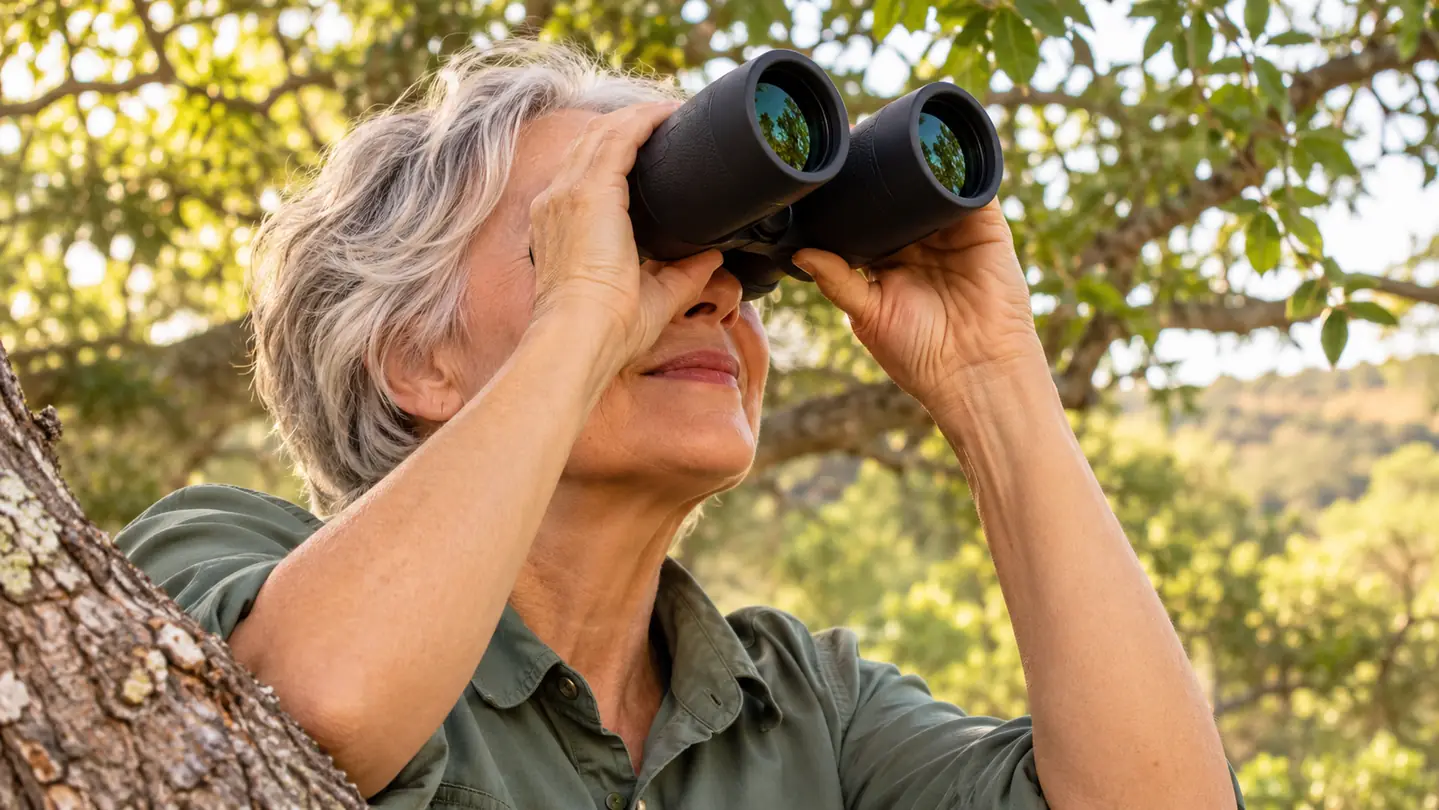
Here is the thing I wish someone had told me in 2022. Do not sweep the binoculars across the canopy like you are mopping a floor. You will see leaves and you will see them fast. Instead, look at the tree with your bare eyes first and pick a section. One branch. One clump of cedar. Give that section ten full seconds of your attention before you move to the next one.
What you are looking for is not a bird. It is something that is not a leaf. A lump on a branch where the branch should be smooth. A shape with a straight edge in a world of curves. A patch of shadow that has a beak on it. White-tailed deer taught me this without meaning to. Once you have looked at enough deer at the fence line, your eye starts catching the horizontal line of a back in tall grass before your brain has named it. Birds work the same way, only smaller and higher up.
This is where decent glass earns its keep, and it is the honest reason I keep the Vortex around. The exit pupil on the Crossfire HD 10x42 is 4.2 millimeters, and the lenses are fully multi-coated, which is the technical way of saying light gets through. The practical way of saying it is that at 6 in the evening, when the sun has dropped behind the ridge and the shaded side of the oak goes flat and black to the naked eye, I can still see into it. My old drugstore pair from my flying days went dim about twenty minutes before the birds stopped moving. That twenty minutes was where most of the good watching happened, and I never knew it.
Step 3: Aim With Your Ears First
Most of the birds I find in trees, I find because they told me where they were. A titmouse fussing at something. Chickadees working a branch in that busy, upside-down way they have. A blue jay announcing himself to the entire county. Stand still, close your eyes for a moment if you have to, and figure out which direction the sound is coming from.
Then narrow it. Turn your head slowly until the sound is equally loud in both ears, which means you are facing it. Look up at the tree in front of you, not the whole tree line, just the one tree. Picture a clock face on the canopy and decide whether the sound is at ten o'clock or two o'clock. You will be wrong a lot at first. Being wrong in a specific direction is still faster than staring at the whole tree.
Listen for the quiet sounds too, once you know to. The scratch of little claws on bark. The rustle of a wing being resettled. The soft tap of something working a branch apart. Those sounds do not carry, which means the bird is close, which means it is in the tree you are already looking at and you simply have not found it yet.
Do not sweep the binoculars across the canopy like you are mopping a floor. Pick one branch and give it ten full seconds.
Step 4: Bring the Glass to Your Eyes, Not Your Eyes to the Glass
This is the habit that separates watching from flailing, and it took me a shamefully long time to get. The mistake looks like this. You spot the bird with your bare eyes. You drop your head to find the eyecups. You raise the binoculars. You look into them and see a completely different part of the tree, and by the time you find the bird again it is gone.
The fix is to never take your eyes off the bird. Keep both eyes open and fixed on the spot. Bring the binoculars up into your line of sight without moving your head, meeting the bird where it already is. Both eyes open feels strange for the first week and then it becomes the only way you can do it. Your brain sorts out the two images and you land on the bird instead of hunting for it.
Practice on something that will not fly away. The feeder post. A knot on the oak by the creek bed. A deer standing at the fence line. Do it twenty times in a row on a stationary target until your hands know the path. Then, when a warbler is working through the cedar and you have about four seconds, you are not learning the motion. You are just doing it. Focus on the branch the bird is on and leave the focus wheel alone. Chasing a moving bird with the focus ring is how you end up watching bark.
Step 5: Stand Still Longer Than Feels Polite
Birds come back. This is the single most useful thing I know, and it is free. A bird that flushes out of a cedar because you shifted your weight will often return to the same perch within a minute or two, sometimes the same branch, because that branch was working for it. The people I see on trails who find the least are the ones who keep walking. The ones who find the most are standing in one spot looking slightly ridiculous.
So when you lose a bird, do not chase it. Stop. Count to sixty slowly. Watch the edge of the tree where it went. Nine times out of ten something moves again, and this time you know exactly where to point the glass. If you do need to reposition, move low and slow, and keep your silhouette broken up against a trunk rather than standing in the open.
In May of 2022 I did this by accident, mostly because I was tired. I sat down on the porch step and stopped trying. About two minutes later a painted bunting landed in the cedar at the creek bed and stayed there long enough for me to get the Vortex up and actually look at him. Not a glimpse. A look. I had been walking that yard for weeks and finding nothing, and the thing that worked was sitting still and letting the bird make the decision.
What Else Helps
The binoculars do the finding, and the Vortex Crossfire HD 10x42 has been the one pair I reach for since 2022. But a few other things in my life have quietly made the tree-watching better, and none of them replace the glass. The K&F Concept travel tripod came along in April 2024 because my arms were done holding a camera with a long zoom lens, and because the little tripod that came with my scope shook in the coastal wind at Aransas. On the porch it holds the camera still while I watch, which sounds like a small thing until you try to hold a long lens on a warbler for thirty seconds. It is not built for heavy professional rigs and I would not pretend otherwise.
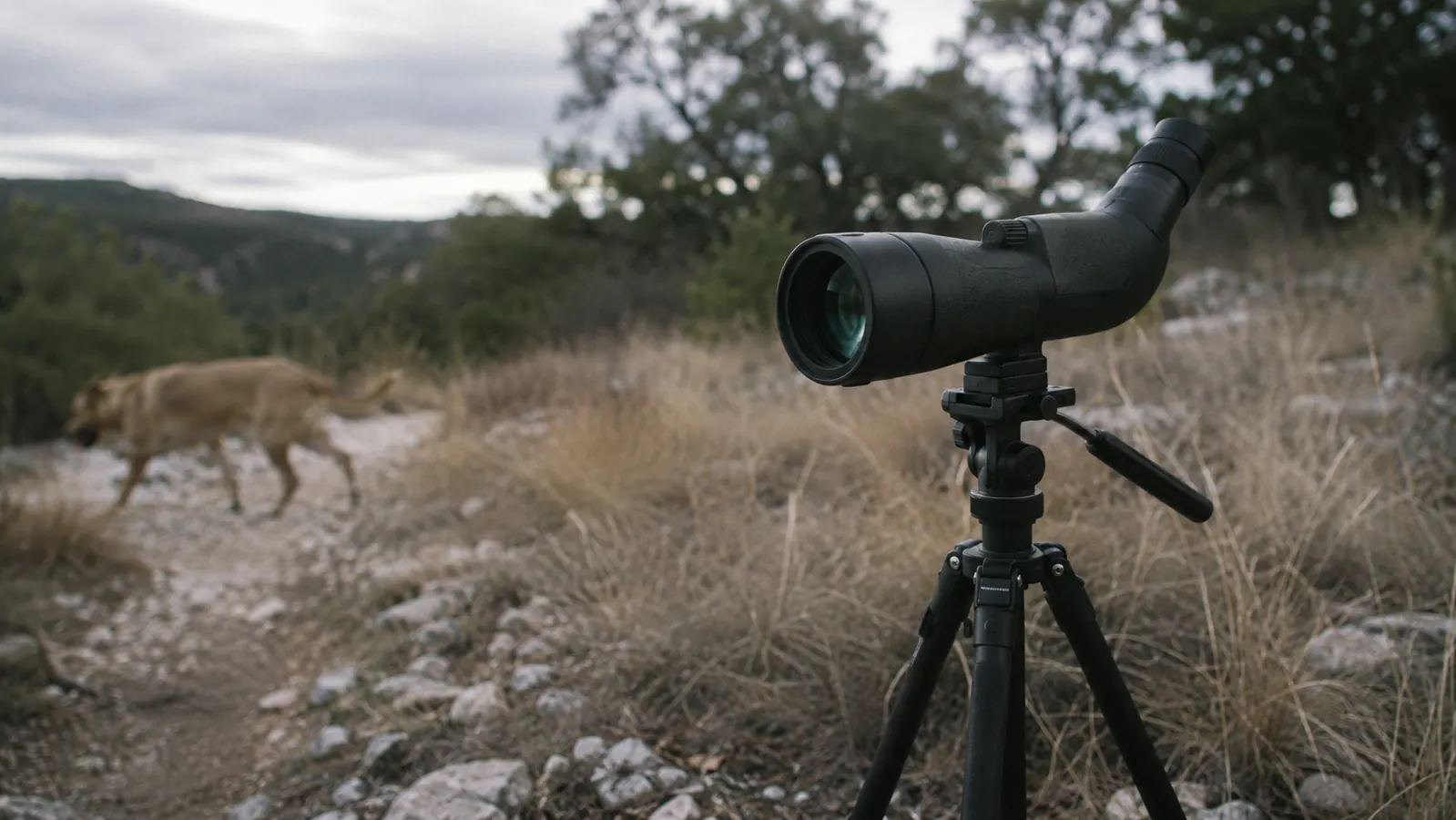
For birds that refuse to come close, the Gosky 20-60x60 spotting scope on its tripod is the answer, and I bought it in December 2023 for the whooping cranes at Aransas. Here is what I would tell you about it: I almost never use 60x. The image gets dim and shaky up there and I stay between 20x and 40x, which is plenty for a crane standing in a marsh a long way off. A scope is a wonderful second tool and a frustrating first one, because you cannot swing it around a canopy the way you swing binoculars.
Two other things built the habit without my noticing. The GardePro trail camera on the live oak facing the dry creek bed has shown me a gray fox I did not know existed on this property, and it taught me that wildlife is out there doing things while I am inside being distracted. And the Birdfy feeder on the post about thirty feet off the back porch gives me cardinals, chickadees, titmice and house finches at close range all morning. Practicing the raise and focus on a bird you can see with your bare eyes, at a distance where there is no guessing, is how the motion became automatic. The feeder is not the same as finding a warbler in a cedar top. It is where you build the hands that will.
Four and a half years, one pair, still on the hook by the door
The Vortex Crossfire HD 10x42 is waterproof, fog proof, and armored in rubber that has survived being set down on limestone more times than I want to admit. Twist-down eyecups if you wear glasses, 15 millimeters of eye relief, and a lifetime VIP warranty behind it. Start with something you do not have to worry about, then spend your worry on the birds.
Amazon See Today's Price on Amazon →