I bought the Vortex Crossfire HD 10x42 in March of 2022, and I want to start with the part most reviews leave out. For the first two weeks I thought I had made a mistake. Not because the glass was poor. Because ten power is a great deal of magnification to hold still in two hands, and nobody at the counter mentions it. I spent thirty-one years as a flight attendant, most of it looking out small windows at country I would never get to walk in, and I retired in 2021 with a short list of things I wanted to see properly. Binoculars were the first item on that list. These nearly went back in the box on day nine.
What changed my mind was a morning in May, on my own back porch, with a painted bunting sitting in the cedar at the dry creek bed. I had seen that bird a hundred times as a moving patch of color. Through the Vortex I could see individual wing feathers, the way it turned its head, the exact moment it decided I was not worth worrying about. That is the whole case for these binoculars, and it is a strong case. But it is not the whole story. What follows is what four and a half years of daily use has taught me, including the things I would say to a friend before she spends the money.
The Quick Verdict
Sharp, bright, waterproof, and backed by a warranty that actually means something. Still the pair I grab four and a half years later, with two caveats nobody mentions: 1.4 pounds gets heavy on a long walk, and ten power is more magnification than thick cover rewards.
Amazon Check Today's Price →The pair that has hung by my back door since 2022
Same model, same 10x42, with more than four thousand reviews on the listing. Weigh my four and a half years against theirs.
Amazon Check Today's Price on Amazon →How I Have Used Them, Day to Day
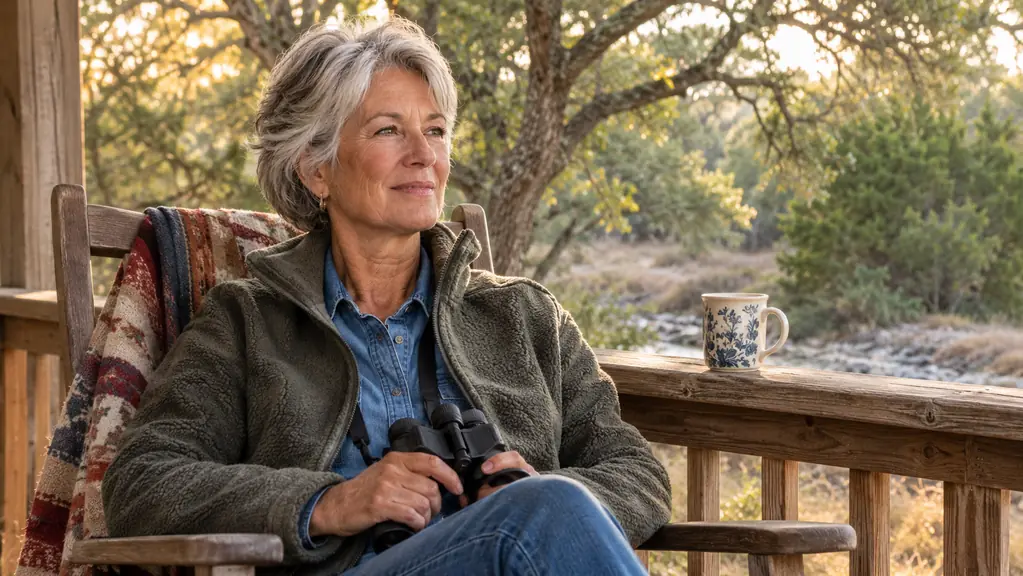
Most mornings they come off a hook by the back door before I have finished my first cup of coffee. I sit in the same chair on the porch, elbows on the rail, and I work the treeline from left to right, then the creek bed, then the far fence. That is the least glamorous possible use of a pair of binoculars and probably the most common one on the planet. They also ride on a harness strap at Lost Maples State Natural Area and South Llano River State Park, they have gone to the Texas coast three Januarys running to look at whooping cranes from a respectful distance, and they get handed to guests who ask what I am looking at.
One morning in October, nothing at the treeline and nothing at the creek bed, and then a shape moved at the far fence about a hundred and twenty yards out. With bare eyes it was a smudge. Through the Vortex, elbows on the rail, it turned into a grey fox working the grass along the fence line, nose down, stopping every few feet to listen. Eleven minutes. I never got a photograph of it and I did not need one.
Before them I owned one small pair of drugstore binoculars from my flying days, and they were the only other pair I had ever had. In full sun they were fine. The minute the light started to go, the view went flat and grey and I stopped bothering. For years I assumed that was simply what binoculars did at dusk. It is not. That assumption cost me a decade of evenings I could have spent actually seeing the deer instead of guessing at shapes at the edge of the field.
What Nobody Tells You Before You Buy Ten Power
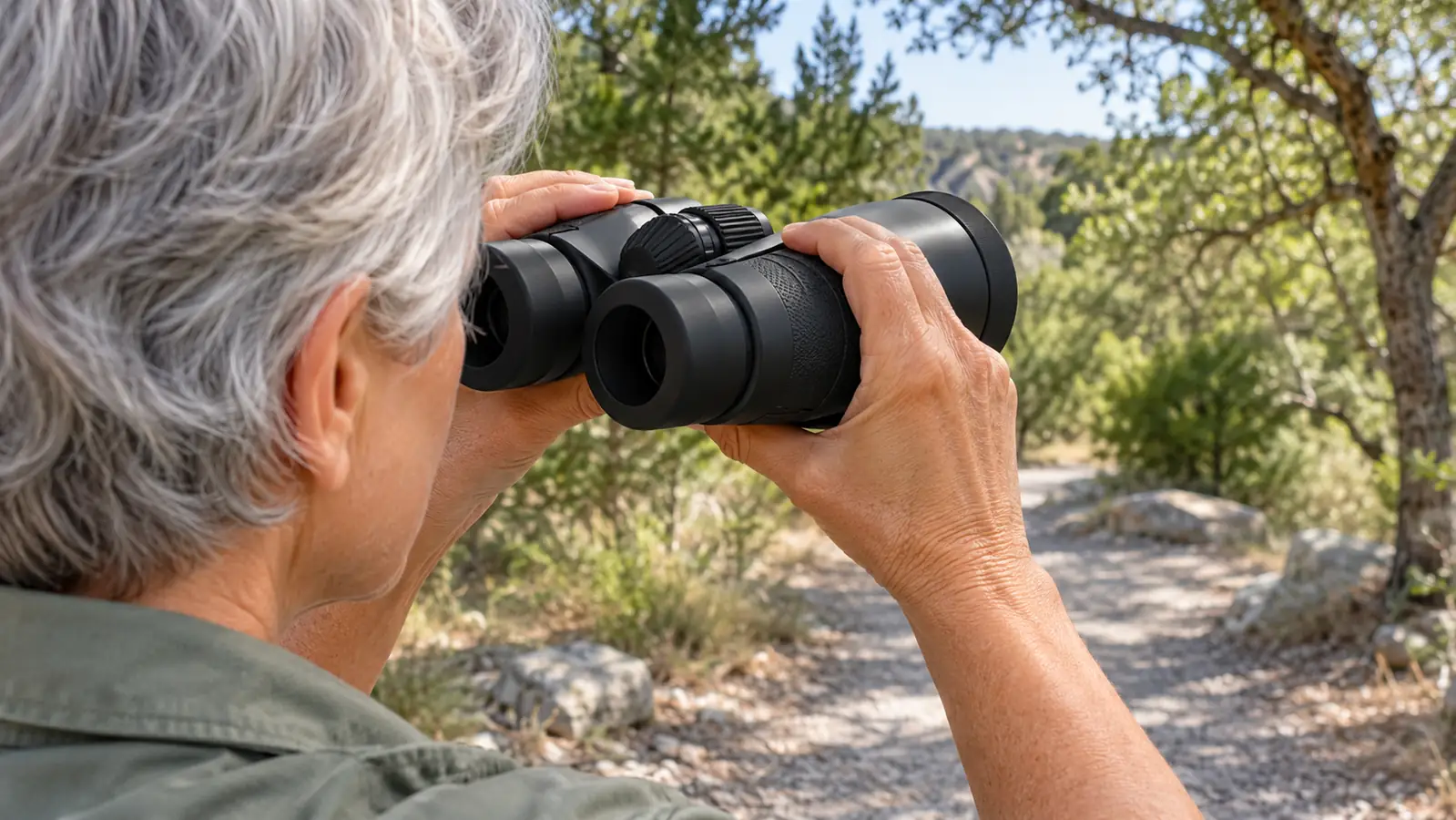
Magnification is the number everyone shops by, and it is the number that misleads the most. Ten power means everything appears ten times closer, which sounds like a pure win until you try to hold it. At my kitchen window, braced on the sill, they are wonderful. Standing in the open with the wind moving the cedar, my own heartbeat puts a wobble in the image that no amount of good glass can fix. A man at the park, older than me and clearly further down this road, told me to breathe out and stop fighting it. That helped more than anything printed on the box.
The first two weeks looked like this: raise them, find the bird, lose the bird, lower them, find the bird again with bare eyes, raise them, lose it once more. Nine days of that and I had the box ready by the door. What fixed it was boring. Elbows on the porch rail, and moving the binoculars in small amounts instead of sweeping the treeline like a searchlight. Anything inside about fifteen yards is still awkward at ten power, and I quit trying.
The second thing nobody tells you is that ten power is too much glass for thick cover. The cedar on my place is dense, and a bird moving through it at close range is a flicker of feather and shadow rather than a portrait. These are for the bird thirty yards out and partly hidden, for the deer at the far edge of the creek bed, for the crane standing in shallow water across a marsh. For something hopping through the brush at your elbow, a wider and lower-powered view would serve you better. I did not understand that when I bought them. I understand it now.
Third, the weight. Vortex lists these at 1.4 pounds, which reads like nothing on a listing page. On a harness strap, two hours into a walk, it is a real object swinging against your chest. I am sixty-three and I feel it by the last mile. Paul feels it too, in the sense that he hears about it in the car on the way home and then watches me do the same thing again the following weekend. It is not a reason to avoid them. It is a reason to buy a decent strap and to stop pretending your neck is thirty-five.
What I do about all three problems is boring and it works. I brace. On the porch, my elbows go on the rail. At a state park, I lean into a tree or against the roof of the Outback. On a viewing platform, I sit down and put my elbows on my knees. My husband, a retired history teacher, calls this my tripod posture and finds it endlessly funny. It is also the difference between a sharp look at a bird and a fuzzy one, so I keep doing it and let him laugh.
Where These Actually Earn Their Keep
Light is where the Crossfire HD separates itself from everything I had before. The lenses are fully multi-coated, which is a plain way of saying light passes through them instead of bouncing off, and the listing gives a relative brightness of 17.64 with a 4.2 millimeter exit pupil. I cannot see a number through a lens. I can see that on an overcast morning, in the twenty minutes before the sun clears the ridge, I can still tell one sparrow from another, and the old pair had already quit. That extra window of usable light is the entire reason the drugstore binoculars went into a drawer and stayed there.
A foggy November morning at Lost Maples makes the same point with worse weather. The valley did not clear until nearly nine and I could see maybe forty yards. Elbows braced against a juniper, I picked a ruby-crowned kinglet out of a branch at the edge of that forty yards, small and quick and mostly backlit. Not a beautiful view. But a view, on a morning when the old pair would have handed me a grey blur and a good reason to walk back to the car.
Second, weather. These are waterproof and fog proof, and I have tested both without meaning to. Texas humidity is not a rumor, and carrying cold glass out of an air-conditioned car into a warm wet morning fogs most optics. These clear. They have been rained on at the coast in January, three winters running, and the view afterward is the same as the view before. I have never dunked them and I do not intend to. But I have stopped handling them like something fragile, which has quietly increased how often I actually use them.
The body is wrapped in rubber armor, which matters more than it sounds when your hands are cold or wet. It grips. It has also survived being set on a porch rail and knocked onto a board floor, which happened once and which I would not recommend as a habit. The eyecups twist up and down so the binoculars work whether or not you have glasses on. I wear glasses for reading and driving, and I use these both ways depending on the day. With glasses, fifteen millimeters of eye relief is workable but not roomy. If your frames sit far out from your face, try a pair before you commit.
One afternoon at South Llano River State Park, a friend handed me her pair to look through, a considerably more expensive set than mine. I expected to be ruined for the Vortex. I was not. Hers were a touch brighter in the last twenty minutes of light, and the edges were a little cleaner. But the gap was not the gulf I had been led to expect, and I handed them back without a pang. If you are worried that buying at this level means buying something you will immediately outgrow, that was the afternoon I stopped worrying about it.
What Four and a Half Years Has Not Changed
The warranty is the part I was most skeptical of. Vortex calls it an unlimited, unconditional, lifetime VIP warranty. I have never had to use it, so I cannot tell you how a claim actually goes, and I will not pretend otherwise. What I can tell you is what the promise does to the way I treat the tool. I leave them on a hook by a back door in a house that touches a hundred degrees in August. I take them to the coast. I hand them to guests. I do not fuss over them. That promise is part of what you are buying, and for a working pair that lives outdoors, it is worth more than a slightly better line on a spec sheet.
The focus has stayed smooth, and the two barrels have stayed lined up with my eyes, which is the quiet part of a good pair that nobody thinks to mention. I have not sent them anywhere, tightened anything, or had a lens go cloudy. Four and a half years is not a lifetime and I am not going to claim it is. But it is four and a half years of Texas heat, coastal salt air, and riding loose in the back of an Outback, and they are still the pair I reach for without thinking.
What I do check, maybe twice a season, is that the center hinge has not loosened, which is the one failure I have watched happen to other people's binoculars. Mine has held. The lens covers live on the strap rather than in a pocket, a small habit that has saved me a cleaning or two, and I wipe the glass with a cloth from the case instead of my shirttail.
Four and a half years, three January trips to the coast, hundreds of mornings on the porch, and the only thing I have had to replace is the habit of reaching for the cheap pair.
What I Got Wrong, and What I Would Tell You
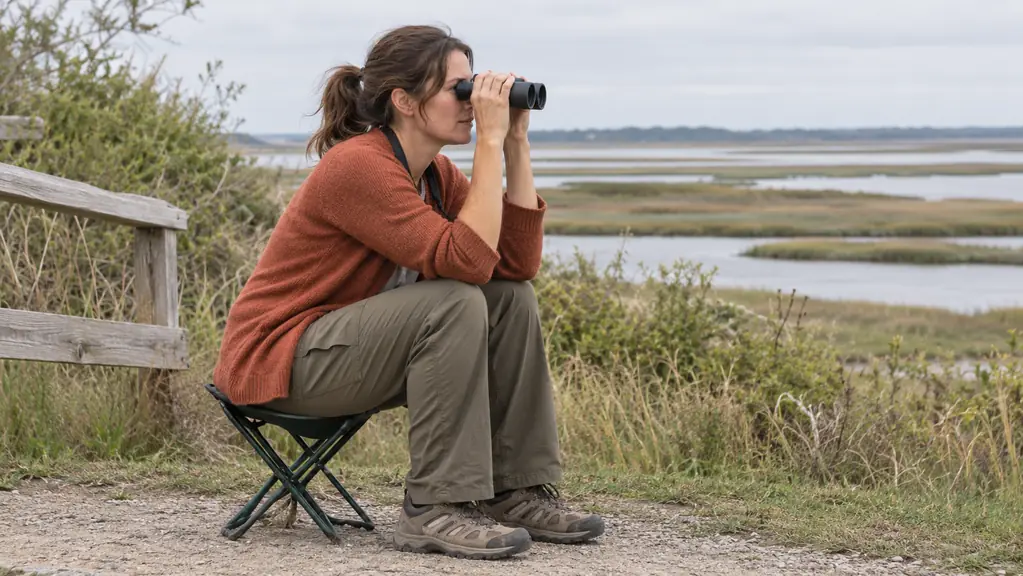
I bought ten power because more sounded better. If I were doing it again for my particular four acres, with cedar thick on three sides, I would at least look hard at a lower magnification for the close work and keep these for open country and the coast. That is not a complaint about the binoculars. It is a complaint about how I shopped. The number that tells you the most about whether a pair will suit you is not printed in large type anywhere, and it is this: what will you be looking through, and at what distance.
The other thing I got wrong was assuming binoculars would do the whole job. They find and they watch. They do not record anything, and by the time I fish my phone out of my pocket the bird has moved on. That is why the spotting scope and the camera came later, why the trail camera is strapped to a live oak facing the creek bed, and why the feeder camera hangs on a post off the porch. Each one answers a different question. The binoculars answer the most common one, which is simply: what is that, right now, over there.
What I Liked
- Fully multi-coated lenses hold detail in shade and early light that my old pair lost completely
- Waterproof and fog proof through Texas humidity and three January trips to the coast
- Rubber armor grips in cold, wet hands and shrugs off being set down hard
- Twist-up eyecups work with or without glasses, though the eye relief is snug
- A lifetime VIP warranty I have not needed but that changed how I treat the tool
Where It Falls Short
- 1.4 pounds swings against your chest after two hours on a harness strap
- Ten power is more magnification than thick cedar cover rewards
- Fifteen millimeters of eye relief is workable with glasses but not generous
- They run out of light a few minutes before the deer do at dusk
Who This Is For
This is for the person who wants to see what is on their own land or on a day walk, who is not going to spend professional money, and who wants one pair that survives being left by the door. If you came to this late the way I did, and you want binoculars that will show you the difference between two similar little brown birds without a fight, this is a sensible place to land. It is also for anyone who has been squinting through a small cheap pair and quietly assuming that dim, flat view is just what binoculars look like. It is not. You have been looking through the wrong glass.
Who Should Skip It
Skip it if you will spend your days in tight cover, close to the birds, where ten power fights you more than it helps. Skip it if you have shoulder or neck trouble and will not wear a harness, because 1.4 pounds will find that shoulder on every walk. Skip it if you need to see in genuine darkness, because no binocular with a 42 millimeter objective does that and you are shopping for something else entirely. And skip it if you are buying the number instead of the use. I did exactly that in March of 2022, and I am still a little embarrassed about it.
If your evenings end with a dim grey guess at what just landed in the tree, this is the fix
I will not tell you these will make you a better watcher. I will tell you that after four and a half years I still reach for them first, and that I stopped squinting in 2022.
Amazon See Current Price on Amazon →