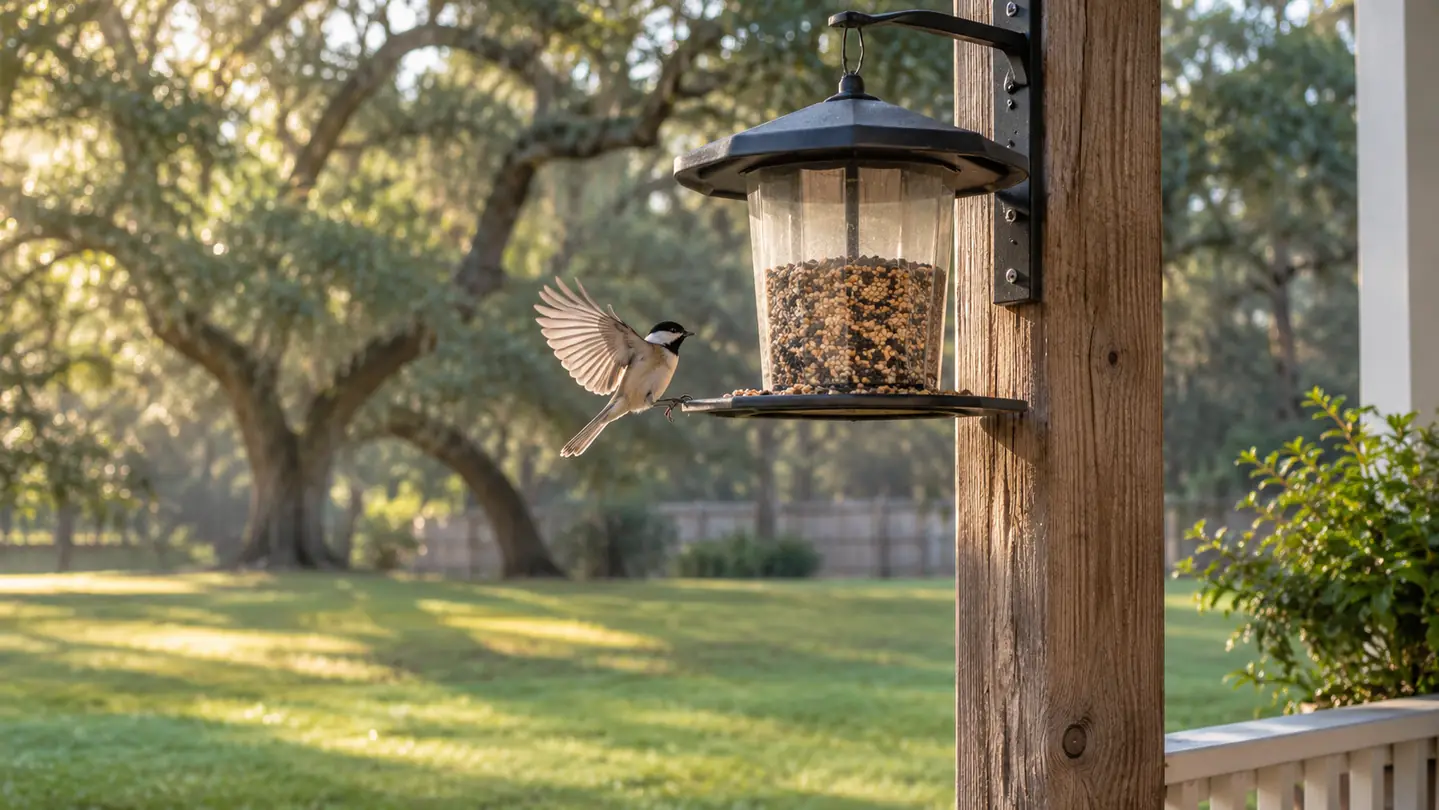
The Birdfy has one job at my place, and it is not the job the box suggests. It is not a security camera and it is not a life list. It is a way to see what turned up at the feeder while I was eight feet away doing the crossword and not looking up. Everything else it does is decoration around that one useful thing.
I bought the NETVUE Birdfy in September 2024. It hangs on a post about thirty feet off the back porch, filled with mixed seed, in plain sight of my chair. Two years on, my honest summary is this: the camera and the bird identification do what they claim, and the app is where your patience gets spent. That is the short version. What follows is the part I wish somebody had told me before I put a post in the ground.
The Quick Verdict
The free identification is the real thing and the 2K clips are worth watching. Go in knowing the app is chatty, the squirrels are undefeated, and a blurry frame will get a confident wrong name.
Amazon Check Today's Price →The feeder that stayed on my post for two years
Battery powered, 1.5 liters of seed, and bird identification with no subscription behind it. That last part is why it is still hanging out there.
Amazon Check Today's Price on Amazon →How I've Used It, and What It Replaced
Before this I had one plain tube feeder with no camera on it. It did exactly what a tube feeder does. I filled it, birds came, and I missed nearly all of them because I was inside or looking at the wrong cedar. When the Birdfy went up I took the tube feeder down. Running both would have doubled the seed and I did not need two stations competing with each other thirty feet apart. That was the end of a very simple era.
The post placement took me a morning and it matters more than people think. I set it on a Saturday in the middle of September, with a post hole digger, a level, and a bag of quick setting concrete, and I had it in the ground before the heat came up. The top of the post stands a bit above my shoulder, which puts the perch close to my eye level when I am sitting in the porch chair. Thirty feet is not a random number either. I wanted the feeder close enough to the house that the home Wi-Fi actually reaches it, because a camera that falls off the network is a camera that tells you nothing. I also wanted it far enough that the birds did not feel watched, and far enough from the live oak that a squirrel had to work for it. That last calculation did not hold. More on that below. It has held that Wi-Fi connection at that distance for two years, through rain and through the kind of July we get out here.
My routine has not changed much since. I fill it with mixed seed about twice a week and I look at the clips on my phone in the morning with coffee. The regulars are cardinals, chickadees, titmice, house finches, and in summer the painted buntings, which are the whole reason I keep a feeder at all. Paul, who has never shown one bit of interest in my binoculars, has started asking who came by. That is the highest compliment I can pay a piece of gear, and I do not hand it out often.
What the Bird Identification Actually Gets Right
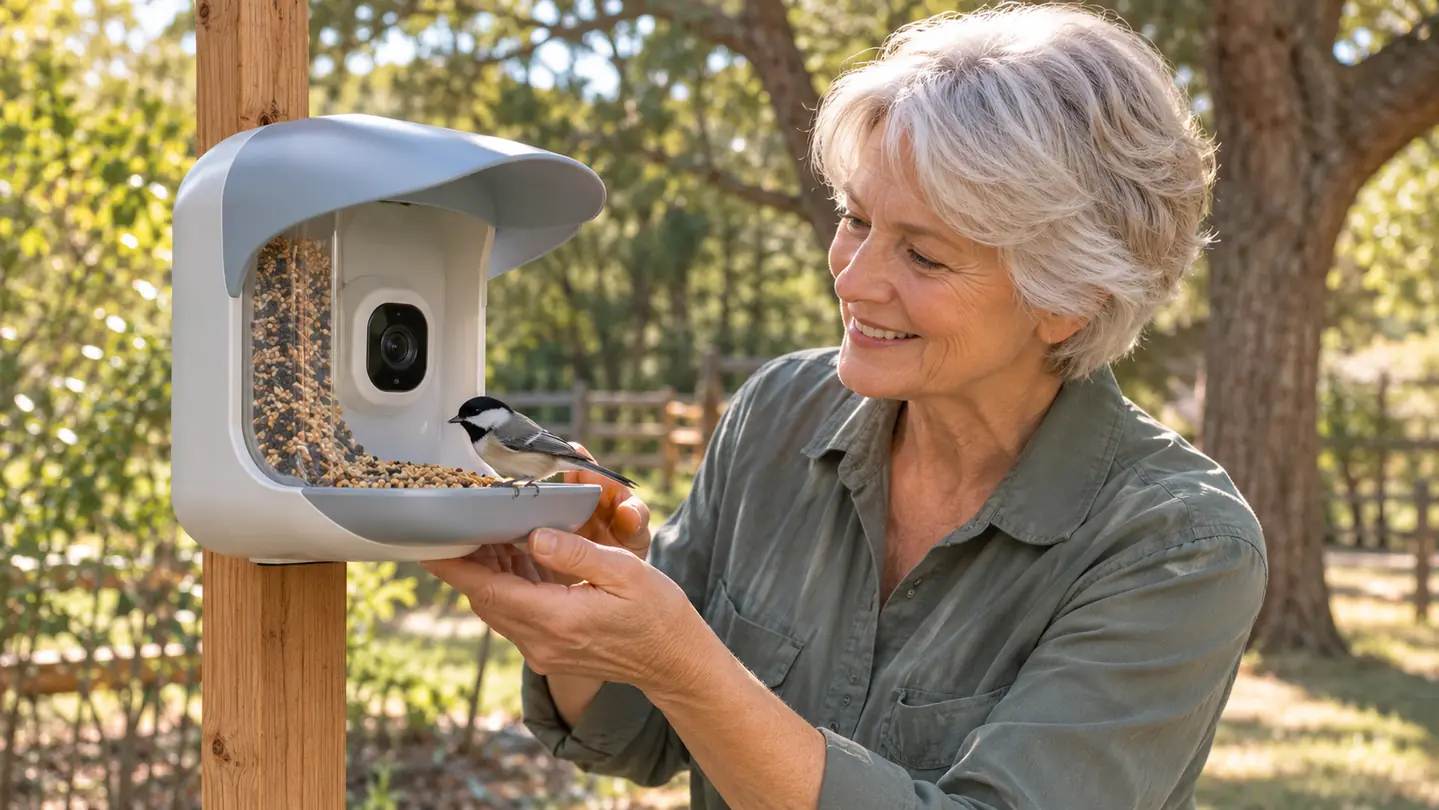
I expected the identification to be a novelty and it is not. The NETVUE feeder names what it sees, and on a clean frame in decent light it is right most of the time. Cardinals and chickadees it never misses. House finches it gets. The blue jays that come through and shove everybody off the perch it gets too, which is more than I can say for my own eyes on a gray morning. The listing mentions cardinals, finches, chickadees, blue jays, sparrows and nuthatches as the birds it is built to recognize, and that tracks with what I have watched it do.
One morning last October I looked at a clip and called the bird a titmouse. The feeder called it a nuthatch, and when I looked again it was plainly a nuthatch, working down the perch the way they do. That is the sort of thing that builds trust slowly. It has been wrong plenty of times. It has still been right more often than my own quick glance at a small gray bird on a gray morning, and I have made my peace with being corrected by a feeder.
Here is the part I want to underline, because it is the reason I picked this feeder over the others I read about. The bird identification does not require a subscription. I have signed up for enough things in my life that quietly turned into a monthly charge, and I was not going to do it again for something hanging on a post. The product is sold with unlimited identification and no paid plan behind it, and in two years nothing has ever asked me for a card. That is worth more to me than any feature on the box.
Where it slips is blurry frames. A bird leaving fast, or a clip shot through a lens with rain still on it, and it will hand you a confident wrong answer. I have had a house finch labeled as something it plainly was not, and I have had a good long laugh at the results on a windy day when everything in frame was moving. I have learned to look at the picture before I believe the name. That is good practice anyway, whether the name comes from an app or from me.
Where the App Will Test Your Patience
The app is not bad. It is just enthusiastic. Every visit gets captured and every capture wants to be mentioned to you. In a wet spring week, with birds moving through all day, that is a great deal of buzzing in a pocket while you are trying to do something else. I cut back how much it tells me about and once I did, we got along fine. I want to be fair here. The problem was not that the app failed to tell me things. The problem was that I had not decided what I actually wanted to know.
What I tried first was the wrong fix. I turned off every notification the app would let me turn off, which meant I stopped hearing about birds altogether, which meant I had bought a very good post ornament. Then I turned visits back on and let the rest go quiet, and that was the setting that actually worked. It took me the better part of a week to get there, mostly because I did the first thing in a temper instead of reading what the settings were telling me.
The first week is the strangest. You will get clips of a squirrel's backside, a leaf in the wind, and the post itself, all delivered with the same seriousness as a painted bunting in full sun. That settles down as you learn what to skim past, but nobody warns you that your phone will spend a few days being very excited about foliage. I would rather be told that before I buy than discover it on a Tuesday.
If I am being straight with you, the app is the weakest part of the package, and it is also the part you cannot avoid, because the clips live there. It works. It has never lost a clip I wanted to go back and find. It just wants more of your attention than the birds do, and the birds are the point. A person who resents an app asking for attention should know that going in, and I would not blame them for deciding against it.
Two years on the same post, thirty feet from the house, and the Wi-Fi has never dropped. The app is the part I had to learn to live with.
Battery, Seed, and the Squirrel Problem
The feeder is battery powered and I have not added a solar panel, so keeping it charged is a chore I own. It is not a hard chore. It is a thing that exists on my list, and in a cold snap the battery goes down faster than it does in May, so I pay more attention to it in January than I do in June. If you are the kind of person who forgets a thing like this, add the panel and be done with it. I did not, and I have made my choice.
Last January, with a hard freeze on and the porch boards popping under my feet, I walked out to check it at seven in the morning in a coat over my nightgown. I would not have done that for a feeder with nothing worth watching on it. The cardinals and the titmice were already at it before I got back inside, and the clip of that morning is one I have kept.
Seed capacity is 1.5 liters. For my traffic that lands at about two fills a week, which suits me fine. If your yard is busier than mine, or you get a big flock through in winter, you will be out there more often than that. The unit weighs 3 pounds, which surprised me a little when I lifted it out of the box, and it has hung on the same post without shifting.
Now the squirrels. They found it within days. Not weeks. Days. I moved the post away from the live oak, which helped some, and I have not bought a baffle, so this is a fight I chose not to finish. The feeder has stayed where I put it, which means the squirrels cannot take it down, only hog the perch and empty it. I have made my peace with that. Some of the clips are honestly funny, and one of them is the most-watched thing in my phone's history.
What the Clips Are Good For, and What They Are Not
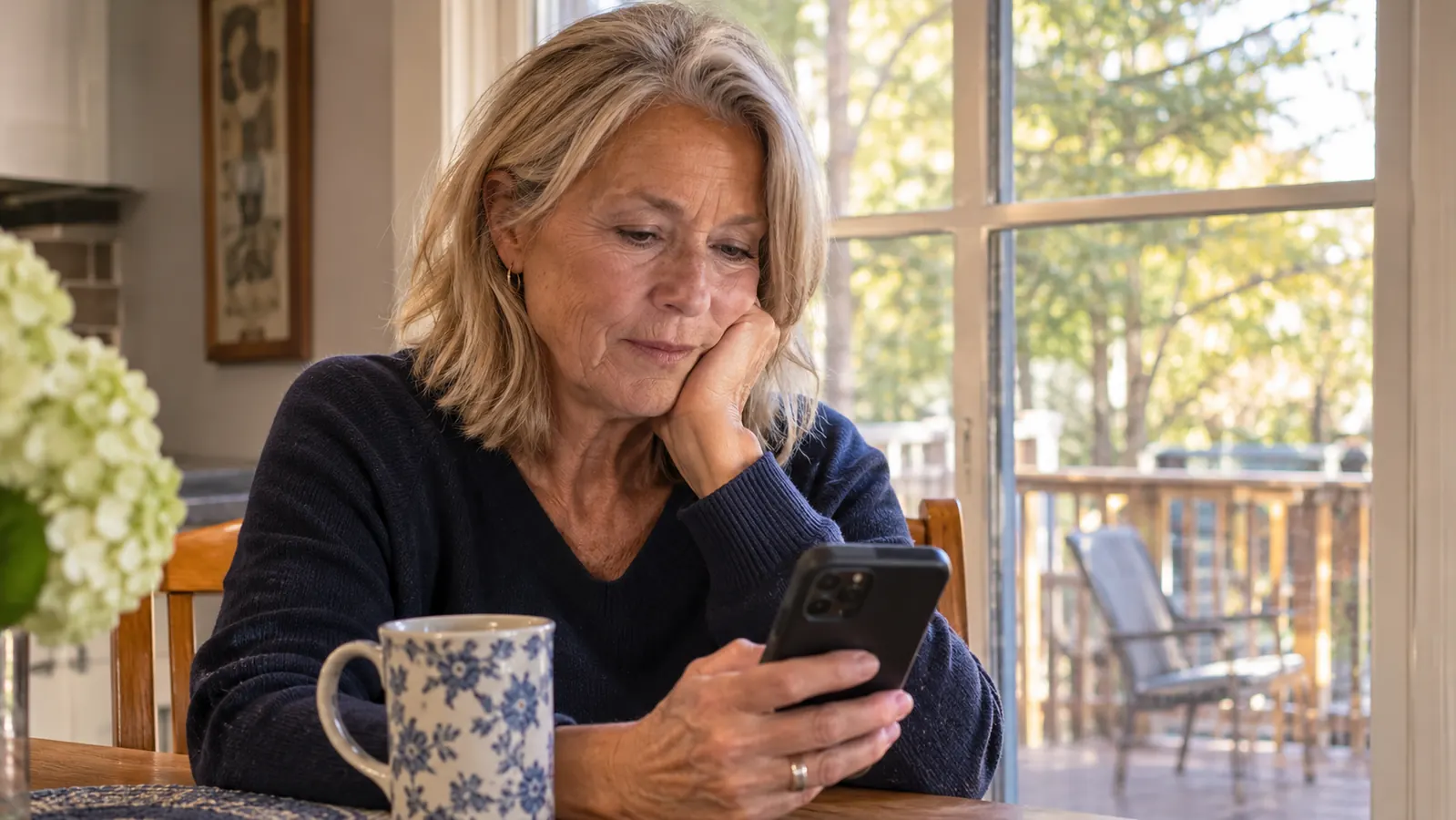
The 2K camera is good enough to see markings, and that is the whole question with a feeder camera. The answer here is yes. You can tell one finch from another on a decent frame, and you can see the red on a cardinal without leaning in and squinting at a phone screen the way I used to. That is the difference between knowing which bird came and thinking you know which bird came.
Night vision is the surprise. I did not expect to care about it. The feeder picks up visitors after dark and I have watched more than one opossum make a nuisance of itself out there. The image is not a photograph and I would not pretend otherwise. It is a look at what is going on, and at my age I will take a look over a guess every time.
What the clips are not is photography. If you want a framed print of a painted bunting, you want the camera on the tripod with the long lens, and you want to be sitting still on the porch for an hour with your coffee going cold. The feeder camera shows you the bird. It does not make a picture of it. I keep both and they do genuinely different jobs, and I would not want to give up either one.
How It Sits Beside My Other Gear
I already had a trail camera strapped to a live oak down by the dry creek bed, and people ask me whether the Birdfy replaces it. It does not. They point at different things. The trail camera is for the ground and the dark and whatever is moving along the creek at two in the morning. The feeder camera is for the post, in daylight, with seed in it. One watches the property and one watches the supper table.
And it does not replace binoculars either. My binoculars are how I find a bird and watch it do what it is doing. The feeder camera is how I find out a bird was there when I was not looking. There is a real difference between watching and logging, and I only understood that after I had both. If you want to see a painted bunting work a cedar branch for ten minutes, use the binoculars. If you want to know one landed at 6:42 while you were in the shower, use the feeder.
What surprised me is how much the two feed each other. The feeder tells me what is around, and then I go out on the porch with the binoculars and look for it. I have caught myself waiting on a clip to load the same way I wait on the kettle. A person could spend a lot of money on worse hobbies, and I have.
What I Liked
- Bird identification with no subscription behind it
- 2K clips clear enough to see markings and settle a finch argument
- Night vision that catches what shows up after dark
- Held the home Wi-Fi at thirty feet for two years
- 1.5 liter seed capacity fits a twice-a-week routine
Where It Falls Short
- The app is chatty and takes about a week to tame
- Confident wrong names on blurry or rain-spotted frames
- Squirrels find it fast and I never did buy a baffle
- The battery wants attention in cold weather
- Not a camera for photographs, only for seeing
Who This Is For
This is for someone who already feeds birds and wants to know what is coming while they are not looking. If you keep a feeder and you have ever found something strange on it and wished you had a record, this solves that specific problem. It is also good for anyone who is porchbound or housebound part of the day and would like the yard to be more interesting than it currently is.
It suits a household with Wi-Fi that actually reaches the yard, and a person willing to check an app the way they check the weather, once in the morning, without resentment. If that is you, the NETVUE is a reasonable place to put your money, and the free identification is the reason I would say so. If you are honest with yourself about the app, you will be happy with it.
Who Should Skip It
Skip it if what you want is photographs. This is a witness, not a camera you will print from, and a feeder camera will never beat a long lens on a tripod for a bird sitting still in good light. Skip it if you want something to leave alone for a month, because the battery and the seed both want you, and a feeder nobody fills is just a post with a camera on it.
And skip it if a chatty app would drive you up a wall and you are not willing to spend a week teaching it what you care about. The birds are worth it. The notifications are the price of admission, and I would rather you know that sitting here than find it out in April with your phone buzzing in your coat pocket.
Find out who eats your seed when you are not watching
Battery powered, 1.5 liters, and identification that never asks for a card. Mine has hung on the same post since September 2024.
Amazon Check Today's Price on Amazon →