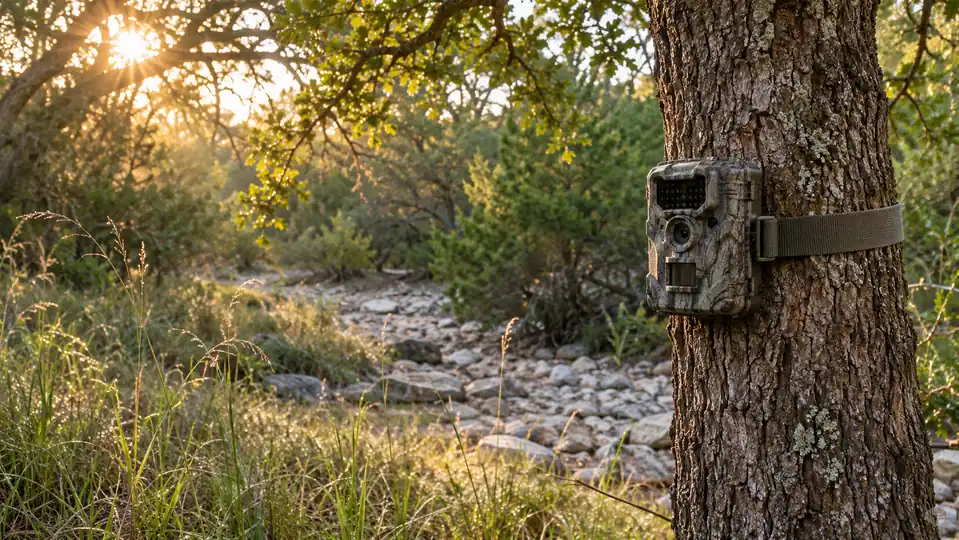
Two trail cameras, one live oak, and about four years of walking out to the same tree with a cup of coffee to see what happened overnight. Here is the short answer. The GardePro A3S is the camera I own, the one strapped to the oak across my dry creek bed since October 2022, and it is the one I would buy again. The WOSPORTS Mini is the camera I would point a neighbor toward if all she wanted was something small on a fence post she can reach without a ladder.
I have never owned the WOSPORTS Mini, and I am not going to pretend otherwise to make this read better. What I know about it comes from the listing, the spec sheet and the photographs, read slowly with a pencil the way I read a seed catalog in January. What I know about the GardePro comes from four years of batteries, weekly card pulls and one gray fox I did not know was using the creek bed until that camera told me.
| GardePro A3S | WOSPORTS Mini | |
|---|---|---|
| Weight | 350 g as listed | Built as a mini, lighter in the hand |
| Fitting a tight spot | Wants a trunk with some room on it | Small enough for a fence post or a gap in the brush |
| Setup | Push-button menu, motion activated, no app and nothing to pair | No app and nothing to pair either, both are non-cellular |
| Low-light sensor | Sony Starvis sensor named in the listing | Not named in the listing |
| Video and sound | 1296P HD video with sound | Sound not advertised in the listing |
| Shooting modes | Time-lapse and hybrid mode listed | Not listed |
| Night illumination | No-glow night illumination | Not stated in the listing |
| Power | AA batteries, or the SP350 solar panel sold separately | Battery powered |
| Best for | Learning what uses a creek bed after dark | A small camera on a post you can reach easily |
Where the GardePro A3S Wins
The GardePro wins the work that happens after dark, and after dark is most of what a trail camera is actually for. Mine runs on AA batteries. It is not cellular and it has no Wi-Fi, which out here matters less as a feature than as a relief, because it means no signal to chase, no account to make and no plan to pay for every month. You push the buttons on the unit, strap it to the tree, and walk back to the porch. The listing names a Sony Starvis sensor for low light, and here is what that looks like in practice: armadillos rooting at eleven at night come out as armadillos, not as gray smears with a suggestion of leg.
It also records 1296P HD video with sound, and the sound is the part I did not expect to care about. A clip of a tom turkey drumming carries something a silent photograph of the same bird cannot. The listing includes time-lapse and hybrid mode, which is what I would use if I ever wanted to watch the creek fill and dry across a whole season instead of one night at a time. The no-glow night illumination matters on my four acres because the creek bed sits close enough to the house that I would rather nothing flashed out there. In four years I have never once felt the camera was bothering the animals, and that is the entire point of watching them.
Where the WOSPORTS Mini Wins
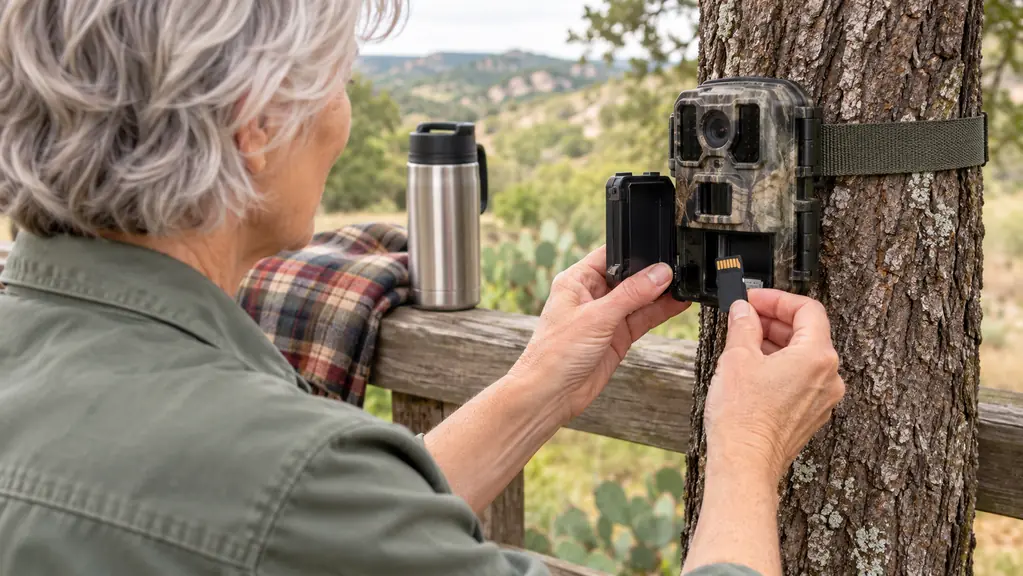
The Mini wins on size and on being easy to live with in an awkward spot, and I will not wave that away. It is built as a small camera, lighter than the 350 g the GardePro lists, and there are places on four acres where that is the difference between getting a camera up and not bothering. A fence post down at the property line. A gap in the brush where the turkeys funnel through. The fork of a cedar where a bigger housing would hang out like a mailbox and sway in a north wind. If your spot is tight, the smaller camera is not a compromise, it is the right tool.
It is also the simpler thing to hand to somebody else. Both cameras are non-cellular, so neither one needs an app or a pairing ritual, and the setup on either is push buttons until the screen says what you want. But a small camera with a short menu is easier to explain over the phone to a friend who has never run one, and easier to check in your slippers with a flashlight in your teeth. If the whole goal is a camera twenty feet from the house that tells you what came through the yard last night, the Mini does that job without asking anything of you.
It was on the tree about two weeks before it showed me a gray fox working the creek bed at night. I had walked that ground for years and never once seen it.
The camera that found the fox in my own creek bed
Non-cellular, AA batteries, no plan to pay for and nothing to pair. It has been on the same live oak since October 2022 and it is still pulling cards every Sunday.
Amazon Check Today's Price on Amazon →What I Ask a Trail Camera to Do
Before I compare anything, here is my whole job description for a trail camera, and it is short. It has to survive a Hill Country summer in a cedar thicket. It has to tell me what is moving between midnight and four in the morning, because that is when the interesting things happen. And it has to make a picture I can identify without squinting, because the point was never art. The point is knowing.
Notice what is not on that list. I do not need anything texted to my phone. I walk out once a week, pull the card and look at it on the laptop while the coffee goes cold. That is not a hardship, it is the best hour of my week. Both of these cameras are non-cellular, so both fit that habit, and neither one is going to wake you at two in the morning to tell you a raccoon is being a raccoon.
The other thing I ask is that the camera not announce itself. One that clicks, whirs or throws light is one that teaches the local deer to walk around it. I have watched the same does come through the same gap for four seasons now, and they treat the oak with the GardePro hanging on it as part of the tree. That took months to earn and I would not trade it for a sharper picture.
The Night Work Is Where They Part Ways
Here is the honest split. In daylight, a small budget camera and a bigger one will both give you a deer. Daylight is easy and nearly everything gets it. The difference lives between dusk and dawn, and that is where the GardePro's listed Sony Starvis sensor and no-glow illumination earn their keep, and where a mini camera is asking a small lens and a small housing to do a genuinely hard job. That is not a knock on the Mini. It is just physics with a price tag attached.
I am careful here, because I have not run the WOSPORTS Mini overnight and I am not going to invent what it does in the dark. What I can say plainly is what its listing says: no low-light sensor named, sound on video not advertised, time-lapse and hybrid mode not listed. None of that makes it a bad camera. It makes it a camera whose case rests on being small, simple and easy to own, which is a real case. It simply is not the case I needed. My questions all happen after the porch light goes off.
The Battery and Card Routine Nobody Warns You About
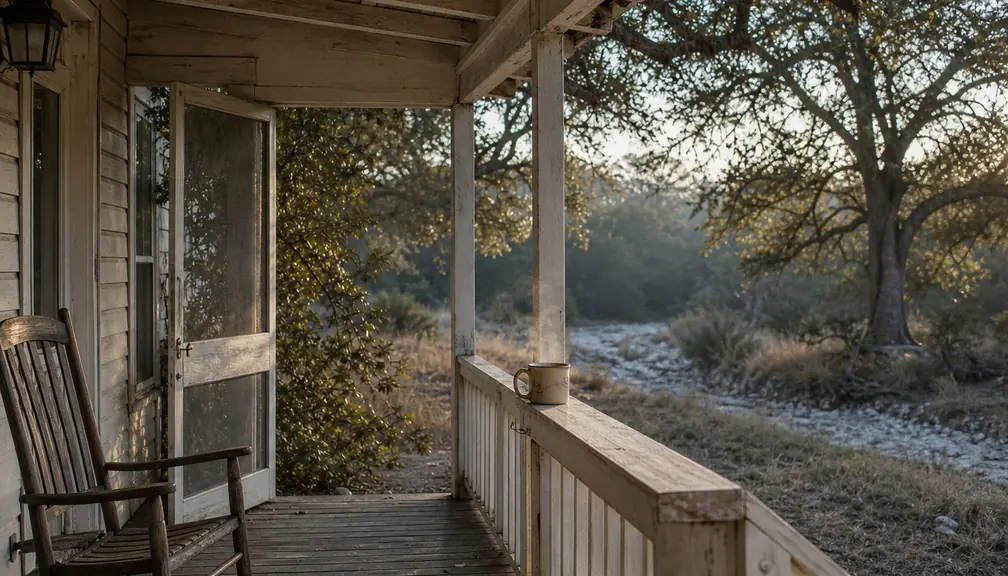
The GardePro runs on AA batteries, and the listing offers a solar option with the SP350 panel sold separately. I have never bought the panel. I keep a strip of fresh batteries in the kitchen drawer and swap them when a card pull suggests I should, and that routine has held for four years on one tree. At 350 g it is a two-hand job to hang and not a project, which matters when you are sixty-three and doing it in the dark before the coffee is finished.
The card is the other half of the whole arrangement. Non-cellular means no plan, no signal, no subscription, and it also means the camera is a dumb box that holds your week until you go get it. Some people hate that. I like it. It is the same reason I still write down what I see in a paper notebook instead of typing it into my phone, and the same reason I would rather hear a turkey drum than read a notification about one.
What Four Years on One Tree Taught Me
The white-tailed deer are the least interesting thing on the card, and I say that with affection. They come through so often that I have stopped counting. The turkeys are better company, especially in a cold snap when the whole flock scratches through the leaf litter under the oak like a crew of tiny rakes. The armadillos are the comedians, always arriving nose first and leaving in a hurry. And the fox, the fox is the reason I keep walking out there.
None of that is a story about a camera. It is a story about putting one in the right place and then leaving it alone for a long time. Whatever you buy, the placement will matter more than the model. Waist height, across a trail rather than down it, clear of grass that moves in the wind, and off the porch sightline so you do not spend the winter sorting through your own comings and goings.
What Neither Camera Will Do for You
Neither one will fix a bad angle. If you point a camera at a tree trunk six feet away, you get four hundred photographs of a tree trunk. My first week with the GardePro taught me that at my own expense, and I moved it that weekend. Neither camera will make a moving armadillo sharp at midnight, and neither will run happily through a blue norther on tired batteries. Those limits are the same for a mini camera and for mine.
And neither will tell you what you are looking at unless you learn your own ground. The gear is the easy part. The hard part is walking the same four acres enough times to know which gap the turkeys use, where the fox crosses, and which direction the deer come from when the wind is out of the north. That knowledge is free and it takes a year.
Who Should Buy Which
Buy the WOSPORTS Mini if the camera is going somewhere awkward and close. A fence post, a feeder leg, a gap in the brush, a spot you can reach in your slippers. It is a sensible first camera for a grandchild, a sensible second camera for a spot you check daily, and a sensible choice if you want the smallest and least expensive thing that will still tell you what came through the yard.
Buy the GardePro A3S if your questions happen after dark, if you want sound with your video, and if time-lapse across a season appeals to you more than a still frame. That is what I use it for, and four years in it has not given me a single reason to look at anything else. It is on the same live oak this morning, facing the same creek bed, and I will pull the card on Sunday like always.
Four years, one tree, still the camera I reach for
Sony Starvis sensor for the night work, 1296P video with sound, time-lapse and hybrid mode, AA batteries with no plan attached. Mine has been out there since October 2022.
Amazon Check Today's Price on Amazon →