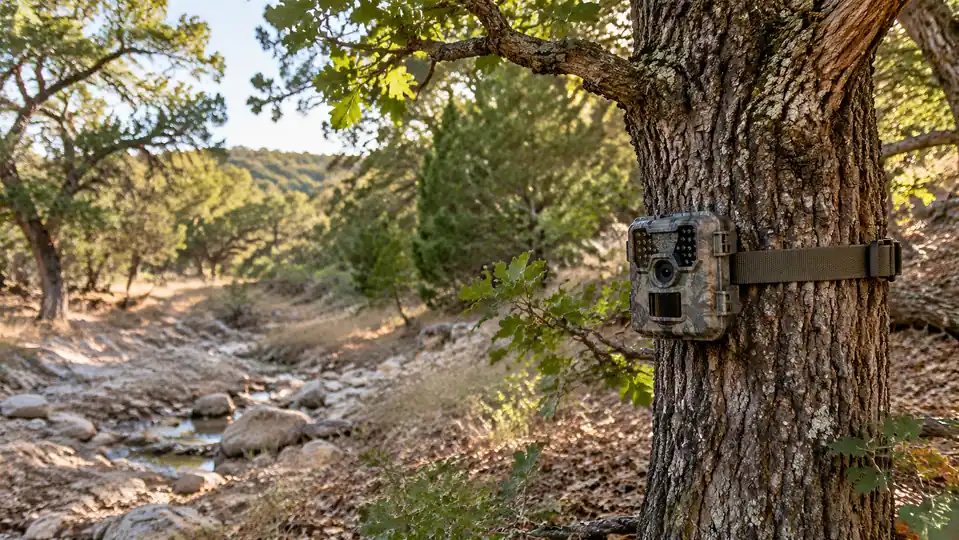
I bought the GardePro A3S in October 2022 for one reason. Something was using the dry creek bed behind my house at night, and I wanted to see it without sitting on the porch in the dark. Four years later, the camera is still strapped to the same live oak, about waist height, facing across the creek bed. It has never been pointed at the porch. That is the whole setup. No solar panel, no phone connection, no subscription. I walk out with my coffee once a week, pull the card, and look at the clips on my laptop.
Most reviews of the GardePro A3S read like the listing. They tell you it records 1296P HD video with sound, that it uses a Sony Starvis sensor, and that it is non-cellular and non-WiFi. All of that is true. What they do not tell you is what the camera is like to own after the first week, when the novelty wears off and it is just a small camera on a tree. This is that part. I am 63, retired after 31 years as a flight attendant, and I live on four acres outside Kerrville, Texas. I am not a professional photographer. I am a woman who likes animals and wants to know what walks through her land at night.
The Quick Verdict
A patient, reliable night watcher for people who do not mind walking out to fetch the card. The night clips are worth it. The weekly sorting is the tradeoff.
Amazon Check Today's Price →If You Want to Know What Crosses the Creek Bed, Start Here
The GardePro A3S is the camera I still use four years in. It runs on AA batteries, records 1296P video with sound, and has no phone connection to fuss with. Check the current price and the full listing on Amazon.
Amazon Check Today's Price on Amazon →How I've Used It, and What Four Years Actually Looks Like
The camera is strapped to one live oak at the edge of the dry creek bed. I put it at about waist height because that is where I could reach it without a ladder. The strap has stayed. The camera weighs 350 grams, so it does not sag or pull to one side. I aimed it across the creek bed, not toward the house, and I have not moved it since. The controls are push buttons. I pressed the buttons to set it up, chose motion detection, and closed it up. Most weeks I do not touch it at all.
The first two weeks, it showed me a gray fox. I had lived on this land for years and never knew a fox was using that creek bed. The clips were at night, black and white, the fox moving along the edge of the frame. That was the moment the camera earned its place on the tree. Since then I have seen deer, turkeys, armadillos, and a raccoon I did not know was around. The fox still shows up, though not on any schedule I can predict.
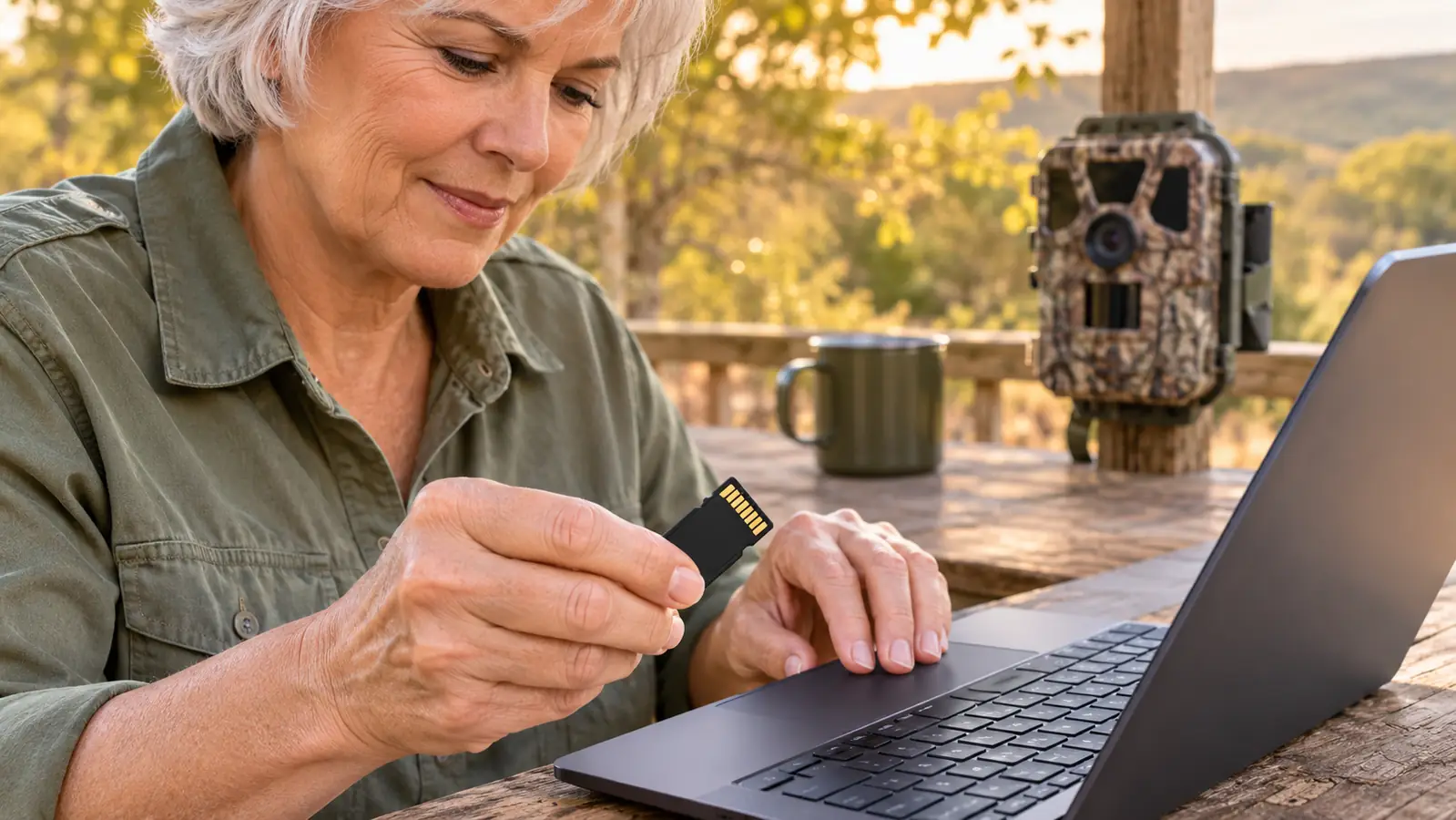
The weekly routine is simple. I walk out with my coffee, open the camera, take the card inside, and put a fresh one in. Then I sit at the kitchen table with my laptop and go through the clips. I keep a folder for each month. I delete the branches and the blank clips. I save the fox, the turkey hens, and anything I cannot identify. The work is not the camera. The work is the sorting. Nobody tells you that part.
I have never lost a clip to a dead battery or a full card because I check it every week. That is not luck. It is the routine. The camera has sat through four years of Hill Country weather, from summer heat to cold snaps, and it is still on the same tree. I am not gentle with it. I am just consistent.
What Nobody Tells You About the Night Vision
The night vision is no-glow. That means the camera does not light up the scene with a visible red glow, so the animals go about their business. I have watched deer stand in front of it without flinching. The fox does not look at the camera. That matters more to me than any resolution number. A camera that spooks the wildlife is a camera that shows you the back of a deer.
What nobody tells you is that no-glow does not mean daylight clear. The night clips are black and white. The Sony Starvis sensor helps in low light, and the edges of the frame are clearer than I expected. But a fox moving close to the camera is still a blur of legs and eyeshine. An armadillo rooting at the edge of the frame is a shape you learn to recognize. If you want color at night, this is not that camera. If you want to know what is there, it does the job.
The A3S records 1296P HD video with sound. I did not think I would care about the audio. Most of it is wind, crickets, and the occasional snap of a branch. But one night I heard a fox make a sound I had never heard before, a sharp little bark, and I would have missed it without the sound. That is the kind of detail that keeps me walking out there every week.
The no-glow part also means you will not see a red glow from the house. I cannot see the camera working from the porch. I only know it is working when I pull the card. That is a small thing, but it matters. It keeps the camera out of the animals' attention and out of mine. It just sits there and watches.
The Battery Life Question, Answered Without Guesswork
The listing says the camera runs on battery power, or on solar with the SP350 solar panel, which is sold separately. I have never bought the panel. The camera sits under live oaks, so the sun is patchy even in summer. I run it on AA batteries. The spec sheet says 1.5 watts and 12 volts of direct current. I do not pretend to understand the electrical math. What I understand is that the camera is non-cellular and non-WiFi, and GardePro says that means minimal power use and fewer battery changes. That matches what I have seen.
I do not have a precise number of months per set of batteries. I change them a few times a year, more often in a cold snap. The camera does not notify me when they are low, so I pay attention to the clips. When the clips start to thin or the camera misses a week, I change them. That is not a fault of the camera. It is the tradeoff of a camera that does not connect to anything.
The battery question is really a habit question. If you can remember to check the camera, you will be fine. If you need a notification on your phone, this is the wrong camera. The same goes for the card. You have to walk out and get it. For me, that walk is part of the pleasure. For someone else, it is the reason to buy something else. I would rather say that plainly than pretend the camera is something it is not.
I thought about the solar panel more than once. The SP350 is sold separately, and it would save me some battery changes. But the live oaks shade the camera for most of the day, and I did not want to move the camera to chase sun. So I stayed with AA batteries. That is a choice, not a flaw. If your camera gets real sun, the panel is there for you.
The Setup Is Simple, and That Is the Point
The setup is simple, and that is the point. There is no account to create, no app to pair, no subscription to renew. The controls are push buttons. I pressed the buttons to set it up, chose motion detection, and closed it up. I have used motion detection most. The camera also has time-lapse and hybrid mode. Time-lapse would be good for a fixed view of a nest or a feeder. Hybrid mode is there if you want both scheduled and motion clips. I have not used either much because motion detection already gives me more clips than I can sort.
Mounting took one strap and about a minute. The camera is light at 350 grams, so I did not need Paul to help me. I aimed it across the creek bed and left it. The first week I checked it every day. Then I settled into once a week. That is the rhythm of the thing. It sits. It waits. I walk out. I look. I put it back.
What nobody tells you is that simple is not the same as instant. You still have to walk out, open the camera, and bring the card inside. There is no phone connection to bail you out. In July, that means heat and mosquitoes. In January, it means a coat. I still go. But I plan for it. If you are the kind of person who wants to check a camera from the kitchen, this is not the one.
The first time I set it up, I got the aim wrong. I had it pointed too high, and the clips showed mostly sky and the top of the creek bank. I moved it down a few inches and left it. That was the only adjustment. The camera does not need a phone or a manual to aim. You press the buttons, you take a test clip, and you look at it on the laptop. Then you leave it alone.
Where the GardePro A3S Falls Short
The biggest limitation is the one the listing states plainly. The GardePro A3S is non-cellular and non-WiFi. You cannot check it from the house. You cannot get a photo on your phone the moment something walks by. That is the whole design. It is also the reason the battery lasts. I knew that when I bought it, and I would buy it again. But I want you to know it before you order.
The second limitation is the sorting. A week of clips can be fifty files or two hundred, depending on the wind and the armadillos. Most of them are branches. The camera does not tell you which clips matter. You learn to scan quickly. You learn to delete whole folders. You learn that a moving branch can look like a deer for half a second. That is not a defect. It is what a motion-activated camera does.
The night clips are black and white. The audio is mostly wind and insects. If you want a live view from your kitchen, this is not that camera. If you want color at night, this is not that camera. If you want a small, patient camera that records 1296P video with sound and does not need a subscription, this is exactly that camera. I would rather have the honesty of the limits than a list of features that do not matter.
The one thing I would change is the lack of a quick check. I would love to know if the camera is still running without walking out. But that would mean a cellular model, and a cellular model means a subscription and more batteries. I chose the simpler thing. Four years in, I still think it was the right choice for me. It may not be the right choice for you.
What I Liked
- No-glow night vision that does not spook the fox or the deer
- 1296P HD video with sound
- Non-cellular and non-WiFi, so no subscription and minimal power draw
- Push-button controls and a simple strap mount
- Light at 350 grams, easy to hang alone
- AA batteries, with an optional SP350 solar panel sold separately
Where It Falls Short
- No phone connection, so you must walk out for the card
- Night clips are black and white, not color
- You will sort a lot of blank or branch clips
- Audio is mostly wind and insects
- The solar panel is sold separately
The first two weeks, it showed me a gray fox using the creek bed. I had lived here for years and never knew.
Who This Is For
This is for the person who wants to know what happens at night on their own land and does not mind a weekly walk. A hobbyist. A retiree. Someone with a creek bed, a fence line, or a back acre that gets quiet after dark. If you like the ritual of pulling a card and sitting down with coffee, the GardePro A3S fits. It is also a good first trail camera because it does not ask you to learn an app or pay for a plan. You strap it on, you walk out, you look. That is the whole relationship.
Who Should Skip It
Skip it if you need a photo on your phone the moment it happens. Skip it if you travel and want to check a camera from another state. Skip it if you want color night footage or a live view. This camera is not that. It sits on a tree and waits. It does not notify you. It does not connect to anything. If that sounds like a limitation, it is one. I would rather you buy the camera that fits your life than the one that fits mine.
The Camera I Still Walk Out to Check, Four Years Later
If the weekly card pull sounds like a ritual you would enjoy, the GardePro A3S is worth a look. It is non-cellular, runs on AA batteries, and records 1296P video with sound. Check today's price and the full listing on Amazon.
Amazon Check Today's Price on Amazon →