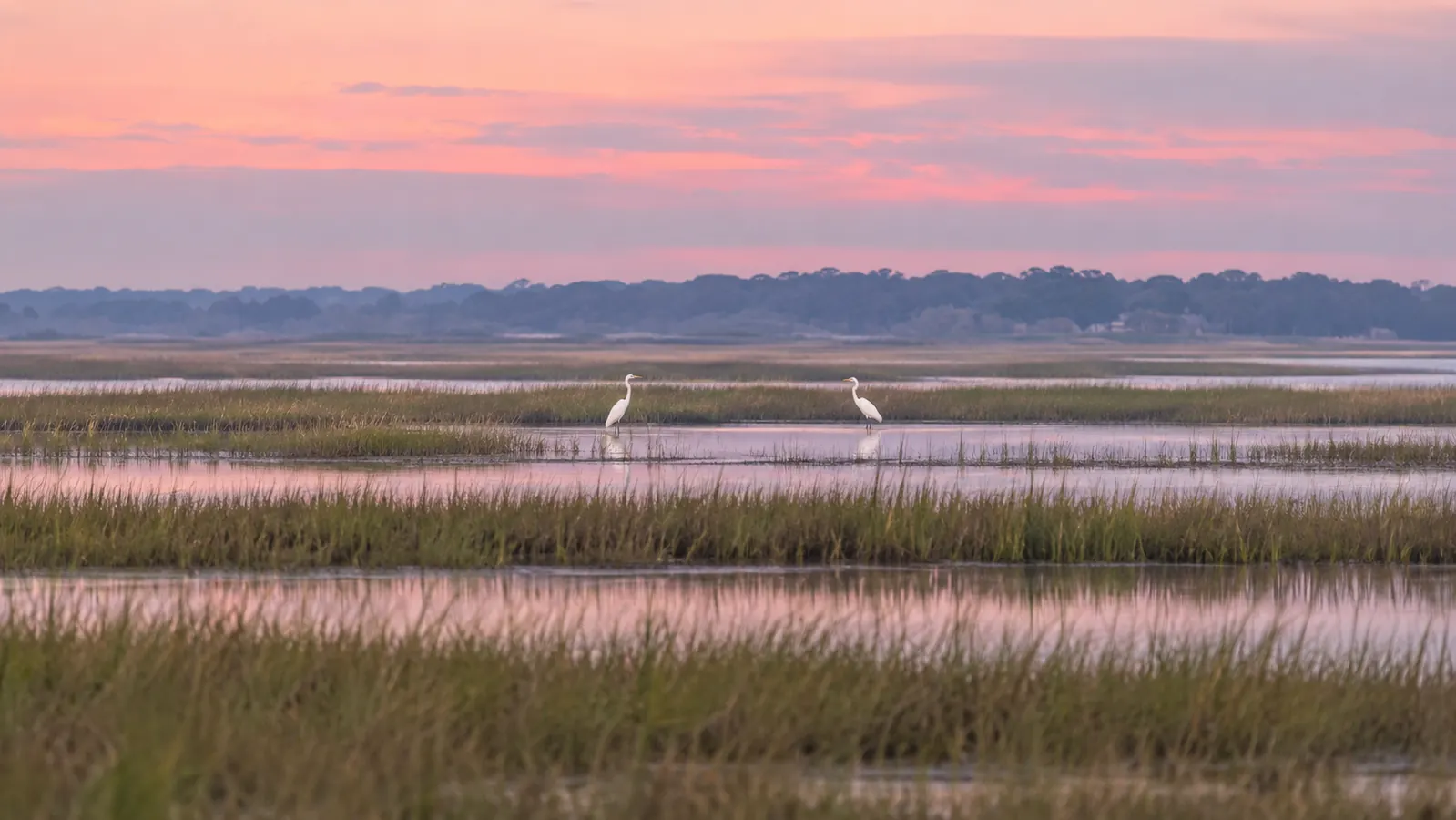
The first whooping crane I ever saw was a white smudge with legs. I was on a viewing platform at Aransas, wind coming off the marsh, and the birds were so far out that my binoculars gave me a shape and nothing else. Thirty-one years of flying and I had never once looked that hard at something I could barely see.
I came home from that January trip with a mosquito bite on my ankle and a burr in my mind. What I wanted was not a stronger pair of binoculars. I wanted to sit in one place and bring the far shore to me. That is the entire job of a spotting scope, and it took me until December 2023 to buy one: the Gosky 20-60x60, with a small tripod, a carrying bag and a phone adapter in the box.
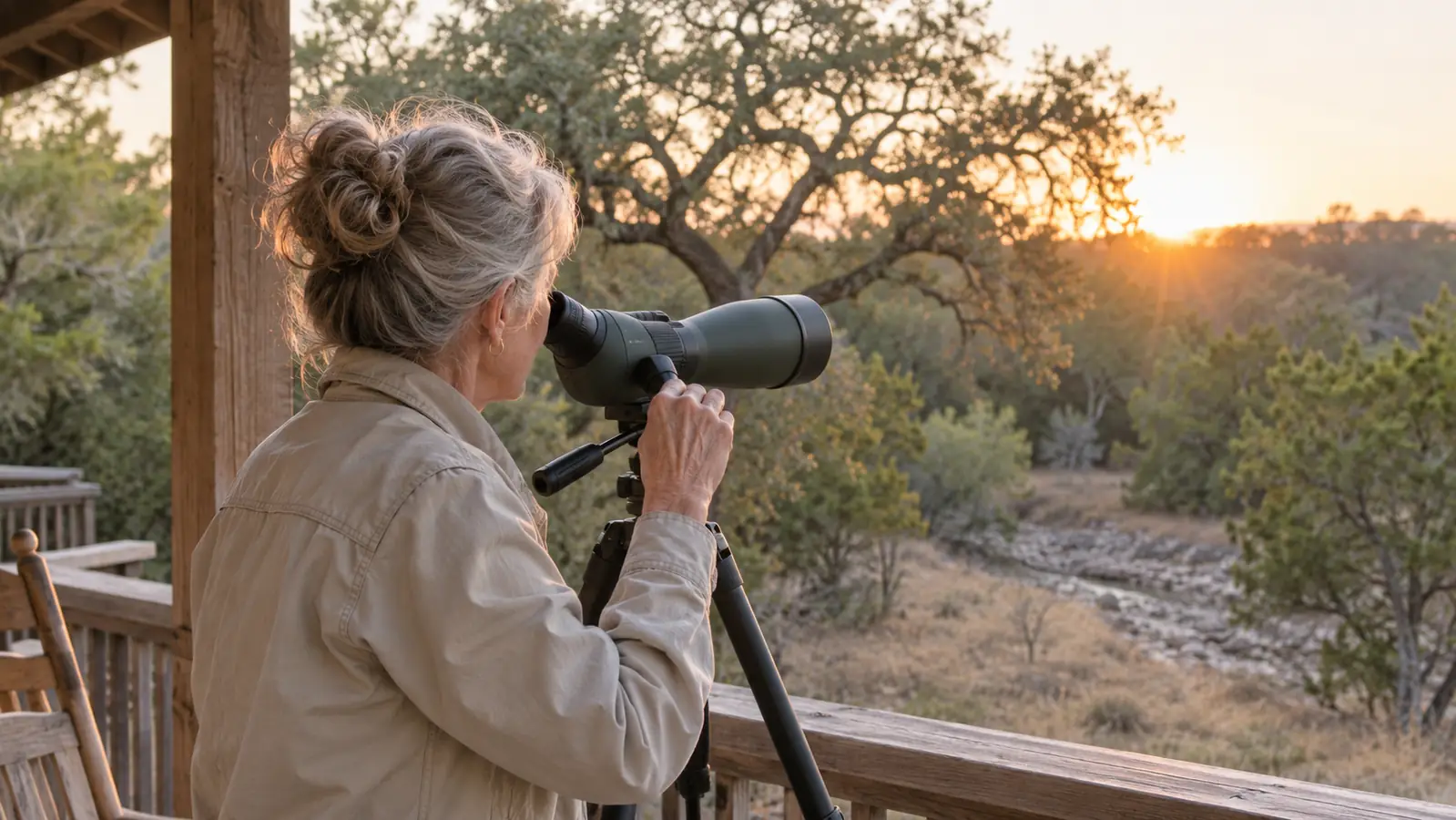
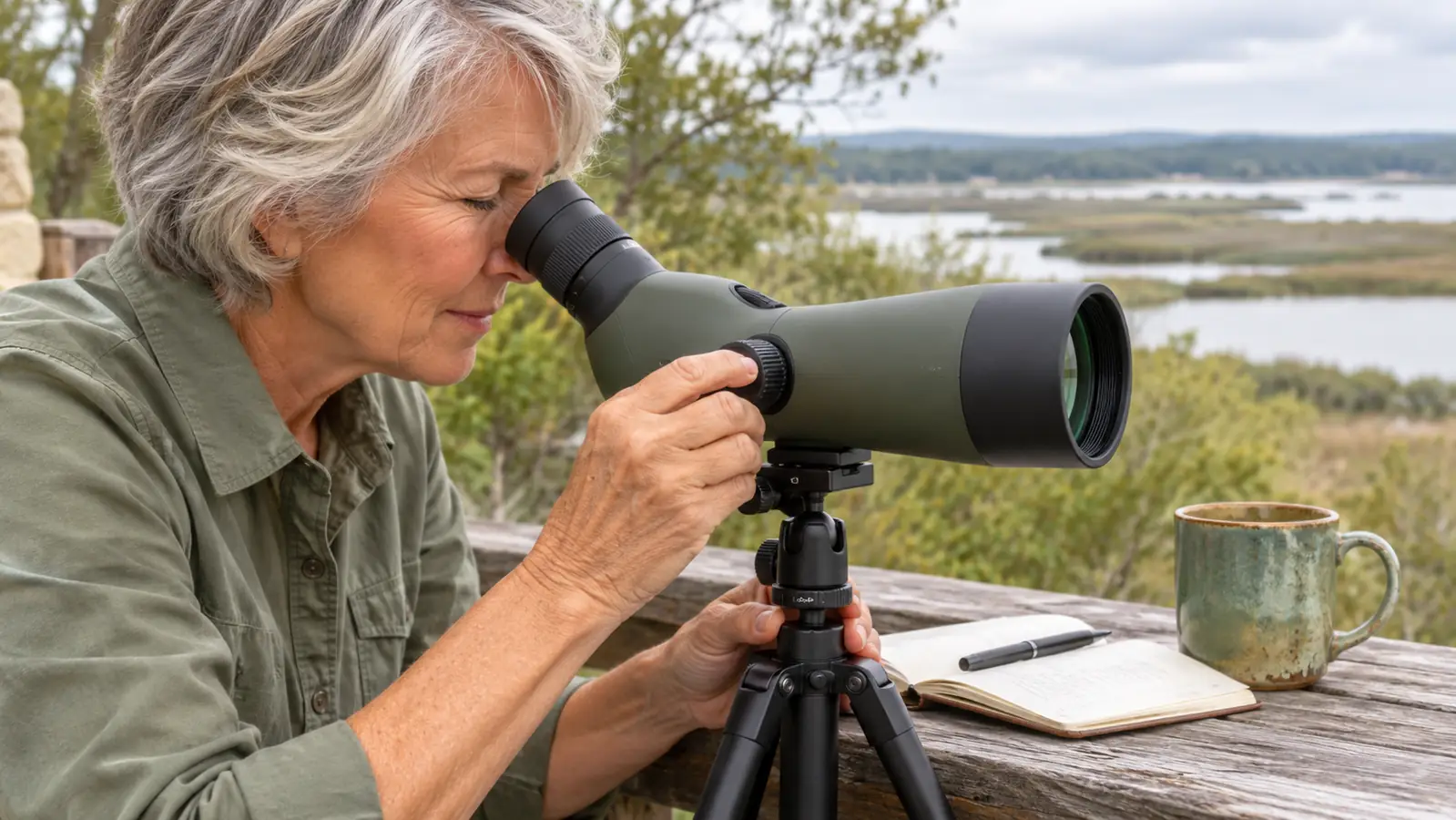
A scope stops being a mystery the minute you hold one. This one zooms from 20 power to 60 power. The eyepiece sits at a 45 degree angle, so I look down into it instead of straight through, and after all those years in a jump seat with my neck folded sideways, that angle is the difference between watching for an hour and quitting after ten minutes. The scope weighs 2.6 pounds, so I can carry it from the porch to the Outback without thinking about it.
Focus is a wheel you turn by hand. The bottom has a tripod mount, and the included tripod means you are set up in about a minute. The 60mm front lens is fully multi-coated, the body is waterproof per the listing, and the field of view runs from 110 feet at a thousand yards down to 50 feet as you zoom in. In plain terms: wide and bright at 20 power, narrow and dimmer at 60.
I set it up on the back porch the week it arrived and pointed it at the dry creek bed where the trail camera had been catching a gray fox. I found the fox in about four minutes. I lost the fox in about four more, because I had the zoom cranked all the way up and the small tripod was doing what small tripods do in a Hill Country breeze.
At 20 power the marsh opens up and the cranes become birds. Past 40 power the wind starts winning.
See What Binoculars Leave as a Blur
The Gosky 20-60x60 comes with the tripod, the carrying bag and the phone adapter, so you can be watching from your own porch the same week it arrives.
Amazon Check Today's Price on Amazon →The phone adapter is the part I almost gave up on. You clamp the phone over the eyepiece and line the camera lens up with the center of the view, and my first several tries gave me a beautiful photograph of the inside of the tube. Then it clicked, and now I take a picture of whatever I am watching without losing my place. My phone is an ordinary iPhone and it does fine.
Storage is simple. The Gosky lives in its bag in the hall closet next to the coat rack, and the little tripod stays in the bag with it. I have never had to baby it. It has ridden in the back of the Outback to Lost Maples, to South Llano River and to the coast three times now, and it still lines up true.
The Morning at Aransas Where It Paid for Itself
January 2024, my second trip to the coast and the first one with the scope. Paul and I took the boat tour that year, and we also spent a long while at the public viewing spots. At 20 power I could see the cranes standing in the shallows with their legs in the water. Somewhere around 30 to 40 power I could see the bands on their legs and the rust colored patches on the young ones. I did not need more than that. I stayed between 20 and 40 almost the whole trip.
At 60 power the image does get dim, and it gets shaky, and I would be lying if I said I use it much. On the coast the wind never stops. The tripod that comes with the scope is fine on my porch and outmatched on a marsh boardwalk, so in April 2024 I bought a sturdier travel tripod and moved the scope onto that for the coast. The small one still lives in the bag and still does porch duty.
What It Changed, and What It Did Not
It did not turn me into a photographer. I still have one older mirrorless camera and one zoom lens, and I have never sold a picture. What the scope changed was how long I am willing to sit still. When the far side of the marsh is a smudge, you leave in twenty minutes. When you can count legs and follow a bird as it walks, you stay two hours and forget your coffee.
One morning last winter I had it pointed at the creek bed and a wild turkey came through with nine poults, and I watched them work the gravel for twenty minutes. That is not a rare bird. It is a common bird seen properly, which is a different pleasure and one I had been missing for sixty years.
It also rearranged my porch mornings. The binoculars still hang by the back door and they are still what I grab to find something moving in the cedar. The scope is what I go get once I know where to look. That order has not changed in nearly three years.
What I'd Tell You If We Were Sitting at My Kitchen Table
I would tell you a scope is not a better binocular. It is a different tool, and the difference matters more than the numbers on the box. If you want to walk a trail and find birds, keep your binoculars and be happy. If you want to sit in one spot and study something a quarter mile away, a scope earns its place. Get the tripod situation sorted early, because a scope on a wobbling tripod is worse than binoculars. Stay between 20 and 40 power unless the air is dead calm. Use the phone adapter even when it frustrates you, because the picture is what you will still have in February when the cranes are gone. And do not wait until you own better gear to start watching. I waited until I was sixty to see a whooping crane properly, and I would like that year back.
Start With the One That Comes Ready to Set Up
Scope, tripod, bag and phone adapter in one box. Mine has been to three coastal trips and two state parks and still does porch duty most mornings.
Amazon Check Today's Price on Amazon →