The first whooping crane I ever saw through glass was a white smudge on a far mudflat at Aransas, and I spent most of that morning arguing with my binoculars about it. Binoculars are wonderful for finding things. They are not wonderful for studying a bird a quarter mile out that has no intention of coming any closer. By the time Paul and I drove home from that trip, I had ordered the Gosky 20-60x60 spotting scope, and I have had it pointed at cranes, deer, turkeys and one very patient armadillo ever since.
That was December 2023. I have owned this scope for nearly three years now. It has made three January trips to the Texas coast with me and a great many ordinary mornings off the back porch here outside Kerrville. It is a modest piece of glass with a specific job, and I want to tell you exactly where that job stops, because the product listing will not. The Gosky is the reason I stopped squinting at white smudges, and it is also the reason I finally bought a second tripod.
The Quick Verdict
A light, genuinely useful 20 to 40x scope for watching birds and deer at distance, and the accessories mean nothing extra to buy before your first trip. The top of the zoom range is dimmer and shakier than the box suggests, and the included tripod is the weak link.
Amazon Check Today's Price →Stop squinting at white smudges on the far mudflat
The Gosky 20-60x60 comes with the tripod, the carrying bag and the phone adapter, so there is nothing else to buy before your first morning out.
Amazon Check Today's Price on Amazon →How I've Used It: Three Winters and a Lot of Porch Mornings
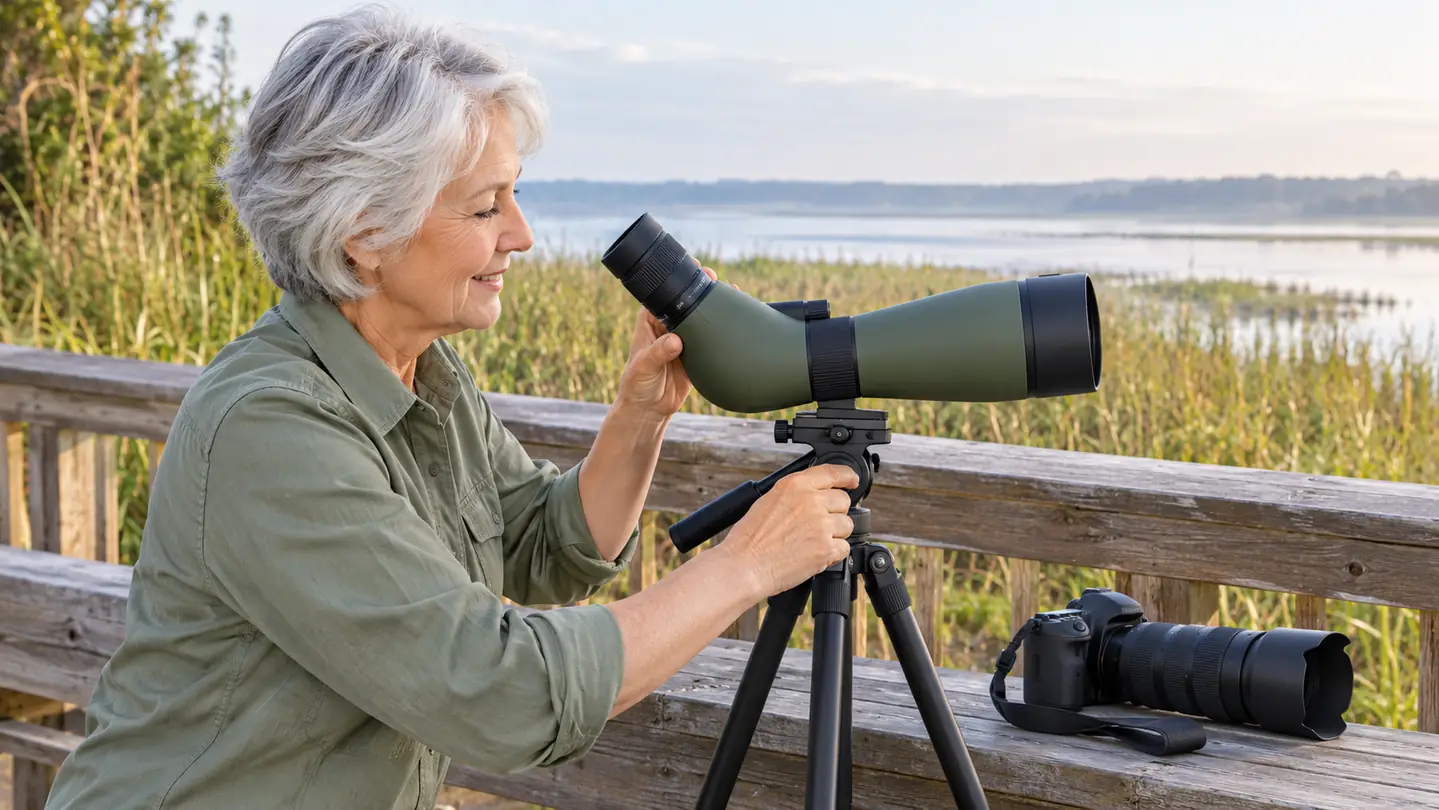
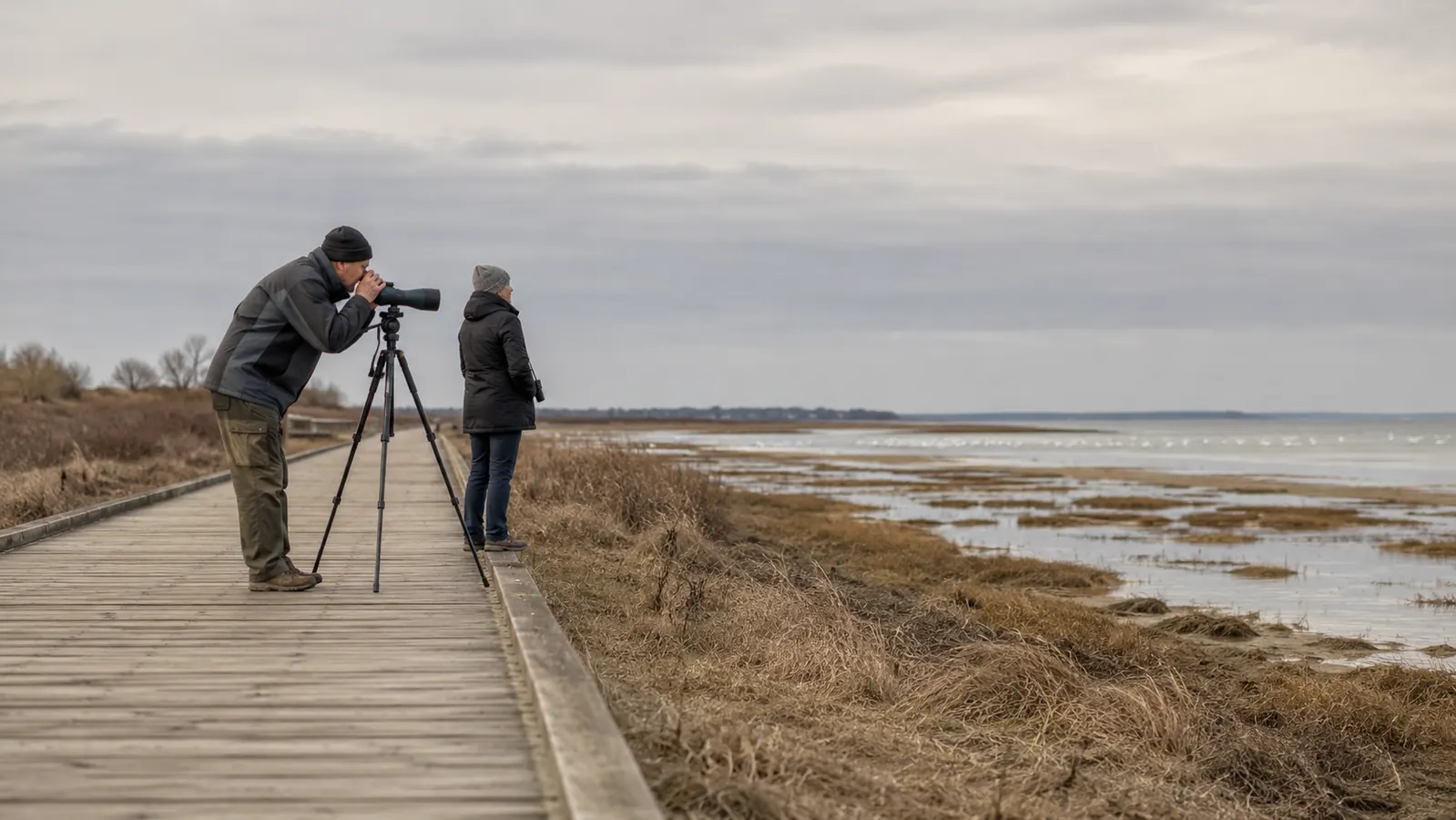
I bought it specifically for the whooping cranes. Aransas is a once a winter trip for us, two nights, in January, and we go in 2024, 2025 and 2026. The cranes are out on the flats and the salt marsh, and you view them from public spots, at a respectful distance, which is exactly the situation a spotting scope exists for. My routine is not complicated. I carry the scope in its bag in one hand, the tripod in the other, walk out to a viewing platform, sit down on the bench, and look at birds I could not otherwise identify. Through the Gosky I could finally see legs, the shape of the bill, the slow way they feed. That is the whole reason I own it and it has never let me down on that count.
Our first morning there in January 2024 the platform was crowded and cold, and the cranes were a long way out past the shallow water. I set the tripod feet on the bench beside me instead of on the railing, which cut most of the wind shake, and then worked slowly across a scattered group of about a dozen until I found three standing close enough together to study properly. I watched one of them feed for eleven minutes by my watch, lifting that long bill and setting it back down, and I have not forgotten it. That is the sort of thing the binoculars could never give me.
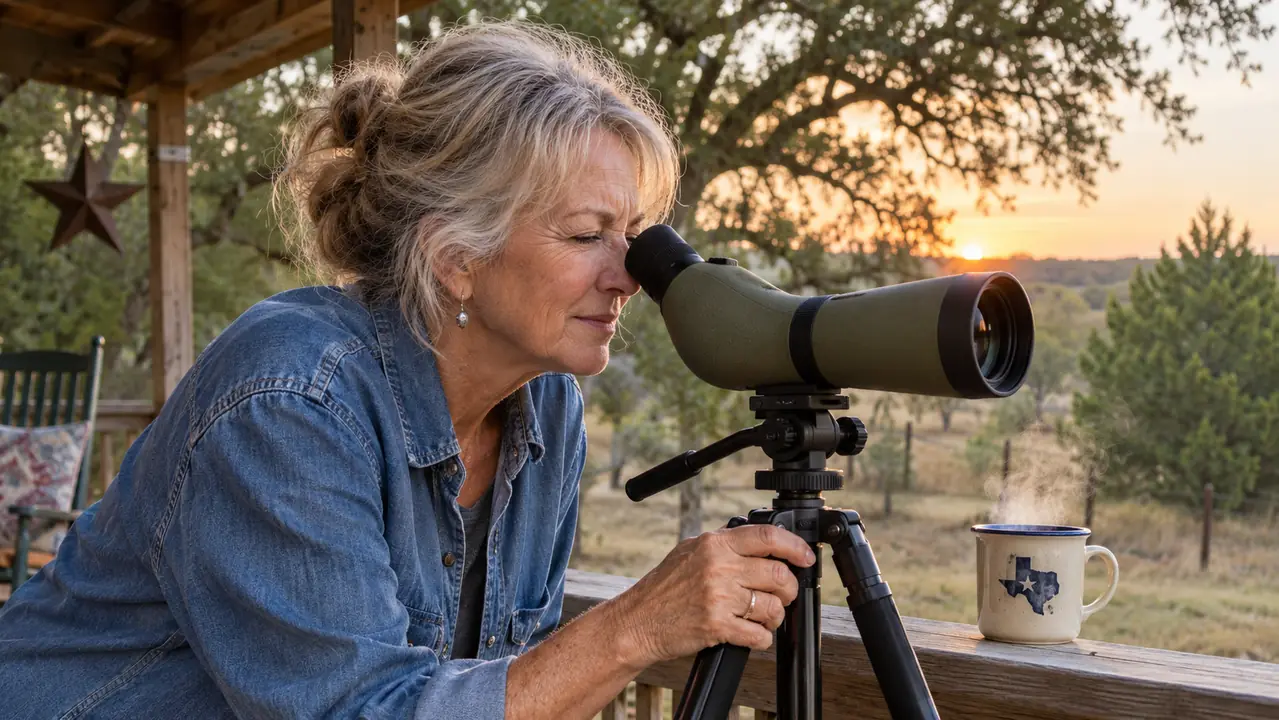
At home it earns its keep differently. My binoculars stay on a hook by the back door and they handle anything inside fifty or sixty yards, which is most of what happens on four acres. The scope comes out for the far fence line, for the far end of the dry creek bed, and for the deer that stand at the edge of the cedar in the last twenty minutes of light when I want to know whether that is the same young buck I saw in October. It sits on the porch rail on its tripod, and I sit in my chair, and the angled eyepiece means I am looking down into it rather than crouching behind it.
Storage is unglamorous. It lives in its bag in the hall closet between outings, next to the bag with the trail camera cards. It is not a thing I leave assembled on the porch, because the weather here turns and because I would rather it lasted.
What 20-60x Actually Looks Like at the Water
Here is the honest part, and it is the part I would want if I were you. At 20x this scope is a pleasure. The view is bright, and the field of view runs wide enough that I can find a crane in a scattered group without hunting for ten minutes. The listing puts the field of view between 50 and 110 feet at 1,000 yards across the zoom range, and that matches what I see: generous at 20x, tight at 60x.
Most of my looking happens between 20x and 40x. At 40x, on a still morning, I can make out the band on a bird's leg and tell a juvenile from an adult by the plumage. That is plenty for me. Past 40x the image starts to dim, and any breath of wind turns it into a gentle earthquake, and I find myself backing off again. At 60x on a grey coastal afternoon I can see more magnification and less bird. I do not consider that a defect exactly, because every scope in this class behaves the same way in bad light. I consider it a fact the marketing does not lead with.
The far fence line here is about three hundred yards from my chair, which is a useful number to keep in your head when you read magnification claims. On an October evening with the light going, at 30x, I can tell a young buck from a doe at that fence line. At 20x I can count the deer and nothing more. That is the honest spread, and it tells you more about what this scope is for than any spec sheet will.
The practical lesson took me one trip to learn. Set the scope at 20x, find your bird, get it centered, and only then zoom in. If you start at 60x you will spend a long time looking at empty water and wondering what you are doing wrong.
The 45 Degree Eyepiece, the Manual Focus and the Reflex Finderscope
The 45 degree angled eyepiece is the single most comfortable thing about this scope. A straight scope forces you to crouch or to raise the tripod to face height, and after twenty minutes of that my neck is done. With the angled eyepiece I sit on a bench, or stand with the tripod a little lower than eye level, and look down. On a two hour morning at a viewing platform that difference is everything. It is also easier for Paul, who is a few inches taller than me, because he only has to lean rather than fold himself in half.
Focus is manual, and simple. There is a focus adjustment you turn until the bird snaps in, and after that it holds. Zooming changes the focus a little, so I refocus after I zoom, which becomes automatic after a while. If you are used to autofocus on a camera this will feel primitive for about one morning and then it will feel like a virtue, because nothing is hunting around while a crane feeds.
There is a reflex finderscope on the body for rough aiming. I use it the way I use a sight on a rifle, though far less precisely: get the barrel pointed where I think the bird is, glance at the finder, then go back to the eyepiece. One January morning I lost a crane while zooming, because it walked behind a hummock of marsh grass just as I turned the ring. Rather than sweep the whole flat from scratch, I lifted my head, checked the finder, put it back on the hummock, and had the bird again in about ten seconds. At the coast, where every patch of marsh looks like every other patch of marsh, that little finder earns its place.
The Included Tripod, and the Trip I Finally Swapped It
The scope arrives with a small tripod, and for porch use it is completely fine. It is light, it sets up in seconds, and at 20x to 30x on a calm morning it holds steady enough that I can watch a turkey work its way along the creek bed without complaint. If all I ever did was watch from my own rail, I would never have thought about it again.
The coast is a different matter. On a viewing platform with wind coming off the water, the little tripod transmitted every gust straight into the eyepiece, and at higher zoom the bird boiled in the view. Before I bought anything I tried the usual trick of hanging my bag from the center hook to add weight. It helped a little on the porch and not at all on the platform, because there the shake was coming from the wind rather than from the rig. After that January 2024 trip I bought a K&F Concept 64 inch travel tripod, which is steadier, taller, and lets me stand up straight instead of perching. It rides in the back of the Outback in its bag and it now holds the scope at Aransas and holds my camera and long lens on the porch. Both tripods still live here. The small one is honestly fine for the deck.
What I Liked
- Bright, easy to use view at 20x, which is where most watching actually happens
- 40x is still sharp enough on a still morning to read a leg band or judge plumage
- The 45 degree angled eyepiece means sitting or standing comfortably instead of crouching
- Comes with the tripod, the carrying bag and the phone adapter, so there is no second shopping trip
- 2.6 pounds and about 12.6 inches long, easy to carry to a viewing platform in one hand
- The waterproof design has handled coastal mist and damp mornings without a problem
- Manual focus stays where you set it, which matters when a bird is feeding slowly
Where It Falls Short
- 60x is dim and shaky in real conditions. I mostly stop at 40x
- The included tripod wobbles in coastal wind, which is why I bought a taller one
- The phone adapter takes patience to line up over the eyepiece
- At the top of the zoom range the field of view is narrow enough that finding a moving bird is fiddly
- It is a hobbyist scope, not something I would hand to someone expecting crisp detail at maximum zoom
At 20x I can find a crane in a scattered group and see the shape of its bill. At 60x I mostly get a dimmer, shakier version of the same bird. So I stop at 40x and I have never once regretted it.
The Phone Adapter, and How Long It Took Me to Get It Right
The scope came with a smartphone adapter, and I want to be straight with you: it took me several tries to get a photo I was willing to show anyone. You clamp the phone over the eyepiece, and the trick is lining up the phone's lens with the center of the view, which is fussier than it sounds when the bird is a quarter mile away. My first few attempts are photographs of the inside of the eyepiece and a great deal of nothing.
What works for me now is setting up on something stable, backing the zoom down to 20x or 30x, getting the bird centered and focused, and only then attaching the phone. I use the phone's own timer so I am not touching anything when the picture is taken. The results are not going on a wall. They are good enough that Paul can see what I saw, and good enough that my sister in Amarillo finally believes the cranes are as tall as I kept telling her. For a hobbyist, that is the job.
Size, Weight, and Living With It Day to Day
It weighs 2.6 pounds and measures about 12.6 inches long, 5.5 inches wide and 5.5 inches tall. In plain terms, it is a thing I can carry in one hand, in its bag, from a parking lot to a platform, with a tripod in the other hand, and not think about it again. That is the entire reason it goes on every trip and the telescope I borrowed years ago did not. If gear is a hassle you leave it at home and then you see nothing.
The lens is fully multi-coated with a 60mm objective, and in low morning light that shows. The first pale light is when the deer move and when the marsh wakes up, and the scope stays usable in it in a way my old drugstore binoculars never did. I wipe it down after a damp morning and put it back in the bag. Three winters in, it looks like a used scope, because it is one.
My routine at the end of an outing is the same every time. Caps back on the eyepiece and the objective, a wipe with a soft cloth if the body has picked up mist, and then the bag. I have never had fogging inside the glass, which is more than I can say for the little binoculars I carried on layovers for thirty one years. When I fly to Amarillo to see my sister, the scope stays home. It travels in the Outback or it does not travel.
Who This Is For
This is for the person who already enjoys watching wildlife and has bumped into the limit of binoculars. You know the feeling: the bird is there, you can see that it is a bird, and you cannot see anything else about it. If you watch from a porch, a deck or a railing, or you take one or two trips a year to a place with big open water and distant birds, the Gosky does that job for a hobbyist budget. It suits someone who wants to sit down, look, and take their time, and who is content to work between 20x and 40x because that is where the image is good.
Who Should Skip It
Skip it if you want a crisp image at maximum zoom, because you will be disappointed, and no amount of adjusting will change the light. Skip it if you are serious about photographing wildlife, since the phone adapter is a convenience and not a camera mount, and you will want a real tripod and a real lens. Skip it, honestly, if most of your watching happens inside sixty yards, because a good pair of 10x42 binoculars is faster in the hand and you already own them. And skip it if you want gear that arrives perfect. The included tripod is the weak point and you may end up buying a taller one, as I did.
The specks out there are birds. Go get a better look at them
One modest scope, one bag, one tripod, and a phone adapter for showing someone else what you saw. That was all it took to stop guessing at the far mudflat.
Amazon Check Today's Price on Amazon →