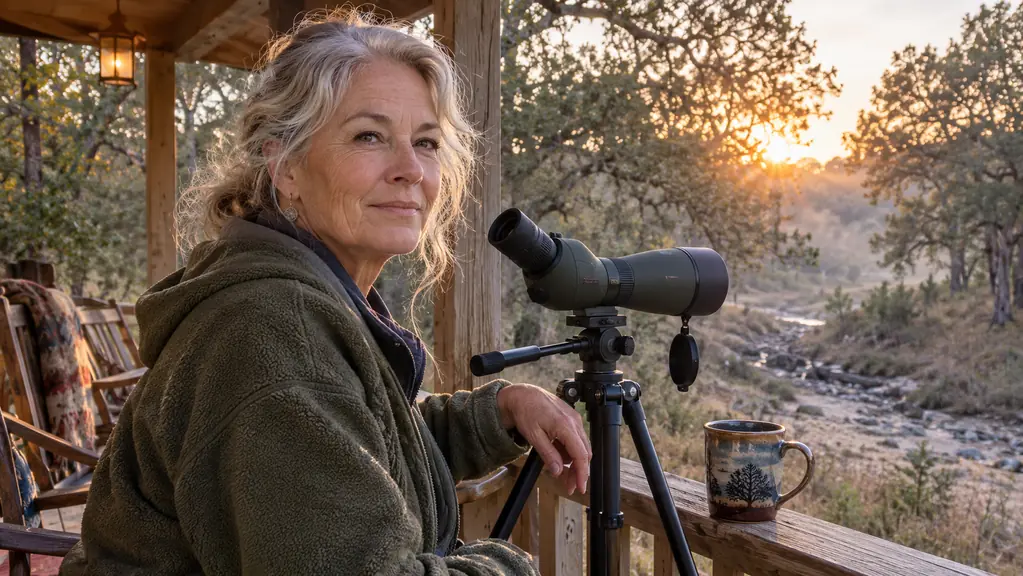
Every October somebody asks me the same question, usually on the porch with a cup of coffee going cold on the rail. Should I buy a spotting scope or put that money into better binoculars? I keep both within arm's reach, and after three winters with the Gosky 20-60x60, my answer has not changed. They do different jobs, and neither one replaces the other.
The short version: binoculars are for finding things, and a spotting scope is for staying with a thing after you have found it. If your watching happens at deer 60 yards out at the edge of a pasture, binoculars do everything you need and you can stop reading here. If you spend your mornings trying to tell one distant white shape from another across a marsh, you want the reach. My Vortex Crossfire HD 10x42 goes on every walk. The Gosky goes where distance is the entire point.
| Gosky 20-60x60 | Vortex Crossfire HD 10x42 | |
|---|---|---|
| Reach at distance | 20-60x zoom. A crane on the far side of a marsh fills the view at 30x. | Fixed 10x. Identifiable at the same distance, but small. |
| Finding the animal | 1.3 degrees, listed as 50-110 ft at 1000 yards. Narrow once you zoom in. | Wide field. Sweep a treeline and let your eye catch the movement. |
| Setup before you look | Mount on the tripod, level it, then focus by hand. | Lift to your eyes. |
| Weight and carrying | 2.6 pounds for the scope, plus whatever it stands on. | Hangs on a strap and you forget it is there. |
| Long looks without arm fatigue | The tripod does the holding. Twenty minutes on one heron is comfortable. | Fine for a minute, tiring by five. |
| Two people looking at once | 45 degree angled eyepiece. A taller person steps up without a reset. | One pair, one person at a time. |
| Photos of what you see | Included phone adapter clamps an iPhone over the eyepiece. | Phone held behind one eyepiece, awkward to line up. |
| Last light at dusk | The 60mm objective at 60x leaves 1mm of exit pupil, so the image dims and I back off the power. | 42mm at 10x leaves 4.2mm, so it stays usable a few minutes longer. |
| Woods, brush and close cover | At 20x through oak saplings it is mostly leaves. | The wide view picks the armadillo out from under the cedar. |
Where the Gosky Spotting Scope Wins
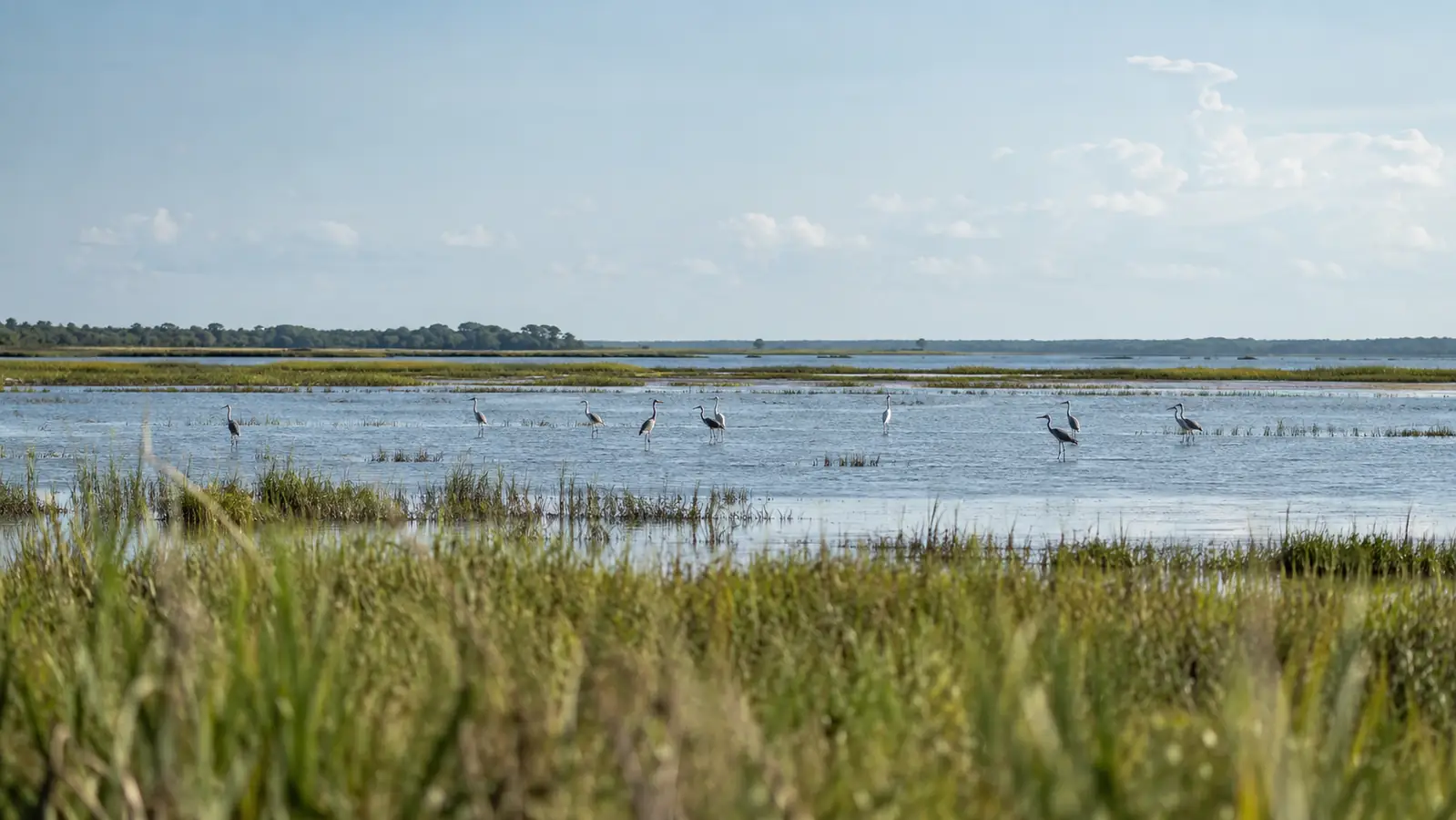
The clearest case is Aransas in January. The whooping cranes stand a long way out in that marsh, and from the boat tour the distance grows instead of shrinking. Through 10x binoculars they are unmistakable white shapes with dark legs and not a great deal else. Through the Gosky at 30x I could see the red crown, the way the bird lifted each foot out of the shallow water, and the slow deliberate walk they have. That is the entire reason I bought the thing. Reach is not a luxury when the animal you came to see has no intention of coming closer.
The first trip in January 2024 was the one where we took the boat. Paul and I had two nights down there and the boat ran a couple of hours mid morning. What surprised me is that the birds did not come much closer than they had from the public viewing spots. A different angle, the same distance. There were maybe forty people aboard and I counted six with anything beyond binoculars. Everyone else was watching white shapes and happy about it, which is a perfectly good way to spend a morning. I had just spent a winter wondering what a whooping crane actually looks like, and I was not going to answer that question with white shapes.
The second point is that the scope does not have to be held. It mounts on a tripod, and the tripod does the holding. I have spent twenty minutes on one heron that way with my arms perfectly fine at the end of it. Twenty minutes of steady watching through binoculars leaves my shoulders complaining. I found that out by accident. A great blue heron worked the same stretch of shallows for the better part of half an hour one morning, and I watched the first ten minutes through the binoculars and the rest through the scope. My arms quit well before the bird did. The 45 degree angled eyepiece earns its keep too. Paul is taller than I am, and with an angled eyepiece he can step up and take a look without me touching the tripod or losing my place.
The zoom is the part I underrated. I assumed I would pick a power, set it and leave it alone. In practice I start at 20x to find the bird, roll up to 35 or 40 to read the detail, and drop back down the moment it moves and I lose it. That correction takes about two seconds with the scope already sitting on the tripod. There is no equivalent with fixed binoculars. The trade is that every step up in power costs light and steadiness, which is why 40x is where I live and 60x is for a bird that has stopped moving in good light.
What I did not expect was how much the zoom changes the way I watch. With binoculars I find a bird and that is the end of the decision. With the scope, finding it is the beginning. I get it in the view at 20x, then I have a choice to make about how much more I want to see, and I make that choice fresh every time. Some mornings I never leave 20x. Some mornings I sit at 45x on a heron's face for ten minutes and forget the coffee. That flexibility is worth more to me than any single number on the spec sheet.
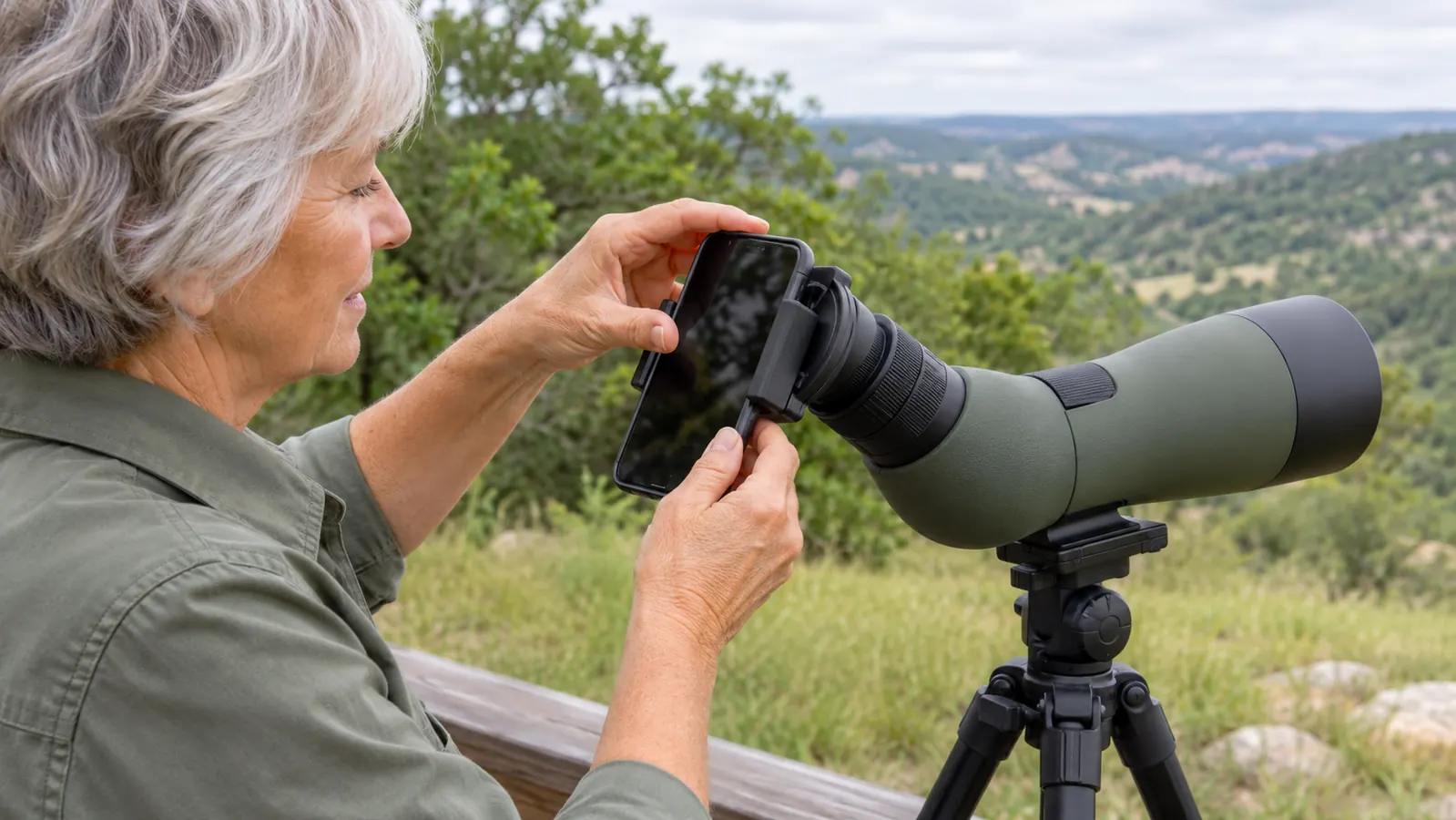
The phone adapter in the box is what makes it more than a viewing glass. It clamps my iPhone over the eyepiece so I can photograph what I am already looking at. It took me several tries to get it lined up and I still take three poor frames for every good one. A passable frame of a crane at a distance beats a sharp picture of a bird that left because I walked closer. Focus is a manual wheel, smooth enough at 40x, and the 60mm objective with its multi-coated lens is bright enough in good light to make the whole thing worthwhile.
Through the Gosky at 30x I could see the red crown and the way the crane lifted each foot out of the water. Through 10x they were white shapes with dark legs. Nothing wrong with white shapes. I just wanted more.
Where Binoculars Win
All of that said, the binoculars go with me far more often. They hang on a strap and I forget they are there. No setup, no leveling, no kneeling in the grass to get the tripod legs right. At Lost Maples last spring I walked four miles of trail with them and never once wished I had dragged the scope along. Most of what happens on a walk happens fast. A fox crosses the path, a warbler works through the cedar, a hen turkey hustles her poults into the brush. You get about two seconds. Ten power is on it in one motion. The Gosky takes long enough to set up that the moment is over.
Field of view is the other half of it. The Gosky is listed at 1.3 degrees, which works out to about 50 to 110 feet across at a thousand yards. At 20x that is workable. At 60x you are looking through a drinking straw, and finding a moving animal at that power is genuinely difficult. The trick is to sight along the tube at low power, get the animal in the view, then zoom. That works. It is also a skill, and it is not one you want to be learning while a bird walks away from you. Binoculars let your eye sweep a treeline and catch the movement on its own.
I keep a rough tally on some walks. Four miles at Lost Maples last April, eleven species I could put a name to, and every one of them through the binoculars. The scope stayed in the car. That is not a knock on the scope. It is just an honest accounting of which tool gets used when the ground is moving under your feet. The last honest point is light. At the end of the day the 10x42 binoculars stay bright a few minutes longer than the scope does at high power. Forty two millimeters divided by ten leaves 4.2mm of exit pupil. The scope at 60x leaves 1mm. That gap shows up right around the time the deer step out of the cedar. Down at 20x the scope is fine, and I mostly stay between 20x and 40x anyway, but if your watching happens in the last twenty minutes of light, the binoculars are the better tool.
What I Got Wrong at First
The first mistake was assuming 60x would be my default setting. It is not. The image at 60x is dim and it shivers with every breath of wind, and the field of view is so narrow that a bird taking two steps walks out of the frame. I stay between 20x and 40x almost all the time. The zoom is there when I need it and now and then, on a still bird in flat light, it earns its place. But a scope is not a telescope you crank to the end and leave.
The second mistake was thinking the tripod that comes in the box would handle everything. It is genuinely useful, it lives in the bag with the scope, and on a still morning on my own porch it is all I need. Down on the coast with wind coming across the marsh, it moved enough to make 40x frustrating. That is why a taller travel tripod ended up riding in the back of the Outback. The included one is not a bad piece of kit: it packs with the scope, it sets up in under a minute, and for porch work it does everything I ask. The trouble starts when the wind has somewhere to come from. On the coast it comes off the water in a steady push, and at 40x a steady push turns into a picture that will not sit still. I spent one January morning fighting it before I dropped to 20x and defeated the whole point of being there.
The third mistake was the phone adapter. I had it in my head that I would clamp the phone on and take pictures. What actually happens is that you line the phone camera up with the eyepiece by hand, tighten it, take a frame, look at it, loosen it, and nudge it a quarter inch. It gets easier. My first attempts were black circles with a bright smear in the middle. Now most of my digiscoped frames are recognizable on the first or second try, and I have learned to brace the tripod with one hand while I tap the shutter with the other.
Reach is the one thing binoculars cannot fake
The Gosky 20-60x60 does what my 10x binoculars cannot: it puts a crane, a heron or a bedded buck close enough to read. Tripod, carrying bag and phone adapter are in the box, it weighs 2.6 pounds, and the 45 degree angled eyepiece means two people can both look without a reset.
Amazon Check Today's Price on Amazon →Who Should Buy Which
Buy the Gosky first if your watching happens at water or across open country. Whooping cranes at Aransas, herons working a stock tank, a buck bedded on the far side of a field, a hawk on a fence line a quarter mile out. Those are all animals that will not let you close and will not move for your convenience. That is the entire case for a scope, and it is a strong one. The distance is the problem, and the scope is the answer to the distance.
Buy binoculars first, or keep the ones you already have, if you walk. Trails at Lost Maples, the paths at South Llano, your own back fence line at dusk. Anything fast, anything in cover, anything in that last twenty minutes of light. A scope on a tripod is a destination tool. It wants you to stop, set up and stay a while. If your habit is to keep moving, it will live in the closet and you will feel foolish about it.
If you can only do one this year and you are honestly not sure which, get the binoculars. They are the tool you will use without thinking, and they will teach you where the animals actually are. Then one morning you will find yourself squinting at a white shape on the far side of a marsh and getting nothing back, and you will know exactly what the scope is for. That is a much better way to decide than reading a comparison, including this one.
If you already own a decent pair and you keep running out of reach, the Gosky is the next step and it is a big one. Twenty power against ten is not a small improvement. Sixty against ten is a different category of seeing altogether. Add the tripod, the bag and the phone adapter that come with it and you have a complete setup on day one, which is more than I can say for a fair amount of gear I have bought over the years. Mine lives in its bag in the hall closet, and it comes out more often than people assume.
Twenty power is where the marsh opens up
If your binoculars keep running out of reach, the Gosky 20-60x60 with its tripod, bag and phone adapter is the piece that closes the gap. It is the scope I have carried to Aransas three winters running, and it is still the first thing I pack.
Amazon Check Today's Price on Amazon →