Nobody tells you that the awkward part of a spotting scope is not the scope. It is everything around it. The tripod, the wind, the angle of the sun, the four inches of space between your eye and the eyepiece when you are wearing a hood. I learned that in January 2024 on a boat out of Aransas, with a whooping crane standing in the marsh a long way off, and my whole rig wobbling like a fence post in a gust.
I am Corinne Ashby. I am 63, I flew for 31 years as a flight attendant, and I live on four acres outside Kerrville in the Texas Hill Country with my husband Paul and no pets at all. I bought this Gosky 20-60x60 in December 2023 for that first Aransas trip, and it has gone back with me every January since. Three trips now. This is not a review written from a spec sheet. It is what I would tell you at the kitchen table if you asked me whether the thing was worth carrying.
Because there is a version of this review that floats around, the one where a scope in this class performs like glass costing several times as much. That is not what I found. What I found is a genuinely useful instrument with two clear limits, and once I stopped fighting those limits I started seeing more.
The Quick Verdict
Plenty of scope for a watcher who stays between 20x and 40x. Dim and fussy at 60x, and the tripod in the box is the weak link, not the glass.
Amazon Check Today's Price →If you mostly watch between 20x and 40x, this Gosky does the job
Three winters of coastal trips and a few hundred mornings on the porch. The zoom range is honest up to about 40x, which is where most real watching happens anyway.
Amazon Check Today's Price on Amazon →The Thing Nobody Mentions: Light Is the Whole Ballgame
A spotting scope is a bucket for light. The front lens on this one measures 60mm across, and that is a real number and not a small one. It is the reason the scope works at all in the grey hour before sunrise, when the deer are moving and the light is thin and binoculars go flat. But it is also the reason the top of the zoom gets difficult. Push the magnification up and you are spreading the same gathered light across a bigger image. Nothing gets brighter. It gets bigger and dimmer, like a photograph blown up past the point where the detail was ever there.
Manufacturers do not put that on the box. They put 20-60x in large type, and a reasonable person reads that as sixty being the good part. In my experience the good part is twenty to about forty. At 60x on a bright January afternoon in the marsh I could make out the shape of a crane's bill against the grass, and that alone was worth the trip. At 60x at seven in the morning, with the sun not yet over the treeline, the image went soft and dim and the shaking got worse and I backed it off.
So here is the honest framing. You are buying a scope that is genuinely useful through the low and middle part of its range, and merely interesting at the top of it. If you can accept that, you will be happy for years. If you plan to live at 60x, you will be disappointed, and you should be looking at a larger front lens and a much heavier commitment of money.
How I've Actually Used It
At Aransas it sits on a tripod on the deck of a boat, or beside a railing at a public viewing spot, pointed at whooping cranes a few hundred yards out. That is exactly the job I bought it for, and it does that job. Cranes are tall and pale and stand in open marsh. Even at 30x you can see the red on a head and the way one bird feeds differently from the others. I have never once approached them. You watch from where you are allowed to watch from, and that is the whole point.
At home it lives in its bag in the hall closet and comes out for the back porch, which faces a dry creek bed. Four acres of live oak and cedar, white-tailed deer most mornings, turkeys in a group, armadillos rooting, painted buntings in summer, and a grey fox that my trail camera found before I ever saw it in daylight. For the creek bed I mostly use the Vortex Crossfire HD 10x42 binoculars, honestly. A scope is a commitment. You set it up, you point it, you commit to one spot. Binoculars let you sweep.
At Lost Maples and South Llano River State Park it rides in the Subaru and sometimes stays there. That is not a knock on the glass. It is 2.6 pounds, and with a tripod added a walk gets slower, and on a trail where the birds move the binoculars around my neck do more work. The scope comes out at an overlook or a blind where I am going to sit down. That is the pattern I have settled into after nearly three years, and I wish somebody had described that pattern to me before I bought it, because it would have saved me carrying it up a hill for no reason twice.
The scope earns its place when there is one thing out there worth studying for ten minutes. For everything else, the binoculars do the work.
What 20-60x Really Means in the Field
Zoom on a spotting scope is not like zoom on a camera. There is no motor and no button. There is a ring at the eyepiece and you turn it. The specs list manual focus, and that is accurate in the plainest sense: your hand does the work, and your hand has to be steady while it does. At 20x you can focus with two fingers and it settles quickly. At 50x a small turn moves the image a long way, and you will overshoot it and come back. It takes a few weeks before your fingers learn the touch.
The field of view is listed at 1.3 degrees, roughly 50 to 110 feet across at a thousand yards depending on where you are in the zoom. That matters more than people expect. At 20x you have a wide enough window to find a bird that is already moving. At 60x the window narrows to something like a dinner plate at that distance, and finding anything without help is genuinely hard. There is a sighting aid on top of the barrel to get you pointed roughly right, and I use it every single time. Without it I would be sweeping the marsh like a searchlight.
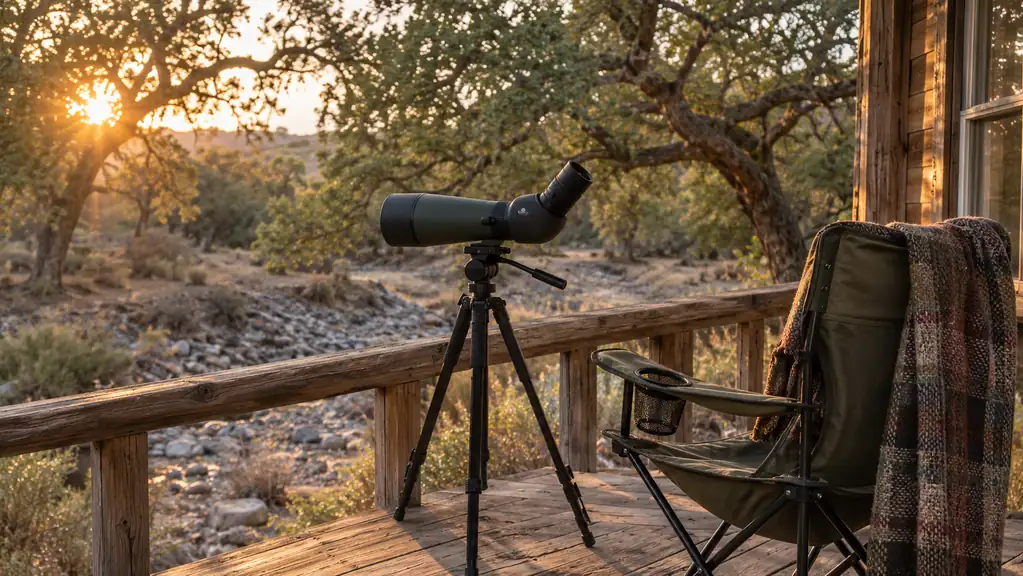
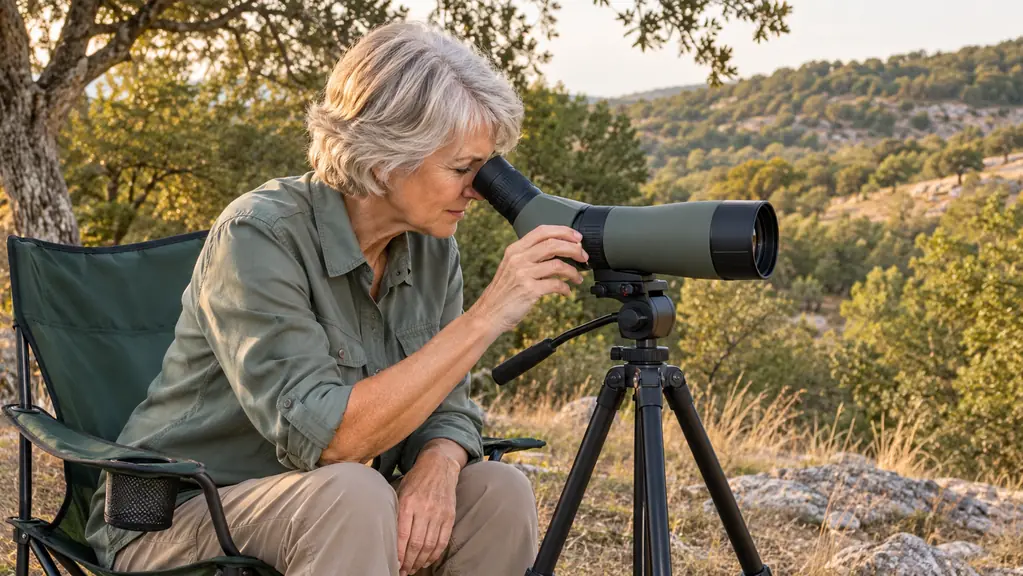
The eyepiece is angled at 45 degrees, which sounds like a small detail and is not. Straight-through scopes force your neck into a position that becomes painful in about four minutes. The angled eyepiece lets me sit in a camp chair with the scope beside me and look down into it. For an hour of watching, that difference is everything. I am 63 and my neck has opinions.
Should You Just Use Binoculars Instead
This is the question I get most, usually from somebody who already owns a decent pair. And the fair answer is that binoculars do most of what most people actually need. They are lighter, they are faster, they go around your neck and stay there, and you can hand them to Paul without a discussion. If your watching happens at fifty to a hundred yards, the binoculars win and you should keep your money.
The scope wins on one thing only, and it wins big: distance. A crane four hundred yards out across open water is a smudge in my binoculars and a bird in the scope. A deer at the far edge of the creek bed is a shape until I put the scope on it and can count the points. That is the trade. You carry more weight, you set up more slowly, and you give up the ability to sweep a treeline. In exchange you get a seat close to something far away.
I would not want to choose between them and I am glad I do not have to. But if you are only buying one thing this year, and you are not sure, buy the binoculars first. They will teach you how you actually watch, and that knowledge is worth more than any scope.
What I Liked
- Genuinely usable from 20x to about 40x, which is where most real watching happens
- The 45 degree angled eyepiece saves your neck on a long sit
- A 60mm front lens gathers enough light for the grey hour before sunrise
- The included phone adapter turns the scope into a camera once you learn to line it up
- Waterproof body, fully multi-coated glass and a BAK4 prism, and nothing about it feels flimsy
Where It Falls Short
- 60x is dim and shaky and I almost never use it
- The tripod in the box is the weak link in coastal wind
- 2.6 pounds plus a tripod is more than I want on a long walk
- The phone adapter has a learning curve that will frustrate you the first afternoon
- The narrow field of view at high zoom makes a moving bird hard to find
The Phone Adapter Is Worth the Fuss, Eventually
The scope came with a phone adapter, and I want to be straight with you about it, because this is the part people give up on. The adapter clamps your phone over the eyepiece and holds it there while you look at the screen instead of through the glass. Lining it up is fiddly. My first afternoon produced a lot of grey circles and one clear photograph of the inside of my own hand. It took several tries over a couple of weeks before it became something I could do in under a minute.
Once it clicks, it changes what the scope is for. I use an ordinary iPhone, nothing special. With the phone on the eyepiece I can take a still of a crane and look at it later on the laptop, and I can show Paul what I saw instead of describing it badly. My photographs are not going to hang in a gallery. They are records. That is all I want from them, and for that the adapter is the most valuable thing in the box after the scope itself.
The way that finally worked for me: zoom the scope down to 20x first, get the phone centered and the image sharp on the screen, and only then turn the zoom up. Doing it the other way around means hunting for a tiny circle of light with a tiny camera, and you will not find it before your arms give out.
The Included Tripod, and Why I Added Another
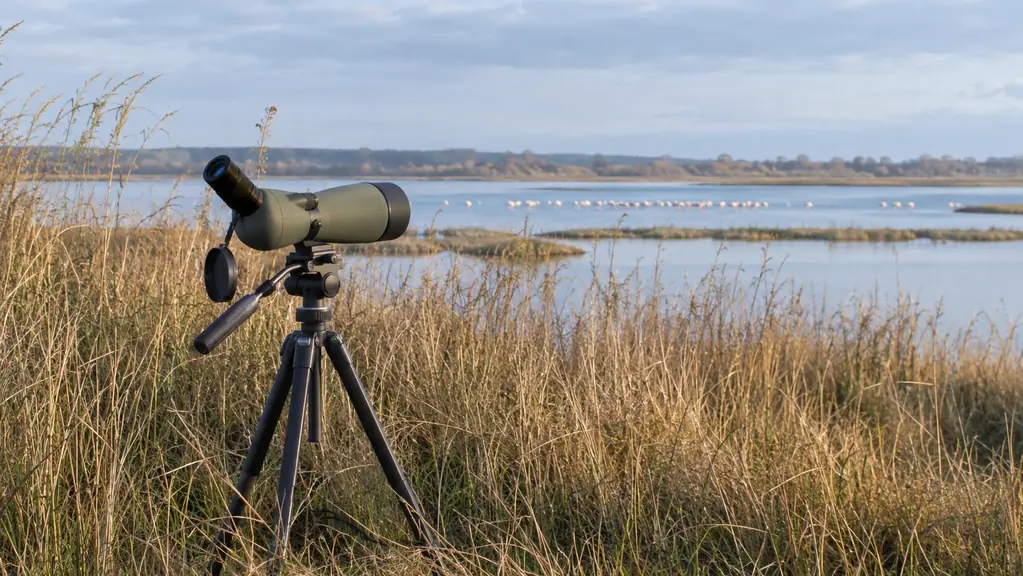
The scope comes with a small tripod, and it is fine indoors and fine on a still morning on the porch. On the deck of a boat in January it is not fine. Coastal wind comes across open water with nothing to stop it, and a light tripod with a scope on top turns that wind into a visible shake in the eyepiece. I spent one trip with one hand on the scope and one hand on the tripod, and saw less than I would have with binoculars.
In April 2024 I bought a K&F Concept 64 inch travel tripod, mostly because I also wanted something steady for my camera and long lens, and the scope benefits from it too. It rides in the back of the Subaru in its bag. I am not going to tell you it is built for a heavy professional rig, because it is not and I would be lying to you. I will tell you it made the scope usable in wind the included tripod could not handle, and that on the porch it means I can set the scope down, walk away, and come back to find it still pointed at the creek bed.
The Details That Hold Up and the Ones That Don't
The body is listed as waterproof and I believe the claim without having tested it hard. I have been caught in a light mist at Aransas, wiped it down, and nothing happened. I have not dunked it and I do not intend to. The glass is fully multi-coated and the prism is BAK4, the better of the two common prism types, and the practical result is an image that stays reasonably bright and reasonably sharp through the middle of the range. It measures 12.6 inches long and weighs 2.6 pounds, which is a size I can carry in one hand and a weight I notice after a mile.
The focus is manual and stays manual, and there is no stabilization anywhere in this design. That is less a flaw than a fact of the category, but it has a consequence people do not think through. Every bit of shake in your hands or your tripod gets magnified. At 20x a light tripod is fine. At 50x the same tripod is a problem. Which is another way of saying the high zoom numbers and the small included tripod work against each other, and you will feel that the first windy day you take it out.
What does not hold up, in my view, is the expectation the listing creates. A person reads 20-60x and pictures sixty. The Gosky's real working range sits lower than that. The honest description is a good 20x to 40x instrument that will show you more at the top if the light is strong and the air is still and your tripod is heavy. That is a narrower promise than the box makes, and it is still a promise worth having.
Who This Is For
This is for the person who has one place they sit and watch, and one thing out there they want to see better. A feeder, a marsh, a creek bed, a lake with birds on the far shore. It is for someone who is content working at 20x to 40x and who understands that a scope is a sit-down tool, not a walking tool. It is for someone who wants photographs for their own records and has no intention of selling them. If that is you, the Gosky will do the job for years, and mine has.
It also suits somebody buying a first scope who genuinely does not know yet whether they enjoy scoping. That is a real question, and buying at this level is a reasonable way to answer it without overcommitting.
Who Should Skip It
Skip it if you intend to live at 60x. Skip it if watching in low light is your habit rather than your exception, because the top of the zoom and the end of the day are the two things this scope does least well together. Skip it if you walk long distances, because 2.6 pounds plus a tripod plus binoculars plus water is a load, and the scope will be the thing you leave in the car. And skip it if you already know you love this and will still be doing it in ten years, because at that point the money is better spent once on more front lens.
Skip it too if you want to pass the view around every thirty seconds. A scope on a tripod is a one-person instrument. Binoculars go hand to hand. I have watched Paul wait while I found a bird and then take his turn, and it is not a fast way to share something with somebody you like.
Three winters in, I would buy it again for the same job
It is not the last scope you will ever want. It is a good first one, and it has shown me every whooping crane I have seen since January 2024.
Amazon Check Today's Price on Amazon →