The first time I tried to take a photograph through my spotting scope, I got a bright white circle, a blurry gray sliver that was supposed to be a whooping crane, and a sore neck. I had the scope pointed at the right bird. I had my phone pressed against the eyepiece. That was the whole plan, and it did not work.
I tried holding the phone by hand. I tried zooming the phone camera to 5x. I tried balancing the phone on the car window frame. The problem was not the bird and it was not my phone. The problem was that I had the order of operations backwards. Digiscoping is not pointing and shooting. It is a small physical routine. The routine is easier with the Gosky 20-60x60 spotting scope I bought in December 2023 because it comes with a phone adapter and a tripod, but the routine matters more than the gear.
Here is the sequence I use now, on my porch outside Kerrville and at Aransas in January. It works with an ordinary phone. It will not make you a professional photographer. It will let you bring home a recognizable picture of a bird that was 100 yards away.
The adapter holds the phone, you handle the focus
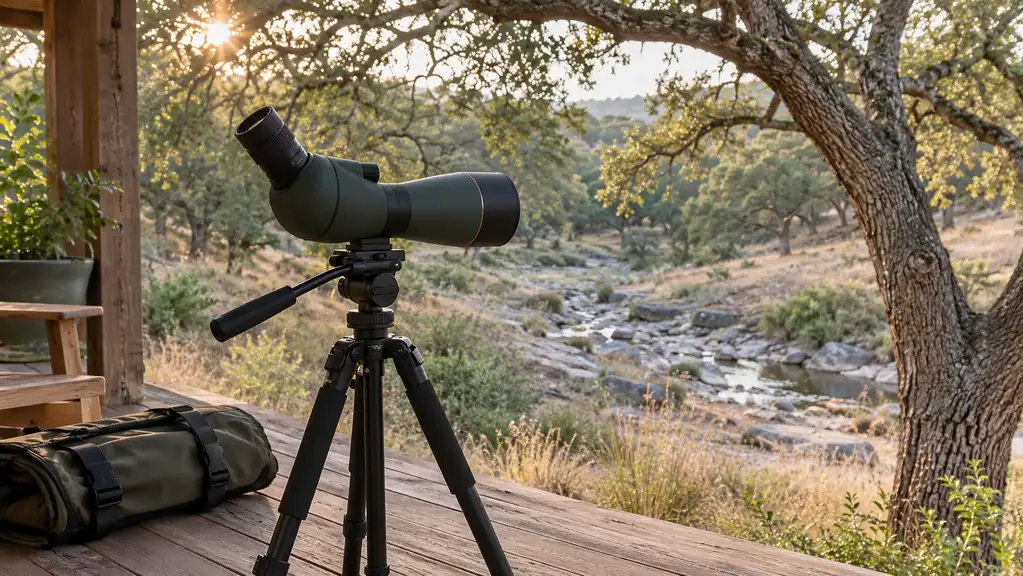
The Gosky 20-60x60 kit includes a tripod, a carrying bag and a scope phone adapter, so you can practice the steps below without hunting for extra parts. It is a 20-60x zoom scope with a 60mm objective lens and a 45 degree angled eyepiece.
Amazon Check Today's Price on Amazon →Step 1: Put the scope on the tripod and make it boringly stable
Stability is the whole game. The Gosky scope weighs 2.6 pounds and measures 12.6 inches long by 5.5 inches wide by 5.5 inches high. That is light enough to carry in its bag, but light is not the same as steady. On my porch, the included tripod is fine on a still morning. At Aransas, with wind coming off the water, I use a taller travel tripod I bought later. If your only tripod is the one in the kit, set it low, keep the legs spread, and stay out of the wind if you can.
Set the tripod so the eyepiece is at your eye level. The Gosky has a 45 degree angled eyepiece, which means you can sit on a stool and look down into it instead of craning your neck. That sounds like a small thing. After twenty minutes of watching a crane, it is not small.
Tighten every knob you can reach. A scope that swivels when you touch the focus knob will ruin more photos than a cheap phone ever will. Once the scope is pointed at the bird, put your hand on the tripod head, not on the scope body, when you make small adjustments. If the whole rig moves when you breathe on it, you are not ready to attach the phone.
The first morning I tried this, I set the tripod up on the porch rail itself. That was a mistake. The rail is a single board on two posts and it flexed every time I leaned my elbows on it. I moved the tripod down onto the deck boards, spread the three legs wide, and put a folded towel under the leg tips to soak up the vibration from my own footsteps. The picture stopped wandering. It took me a full hour that first day to learn that the surface under the tripod mattered more than anything I was doing with the phone.
Step 2: Find the bird at 20x and focus before the phone goes on
Start at 20x, the low end of the Gosky's 20-60x zoom. The listing gives a field of view from 50 to 110 feet at 1,000 yards and 1.3 degrees. The view is widest at 20x, which is why you start there. Use the reflex finderscope to get the scope pointed in the general direction, then look through the eyepiece and turn the manual focus knob until the bird is crisp.
Do not start at 60x. At 60x the image is dimmer and every tremor in the tripod shows up. On a hot Texas afternoon, the heat shimmer at 60x makes a crane look like it is underwater. I stay between 20x and 40x for almost everything. If the bird is far and the air is cool and still, 50x can be useful. Most of the time, 30x is the sweet spot.
Get the focus right before you attach the phone. Once the phone is on the eyepiece, your hand is busy holding the phone and you cannot chase focus and alignment at the same time. Focus on the bird's eye or beak if you can. Then zoom in slowly and refocus. The scope's manual focus is smooth enough for small adjustments, but it is not automatic. You will turn it a lot.
One morning last November I spent twenty minutes at 50x trying to hold a wild turkey's beard in the frame through the shimmer coming off the dry creek bed. At 30x the same bird was crisp and I could count the barbs on a single feather. Nothing about the bird changed and nothing about the light changed. I had simply been too greedy with the magnification. Now I start every session at 20x and only creep up if the air is cool and the tripod is dead still under my hand.
Step 3: Clamp the phone adapter on the eyepiece and center the camera
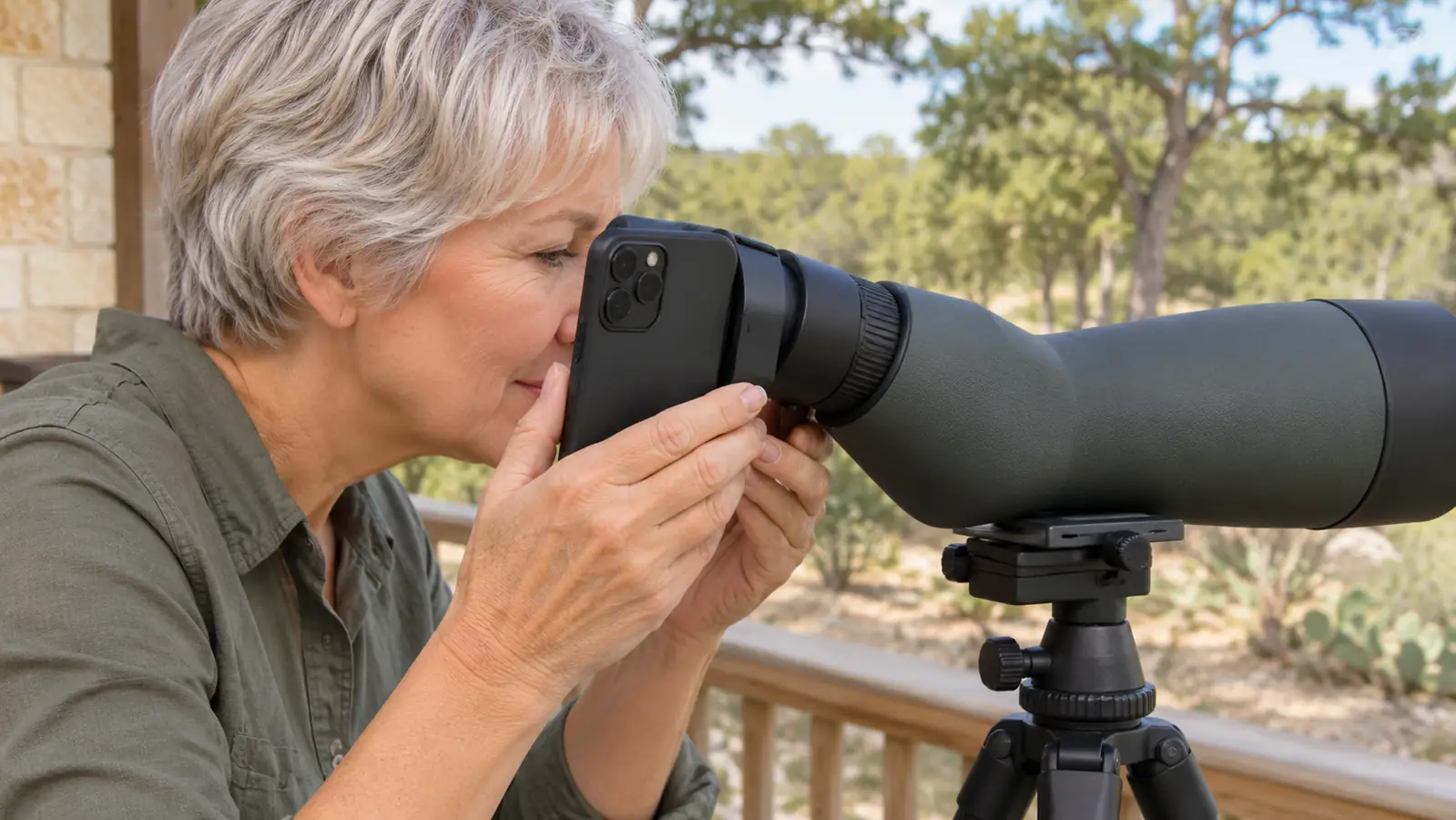
The Gosky kit includes a smartphone digiscoping adapter. The adapter holds the phone against the eyepiece. Fit it over the eyepiece, tighten it, and set the phone in the holder with the camera lens centered. Open the camera app that came with the phone. Use the main lens at 1x. Do not use the phone's digital zoom to make up for a bad alignment.
You will see a bright circle in the phone screen, or a crescent, or nothing. Move the phone in the holder until the circle is centered and as large as it will go without black edges. This is the part that took me several tries. The first time I got a white crescent and a lot of black. The second time I got the bird but the edge of the eyepiece cut off its legs. The third time I slowed down and got it.
Once the circle is centered, do not bump the tripod. Tap the screen to focus on the bird, then use the scope's manual focus for the final sharpness. The phone's autofocus and the scope's focus fight each other if you adjust both at once. Pick one. I usually let the phone focus first, then turn the scope knob in tiny amounts.
The adapter clamps onto the eyepiece and holds the phone flat against it. Hand tight is plenty. I overtightened mine once and the phone sat crooked in the holder for the rest of the morning, so every frame came out with a dark slice down one side and I did not notice until I was back in the house. Seat the phone flat against the adapter before you tighten anything, and check the camera lens against the center of the eyepiece one more time after the clamp is snug. A phone sitting slightly off center gives you a crescent every single time, no matter how well you focused.
Step 4: Cut the shake with a timer, a burst, and a little patience
A phone held against an eyepiece is a small lever, and every tap moves the image. Use the phone's self-timer if it has one. Three seconds is enough to take your hand away. If your phone can shoot a burst, use it. If it can record video, record ten seconds and pull the best frame later. I do this with cranes because they move their heads and a still photo often catches a beak in the wrong place.
Keep your body quiet. Rest your elbows on the porch rail or your knees. Do not hold the phone with one hand and the tripod with the other. If the wind is up, wait. A blurry photo at 40x is not a failure of the scope. It is a failure of the day. The Gosky's 60mm objective lens gathers enough light for early morning and late afternoon, but it cannot stop the air from moving.
If the image is still soft, check three things in order. Is the scope focused? Is the phone centered? Is the tripod tight? Do not start zooming to 60x to fix a focus problem. That just makes the blur bigger. I have made that mistake more than once.
One more habit that helped me: take the first frame before you think the bird is ready. Turkeys and deer do not hold a pose, and the moment you decide everything is perfect is usually the moment they step behind a branch. I shoot early, check the screen, adjust once, and shoot again. Two or three calm frames beat twenty frantic ones, and my shoulders are less sore at the end of it.
Step 5: Take the photo, then put the phone down and watch the animal
The photo is a nice souvenir. The reason I carry the scope is the animal. After you take a few frames, pull the phone off and look through the eyepiece with both eyes open if you can. You will see more detail in real time than you will in a phone photo. The 45 degree eyepiece makes this comfortable for a long watch. That is the point of the angled design.
Keep a respectful distance. Do not bait, call, or approach wildlife to get a better shot. At Aransas, the whooping cranes are watched from public viewing spots and from a boat tour on one trip. The birds are far away. That is fine. A recognizable photo at distance is better than a close photo that pushes a bird off its feeding area. The same rule applies to a fox in the creek bed or a turkey in the oak.
When you are done, put the scope back in the carrying bag. Wipe the eyepiece with a lens cloth if it has fogged or picked up dust. The Gosky is listed as waterproof, but I still do not leave it out in the rain. Waterproof is a backstop, not a plan. Store the adapter with the scope so you are not hunting for it the next morning.
On the January 2025 trip, Paul and I stood at a public viewing spot for close to an hour. I took maybe fifteen frames and kept two. The rest had the crane's head turned away, or a blade of grass across the chest, or a soft edge where the bird had shifted while the timer counted down. That ratio is normal and it is not a reason to keep shooting. Once I had two good ones I put the phone in my jacket pocket and watched the bird work the flat with Paul's binoculars. That hour is the part I remember. The photos just prove I was there.
What Else Helps
A pair of binoculars is still the fastest way to find a bird. I use the Vortex Crossfire HD 10x42 I bought in March 2022 to spot movement in the trees, then I point the scope at that spot. The binoculars go on a harness strap and stay by the back door. The scope does the distance work. The binoculars do the finding. Trying to find a bird at 40x is like looking through a straw.
A taller tripod helps in wind. The small tripod in the kit is fine for a still morning on the porch, but at Aransas I use a 64 inch travel tripod I bought in April 2024 because the wind off the water shook the light setup. If you already own a sturdy tripod, use it. If you do not, start with the one in the kit and learn where it struggles.
Patience helps more than any accessory. The best digiscoped photo I have is not a rare bird. It is a painted bunting on a cedar branch at the creek bed, taken at 30x with the phone adapter and a timer. I had been sitting still for twenty minutes. The bird did the rest. For backyard birds, the Birdfy feeder camera is a different tool and it is not a substitute for the scope. It shows you who came to the feeder. The scope shows you what is happening across the creek.
A notebook is useful. Write down the date, time, zoom, and what the bird was doing. When you look back at a photo, the note is what makes it a memory instead of a blur.
At 30x, with the phone clamped in the adapter and a three second timer, I finally got a whooping crane standing in shallow water with both legs visible. Not a white blob. A bird.
Start at 20x and let the scope do the distance
The Gosky 20-60x60 kit gives you the scope, tripod, bag and phone adapter in one box. Practice the five steps on a feeder bird or a fence post before you take it to a state park. The more boring the setup, the better the photo.
Amazon Check Today's Price on Amazon →